
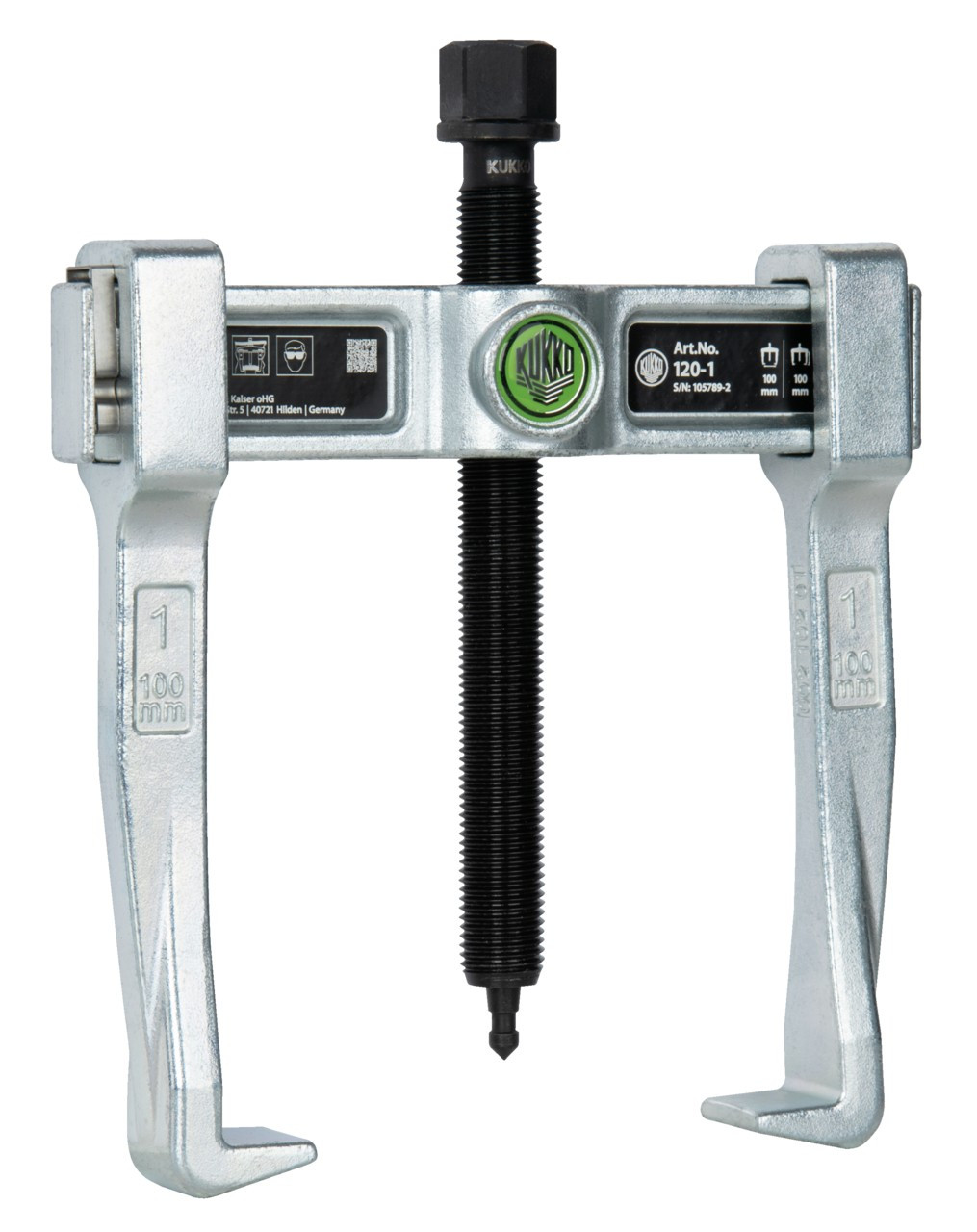
Choose KUKKO pullers by the grip you can get
Look at the part before looking at the spindle. Can you reach its outside edge? Is there a solid shoulder behind it? Can a tool grip the inside bore instead? Those questions narrow the Pullers & Extractors selection faster than starting with a force rating.
- Gear & Jaw Pullers: hooks behind an externally accessible bearing, gear or pulley.
- Hydraulic Pullers: hydraulically driven pulling arrangements, selected with their specified jaws and working dimensions.
- Bearing Pullers & Separators: a separating edge behind a closely seated bearing or ring.
- Pilot Bearing & Blind Hole Pullers: an internal grip where an external hook cannot reach.
- Slide Hammers: an impact-driven pulling method with a compatible attachment.
Two jaws or three for gears and bearings?
A KUKKO gear puller needs a sound place for every hook. Two jaws can be useful when surrounding parts leave only two opposite access points. Three jaws distribute the grip around three locations, provided all three can sit properly behind the component. Neither arrangement fixes a poor seating surface.
Browse 2-jaw pullers when the available access favors an opposed pair, and 3-jaw pullers when there is room around the part. The KUKKO Techno series 110 is one two-jaw family with parallel, slender jaws and a claw lock. Check the selected model's dimensions rather than treating the whole family as one size. Our two-jaw vs three-jaw guide explains the access tradeoff.
When a bearing sits too close to a shoulder
If the hook tip cannot get fully behind the bearing, stop there. Loading just the tip is not a substitute for a proper seat. KUKKO pullers with a separator arrangement address a different access problem: thin separating edges enter behind a flush-fitting part, and a compatible puller supplies the axial pull.
Start with bearing separators for that arrangement. Match the separator and puller connections, opening and working length. A separator by itself is not necessarily the complete removal setup. See bearing separator vs bearing puller if you are deciding which grip the job allows.
Internal and pilot bearing extraction
A bearing trapped inside a housing may offer no outside edge at all. Series 21 internal extractors grip from inside and work with a compatible counter support or sliding hammer. Measure the bore and check that the gripping edges can engage as the tool instructions require.
A counter support needs a suitable surface to react against. A KUKKO sliding hammer can be useful where that surface is absent or too delicate, as described for series 22-0. Inspect bearing race pullers for race-removal options, or read how to remove a pilot bearing before choosing the attachment.
Hydraulic and automotive pulling jobs
Hydraulic drive does not make an unsuitable grip safe. Select KUKKO pullers with enough spread and reach, then check the force limit for the complete specified assembly. Keep heat away from hydraulic seals and follow the tool instructions for the spindle or pump.
For vehicle work, route by the connection: Ball Joint & Tie Rod Pullers address tapered steering and suspension connections, while Wheel Hub & Axle Pullers use application-specific attachments. Follow the vehicle procedure, including support points and retainer removal. An outside diameter alone cannot establish automotive fit.
Size the tool, then decide whether a set makes sense
Compare three things before buying KUKKO pullers: the spread around the part, the reach to its rear gripping surface and the rated pulling force. Also check hook thickness and clearance for the spindle. The puller size guide shows real KUKKO model dimensions and explains why a larger spread does not automatically mean a higher force rating.
A KUKKO puller set is worth considering when its supplied parts cover the jobs you actually have. Check the contents of puller sets, including the included jaw styles and attachments. Do not assume every combination in a box has the same capacity. Before loading any arrangement, wear eye protection, center the spindle, use a rated protective cover and keep your body out of the pulling line. Stop if a jaw shifts or the part starts to cock.
Frequently asked questions
Which KUKKO puller should I choose for a gear?
Start with the gear's accessible gripping surfaces, outside diameter and distance to the shaft end. A jaw puller needs fully seated hooks behind the gear and a centered spindle. If the gear sits flush against a shoulder, look at a separator arrangement instead. Then check spread, reach and force for the selected model.
Do I need a two-jaw or three-jaw puller?
Choose the arrangement that can seat all its hooks securely. Two opposing jaws can fit access that will not accept three. Three jaws spread the grip around more of the component when space permits. Jaw count does not replace checking reach, hook thickness, spread and the tool's rated capacity.
Can an internal extractor remove a pilot bearing?
An internal extractor is a candidate when its gripping range fits the bearing bore and its edges can engage correctly. You also need a compatible pulling method, such as a counter support or sliding hammer. Check bore depth and the manufacturer's engagement instructions before choosing the size or applying force.
Are hydraulic pullers suitable for every tight bearing?
No. Hydraulic drive supplies force, but the jaws or attachment still need a sound grip and enough clearance. A flush bearing may call for a separator, while a bearing in a blind housing may need an internal extractor. Select the grip first and check the complete assembly's limits before loading it.
What should I check in a KUKKO puller set?
Read the supplied-parts list and match it to your work. Check jaw styles, working dimensions, spindle type and any internal or separator attachments. Confirm which combinations the manufacturer permits. A set with several parts is useful only if those parts form a correctly sized, compatible arrangement for the components you need to remove.