
Nut Splitters
A nut splitter sacrifices a seized nut when saving the stud matters more than saving the nut. The chisel opens the nut instead of relying on rounded flats to transmit turning force. At BRAIGG, our KUKKO options include single-blade and double-edged mechanical tools, grease-hydraulic models and pump-hydraulic sets. Start with the nut's actual width across the flats, then check its property class and the space around it. A larger opening alone doesn't mean a tool can handle a stronger nut. Before buying, check that the chisel can reach a flat without the body fouling a neighboring flange.
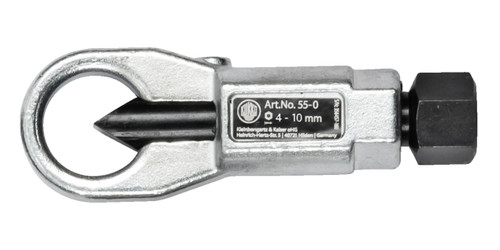
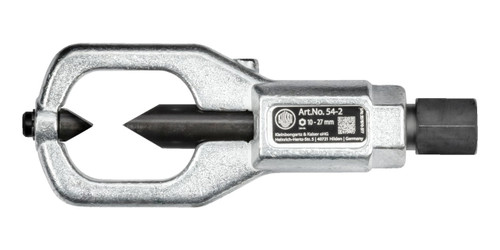
Choose a nut splitter by width, not thread diameter
Measure across opposite flats. That is the wrench size used in KUKKO's splitter tables, not the diameter of the threaded hole. Then measure the working space around and above the nut. A tool that covers the hex size still needs room for its body, chisel and operating wrench.
For example, the single-blade 55-2 covers 19 to 27 mm across flats, approximately 3/4 to 1-1/16 in. The double-edged 54-2 covers 10 to 27 mm, about 3/8 to 1-1/16 in. Their overlapping size ranges do not mean their bodies or cutting actions are interchangeable. Check the individual model table before choosing.
Single-blade or double-edged mechanical tools
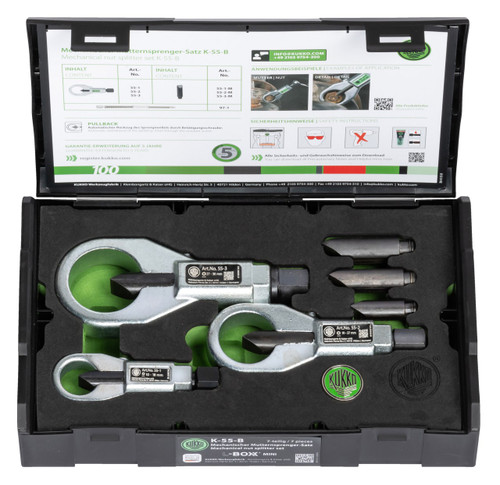
A series 55 mechanical nut splitter uses one chisel and is intended for limited space around the nut. The individual model table starts with 55-0 at 4 to 10 mm and reaches 55-4 at 32 to 46 mm, roughly 5/32 to 3/8 in and 1-1/4 to 1-13/16 in respectively. Select the specific model within that family rather than treating the whole span as one tool's capacity.
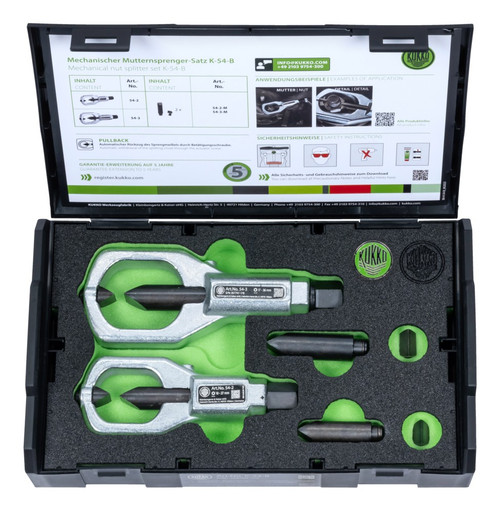
The double-edged series 54 applies two cutting edges in one working operation. Its 54-3 table lists 17 to 32 mm across flats, approximately 11/16 to 1-1/4 in. Both mechanical families use KUKKO's Pullback Technology to retract the chisel after the split.
Check strength limits separately. KUKKO's tables list series 54 for nut property class 8 and series 55 for class 6. Do not assume that two tools sharing a width range share a strength rating. Choose a manual nut splitter based on its stated rating, not how much leverage you can apply to its spindle.
When grease or pump hydraulics fit the job
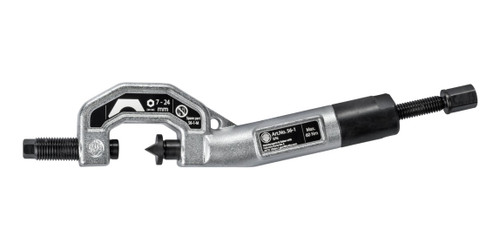
The series 56 grease-hydraulic tool has a slightly angled body and covers nut classes 5, 6, 8 and 10 according to KUKKO. Its three models cover 7 to 24, 22 to 36 and 27 to 46 mm across flats. Those ranges are approximately 1/4 to 15/16, 7/8 to 1-7/16 and 1-1/16 to 1-13/16 in. Each model has its own maximum operating torque; more wrench force is not a safe way to extend its rating.
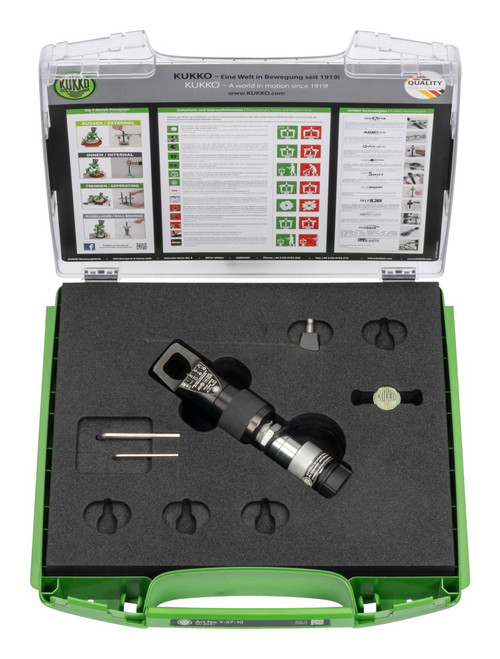
The pump-operated Y-57 family reaches larger nuts. The supplied model tables run from Y-57-10 at 10 to 19 mm to Y-57-60 at 60 to 75 mm, roughly 3/8 to 3/4 in and 2-3/8 to 2-15/16 in. These are separate sizes, not one adjustable head. Check pump compatibility and the operating instructions before assembling a hydraulic setup.
What to check in a nut splitter set
The K-54-B set groups double-edged tools with replacement chisels and ring wrenches. The K-55-B groups single-blade tools with replacement chisels and a thread file. Review the included model numbers and their individual ratings, especially if you're replacing parts in an older set. A spare chisel is useful only if it matches the specific tool model.
For a brand-focused overview of these families and related separating tools, see KUKKO nut splitters and separators. Our Learn guide on how to use a nut splitter covers the working sequence.
Protect the stud during the cut
Seat the nut splitter tool squarely, with its chisel aimed at a flat and clear of any washer. Wear eye protection and keep fingers away from the cutting path. Stop advancing when the nut splits; continuing drives the chisel toward the threads you are trying to preserve. Release the load before repositioning or inspecting the blade.
With hydraulic equipment, inspect hoses and connections before loading and never use heat near seals or hoses. Replace a damaged chisel according to the tool instructions rather than reshaping it yourself. If the fastener has already broken, see screw and stud extractors. Other removal tools are grouped under pullers and extractors.
Frequently asked questions
Will splitting a nut damage the bolt threads?
KUKKO describes these tools as removing the nut while preserving the threaded stud. That depends on correct setup and stopping at the split, not continuing to drive the chisel inward. Keep the tool square, place the chisel on a flat and inspect the threads after removing the damaged nut.
What size splitter do I need?
Measure the nut across its flats and choose a model whose listed wrench-size range includes that measurement. Then check body clearance and the nut's property class. For example, 55-2 covers 19 to 27 mm, about 3/4 to 1-1/16 in. Nominal bolt diameter is not the selection dimension.
Is one blade or a double-edged tool better in a tight space?
KUKKO identifies the single-blade series 55 for limited space around the nut. Series 54 uses double edges to split in one working operation. Check the actual head and wrench clearance before choosing. Blade count by itself does not tell you whether the tool will seat against a nearby flange.
Can series 55 split class 10 nuts?
The supplied KUKKO table lists series 55 for nut class 6, not class 10. Series 56 grease-hydraulic tools are described for classes 5, 6, 8 and 10. Use the rating for the exact model and size. Do not try to compensate for an unsuitable rating with a longer wrench.
Do the sets include replacement chisels?
KUKKO lists replacement chisels with K-54-B and K-55-B, and a replacement chisel with the Y-57 sets. Confirm the included model numbers and replacement part fit before ordering. Release all load before changing a chisel, then follow the manufacturer's fitting instructions and inspect the head before returning it to use.