
Lever & Toggle Clamps
A toggle clamp from KUKKO is a heavy all-steel bar clamp that you tighten with a sliding toggle bar or tommy bar instead of a small wooden grip, so you can put real force on a weld joint or a stack of plate. At BRAIGG, this page carries five KUKKO families: the fast VIRIDIS lever clamp, three locksmith clamps rated up to 10,000, 12,000 and 22,000 N, and a U-clamp for steel beams. Openings run from 120 mm (about 4-3/4 in) to 1,250 mm (about 49 in). All are made in Germany.
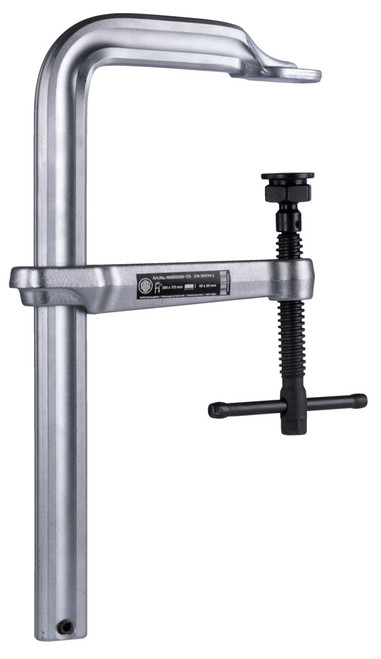
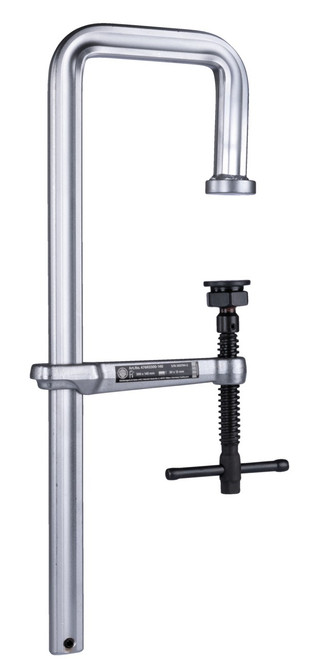

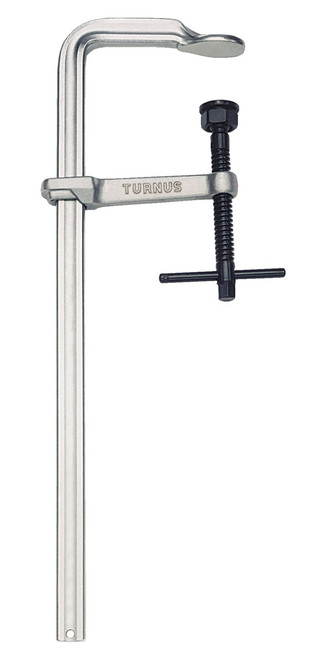

What a toggle clamp handle does here
In many US shops, "toggle clamp" means a bench-mounted hold-down with a lever linkage. The clamps on this page work differently. Each one is an F-style clamp with a sliding arm on a steel rail and a threaded spindle. The toggle or T-bar handle passes through the spindle head, so you can slide it to one side and get a long lever on it. That lets you crank a toggle clamp much tighter than a palm grip would allow. If you want a lighter-duty screw clamp with a regular handle, look at our screw clamps.
VIRIDIS lever clamp, series 472
The VIRIDIS all-steel lever clamp is the speed option. KUKKO shapes the rail profile so clamping force builds up uniformly at full spread too, and says the 472 is up to five times faster than conventional clamps. It is self-locking, so vibration from grinding or hammering on the part doesn't walk it loose. Rated tensile strength is up to 6,000 N (about 1,350 lbf). Ten sizes run from 120 x 60 mm to 1,000 x 120 mm, with the throat (the reach from the rail to the spindle) growing from 60 to 140 mm on the shorter models. Use this lever clamp for repeat setups: tacking brackets, holding a fence while you drill, or clamping several parts in a row.
Locksmith clamps for heavy work
KUKKO calls its heavy F clamp a locksmith clamp, a name borrowed from the German metalworking trade. There are three here, and they step up in force:
- Series 473K with toggle handle: 200 to 600 mm openings, 120 mm throat, up to 10,000 N. The spindle end has a hex, so you can run it down with a ratchet or an impact wrench when you set a lot of clamps.
- Series 475K with T-bar handle: 250 to 1,250 mm, 120 or 140 mm throat, up to 12,000 N. The movable clamping cap tilts to grip faces up to 35 degrees out of parallel.
- Series 480K with tommy bar: 300 to 1,250 mm, a deep 175 mm (about 6-7/8 in) throat, and up to 22,000 N (about 4,950 lbf). It has the same 35 degree swivel cap. This is the one for pulling a warped flange flat or holding a heavy frame member during welding.
U-clamp for beam flanges
The 476K heavy U-clamp has a 300 mm opening, 140 mm throat and a 100 mm (about 3-15/16 in) clearance in its U-shaped body, so it can reach around the flange of a T or I-beam. KUKKO rates it up to 11,000 N. A pressure plate with a built-in spindle lock stops it from backing off when the beam vibrates. It weighs about 8.1 lb.
How to pick a size
Measure the thickest stack you'll clamp and add some room for the pads; that's your clamping width. Then measure how far in from the edge the pressure must land; that's your throat depth. A clamp with too shallow a throat bears only on the edge and can let a plate lift in the middle. As a guide, sheet and bracket work suits the 472 in 160 to 300 mm. For structural work and long weldments, choose a 475K or 480K. Most welding clamps in a fab shop get bought in pairs or fours, since one clamp rarely holds a part square.
Use and care
- Keep the spindle and the rail clean of spatter. A spatter bead on the rail stops the sliding arm from locking square.
- Don't extend the handle with a pipe. The rated force is already high, and a cheater bar can bend the rail.
- Set the clamp so the cap sits flat or at an angle within its 35 degree swing, never on a sharp edge.
- Wear gloves and eye protection when loosening a toggle clamp on a part under tension. A plate under spring tension can jump when the clamp releases.
- A drop of oil on the spindle threads now and then keeps it turning smoothly.
For holding parts on the bench, see our vises. The full workholding range is under clamps and vises, and more from the maker is on the KUKKO brand page.
Frequently asked questions
Is this a toggle clamp or an F clamp?
Both terms fit. These KUKKO tools are all-steel F-style bar clamps with a sliding arm and a threaded spindle. What makes them a toggle clamp is the handle: a sliding toggle bar, T-bar or tommy bar through the spindle head that gives you far more leverage than a wooden grip. They are not bench-mounted hold-down clamps with a lever linkage.
How much force do these clamps hold?
KUKKO rates the VIRIDIS 472 up to 6,000 N, the 473K up to 10,000 N, the 476K U-clamp up to 11,000 N, the 475K up to 12,000 N and the 480K up to 22,000 N. For reference, 10,000 N is about 2,250 lbf. Pick by the heaviest job you expect, not the average one.
Can I tighten them with an impact wrench?
The 473K has a hex on the spindle that KUKKO says takes a key, ratchet or impact wrench. That speeds up big setups with many clamps. Run it down gently and finish by hand where you can, so you don't overshoot the force you need or crush thin material.
Which clamp works on tapered or angled parts?
The 475K and 480K have a movable clamping cap that KUKKO says can grip workpieces up to 35 degrees out of parallel. That helps on flange tapers, gussets and bevels. A fixed pad on a tapered face tends to slip under load, so use one of these two models when the faces aren't square.
What is the 476K U-clamp for?
It clamps onto T and double-T steel beam flanges. The U-shaped body gives 100 mm of clearance so it can reach around the beam edge, and the pressure plate has a built-in spindle lock that resists vibration. Use it to hold a cleat, plate or bracket to a beam while you weld or drill.