
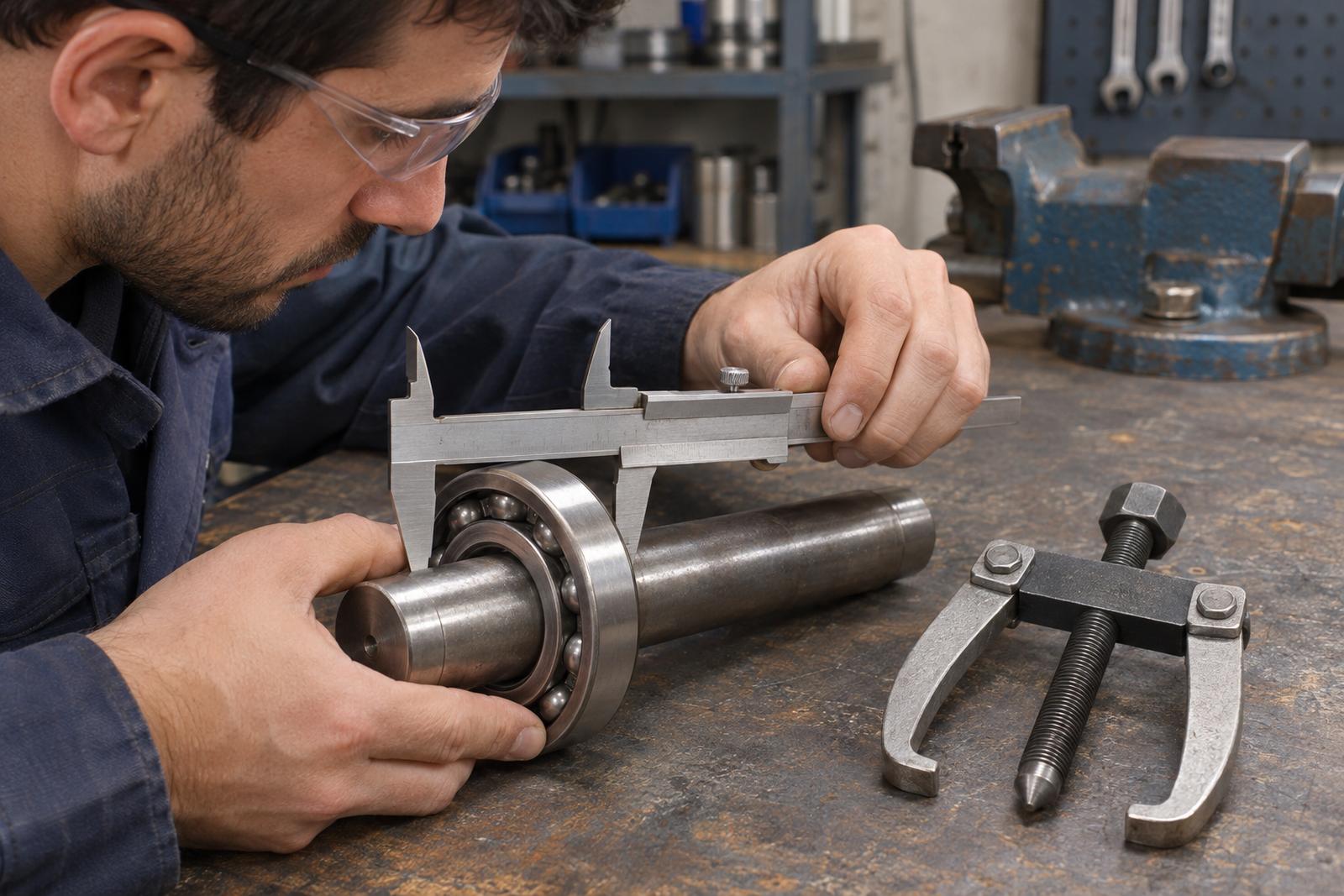
What does puller size actually describe?
A size description may emphasize a maximum spread, a reach or a force rating. These are not interchangeable. Spread is the opening available at the grip, while reach is the axial distance the jaws can extend toward the gripping surface. Force describes how much axial load the specified tool can apply within its rating.
Read the manufacturer's dimension drawing for the exact measuring points. An external spread figure is not automatically an internal gripping range, even when the jaws can be reversed. For the overall choice of gripping method, start with Pullers & Extractors before narrowing the dimensions.
1. Measure the diameter at the gripping surface
For an external jaw pull, measure the component where the hooks will engage. Check that this diameter falls inside the model's external spread range, including its minimum. A puller that opens wide enough can still be too large to close around a small part.
Now look around that diameter. A housing lip, nearby gear or bracket may block one jaw even though the spread number looks right. Check every hook position. The two-jaw vs three-jaw guide helps you choose an arrangement that fits the available access rather than just the nominal diameter.
2. Measure reach along the shaft
Locate the shoulder the jaws must grip behind, then measure the axial distance shown in the tool's drawing. Account for the shaft end where the spindle will react and the room the crossbar needs. The hooks must reach the shoulder while the spindle can still seat centrally.
Do not choose puller size by maximum spread and assume reach grows with it. In the chart below, KUKKO 110-1 and 30-1 both list 100 mm reach (about 3.94 in), but their spread ranges and force ratings differ. A deeper component may require another jaw length or another tool altogether.
3. Use this puller size chart as a model reference
These are representative models, not a list of interchangeable tools. Dimensions and maximum tensile-force values come from KUKKO's item-level specification tables. The first three models belong to the Techno two-jaw family; 30-1 is a Classic three-jaw model. Links open the product family, where you must select the exact item number.
| Model | External spread range | Reach | Maximum tensile force |
|---|---|---|---|
| KUKKO 110-01 | 22 to 50 mm (0.87 to 1.97 in) | 50 mm (1.97 in) | 5 kN |
| KUKKO 110-1 | 28 to 100 mm (1.10 to 3.94 in) | 100 mm (3.94 in) | 20 kN |
| KUKKO 110-2 | 42 to 165 mm (1.65 to 6.50 in) | 150 mm (5.91 in) | 50 kN |
| KUKKO 30-1 | 0 to 90 mm (0 to 3.54 in) | 100 mm (3.94 in) | 60 kN |
Inch values are approximate decimal conversions of the metric dimensions using 25.4 mm per inch. They may differ from rounded fractional-inch labels. For 110-2, the detailed manufacturer table gives a 42 to 165 mm external spread; a shortened option label may say 160 mm. This guide uses the detailed table. Confirm the current drawing for that exact item if fit is close.
Notice that 30-1's smaller maximum spread does not mean a lower force rating. That model lists 60 kN, while 110-2 lists 50 kN. There is no universal conversion from opening size to pulling capacity. Keep the three columns separate when comparing candidates.
4. Check force without guessing from bearing diameter
A kilonewton, written kN, is a force unit: 1 kN equals 1,000 newtons. A maximum tensile-force rating is a tool limit, not a promise about how easily a fitted component will move. Interference fit, corrosion and contact conditions affect the force needed.
You cannot calculate a reliable required force from outside diameter alone. Use the equipment's service procedure and the tool manufacturer's permitted arrangement. When considering hydraulic pullers, check the complete system rather than assuming the hydraulic spindle's rating applies to every jaw or accessory attached to it. Never add handle length to exceed a tool limit.
5. Check the hook tips and the reaction point
A puller size that looks right on paper may still leave the hooks with nowhere to sit. Measure the gap behind the bearing or gear and check jaw-tip thickness, usable hook depth and the surface the hook will bear against. A hook touching only at its corner can shift under load. Seat every jaw as instructed.
If there is not enough room for ordinary hooks, consider bearing separators and a compatible pulling attachment. For a bearing inside a housing, use the gripping range and engagement requirements of an internal extractor instead of this external-jaw chart. See how to choose a bearing puller for that distinction.
6. Make a final setup check before loading
Correct puller size is only the start. Remove the relevant retainers according to the equipment procedure, support the assembly and center the spindle on a suitable reaction point. Verify that the pulling path is clear and the part can move off the shaft without meeting another obstruction.
Wear eye protection, fit a rated protective cover over the loaded puller and keep clear of the pulling line. Stop if a jaw shifts, the component cocks or the tool visibly distorts. Keep heat away from hydraulic seals. More force will not fix an overlooked retaining ring or a blocked removal path.
Before ordering, record the part diameter, required reach, rear clearance and selected item number together. Then check all four against the model drawing. Browse KUKKO pullers by type once those measurements point to a suitable gripping method.
Frequently asked questions
What size puller do I need?
Measure the diameter at the intended grip, the axial reach to the gripping shoulder and the clearance behind it. Then check those measurements against the exact model's drawing and force rating. There is no single outside-diameter rule that establishes the right puller for every bearing or gear.
What is the difference between puller spread and reach?
Spread describes the opening at the gripping area. Reach describes how far the jaws extend axially to get behind the component. A tool may open around a wide gear yet have jaws too short to reach its rear face. Check both measurements independently using the manufacturer's defined measuring points.
Can I choose a puller by its force rating alone?
No. A high force rating does not make the jaws fit a small bore, clear a nearby housing or reach a distant shoulder. Establish a secure grip and a centered reaction point first. Then check the rating for the complete permitted assembly against the equipment and tool instructions.
Does this puller size chart cover internal extraction?
No. The chart gives external spread and reach for four specific KUKKO jaw-puller models. Internal extraction uses a different gripping range and engagement geometry. Even if a jaw can be reversed, do not substitute the external range for an internal specification. Use the exact item's internal-extraction data instead.
Why do the inch dimensions differ from some product labels?
This guide converts the metric dimensions at 25.4 mm per inch and rounds to two decimal places. Manufacturer labels sometimes use rounded fractions instead. Treat these inch values as approximate equivalents, not separate specifications. If the clearance is tight, check the current metric dimension drawing for the exact model.