
Step Drill Bits
A step drill bit cuts several hole diameters with one tool, making it useful when panel work calls for more than one opening size. At BRAIGG, this category carries Norseman Ultra Bit Multi-Diameter Step Drills. Start with the finished hole diameter, then check the stock thickness and the exact option before ordering. The steps are cutting surfaces, not a depth scale for drilling thick plate. For a bracket, enclosure panel or other thin workpiece, a correctly matched tool can let you make or enlarge a hole without changing bits for each diameter.
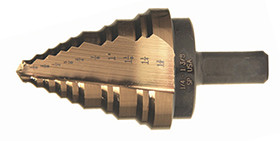
Choose a step drill bit for thin stock
The stepped profile explains both the tool's usefulness and its limit. As the drill advances, successively larger cutting diameters reach the work. Each cylindrical step must pass through the stock to produce that diameter through its full thickness. If the material is too thick, the next cutting shoulder reaches the top before the selected step has cleared the bottom.
That is why a step drill bit for sheet metal is selected by more than maximum hole size. Check the axial length of the step against the material thickness. Norseman's electrician step-drill guidance specifies thin metals and other suitable materials with a thickness equal to or less than the step thickness. The overall length of the drill does not establish that capacity.
Read the Ultra Bit options carefully
The Norseman Ultra Bit Multi-Diameter Step Drills family has five listed options. Two labels give explicit diameter ranges: 1/8 to 1/2 inch and 1/4 to 3/4 inch. The remaining labels are "3/16 inch A, TiN Coated," "3/16 inch B" and "7/8 inch A." Read the selected item's details rather than interpreting a single number in an option label as a complete cutting range.
Write down every required finished diameter before choosing. A minimum and maximum alone do not prove that all the sizes between them appear as cutting steps. Verify the intermediate diameters and step thickness for the selected tool. If either is missing from the product information, confirm it before committing the tool to a job with a specified hole size.
The TiN-coated option is identified in the family listing; do not assume every option has the same treatment. Norseman's electrician step-drill information describes titanium nitride as adding lubricity and hardness. A coating does not change the need to match diameter, thickness and application. Nor should it be used to infer a capacity that is not stated for the selected item.
Control the cut before the next shoulder reaches the panel
When using a step drill bit for metal, mark the hole center and secure the work against rotation. A loose panel can catch on the bit and spin. Leave room beneath the hole for the cutting end to emerge without hitting the table, fixture or components behind the panel. Check the back of an enclosure before drilling into it.
Identify the target step before starting, then watch its position as you feed. Reduce feed pressure near breakthrough so the next diameter does not enter unintentionally. Stop the machine before checking the hole with a gauge or removing chips. Use eye protection, keep hands clear of the rotating tool and remove burrs before handling the finished edge.
Use the manufacturer's speed and feed guidance for the stock and cutting diameter. As the hole grows, the cutting edge travels farther per revolution, so the speed appropriate at the small end may be too high at the larger steps. An appropriate metal-cutting lubricant may be needed for the operation. Stop if the edge is rubbing instead of cutting; pressing harder without checking the setup is not a remedy.
Know when another drill style fits better
A step bit is convenient for several panel-hole sizes, but a deep, constant-diameter bore is a different job. Look at twist drill bits when you need one diameter with suitable flute length for deeper stock. For larger conventional holes, check reduced-shank drills and verify the machine's capacity as well as chuck fit.
Hole finishing is also a separate decision. Use countersinks and deburring tools when the requirement is a screw recess or controlled edge cleanup. Do not drive the next step into a finished hole simply to remove a burr if that will enlarge it beyond the required diameter.
For repeated panel jobs, record the successful tool option, material thickness and finished diameter alongside the job notes. Keep those notes with the setup instructions for the next run. Return to the drill bits department when the next job changes from thin sheet to deeper stock, broken-fastener removal or a different hole-finishing operation.
Frequently asked questions
What is a step drill bit used for?
It makes or enlarges holes in thin material using a series of cutting diameters on one tool. You advance only as far as the step for the required hole size. Match the stock thickness to that step's axial length; the tool's total length does not determine how thick a workpiece it can drill at one diameter.
Which Norseman step drills are listed here?
This category carries the Norseman Ultra Bit Multi-Diameter Step Drills family with five options. Two are labeled 1/8 to 1/2 inch and 1/4 to 3/4 inch. The others use A or B designations, including a TiN-coated option. Check the exact option details rather than assuming those designations identify a complete diameter range.
Can I use a step drill bit in thick steel plate?
Do not choose one for thick plate based on maximum diameter alone. The selected step must be long enough to cut through the stock before the next diameter enters. Norseman's electrician step-drill guidance limits material thickness to the step thickness. A conventional twist drill with suitable length is generally the place to look for a deeper constant-diameter hole.
Does every Ultra Bit option have a TiN coating?
The current family lists one option explicitly as TiN Coated. That label should not be applied to the other options without their own supporting specifications. Norseman describes titanium nitride as adding lubricity and hardness on its electrician step drills. Still check the chosen tool's sizes and application; coating information alone does not establish its cutting capacity.
How do I avoid making the hole too large?
Locate the required step before cutting, clamp the work and leave clearance below it. Watch the step's position and ease the feed near breakthrough so the next shoulder does not enter. Stop rotation before measuring the hole or clearing chips. Deburr with a suitable separate tool if advancing farther would enlarge the finished opening.