
T-Handle Hex Keys
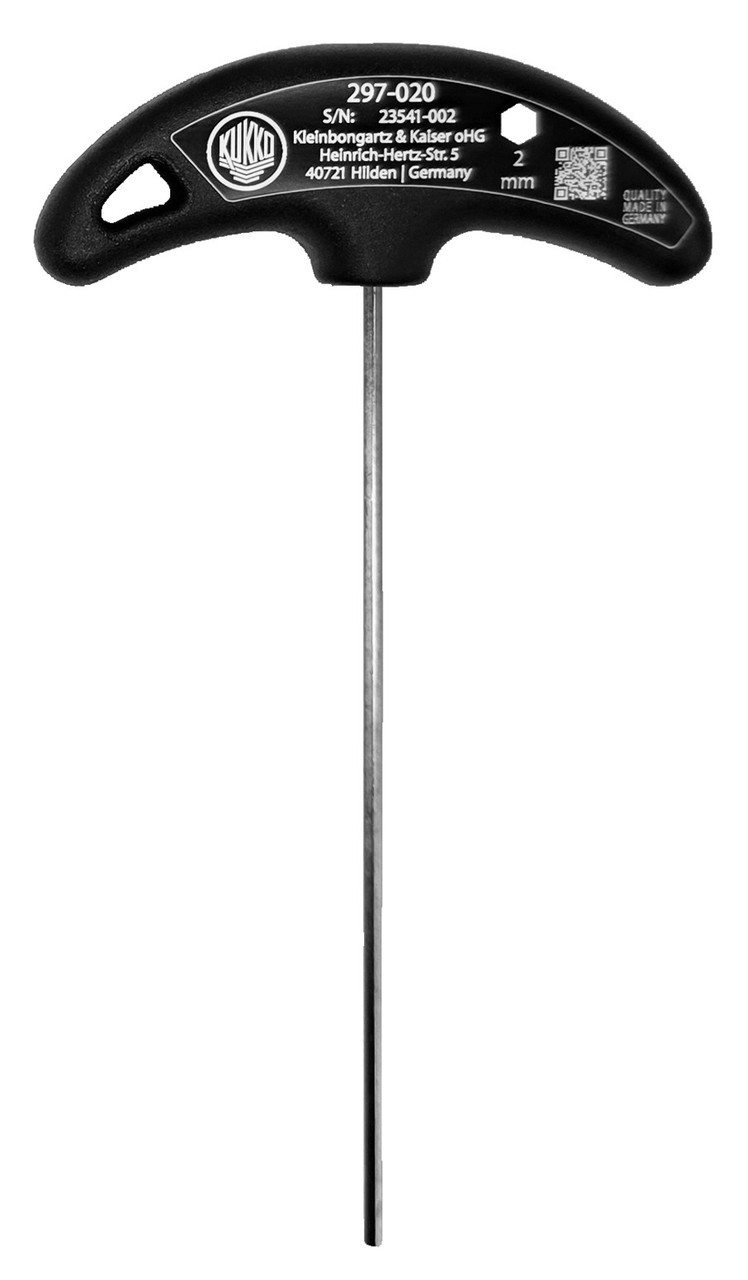
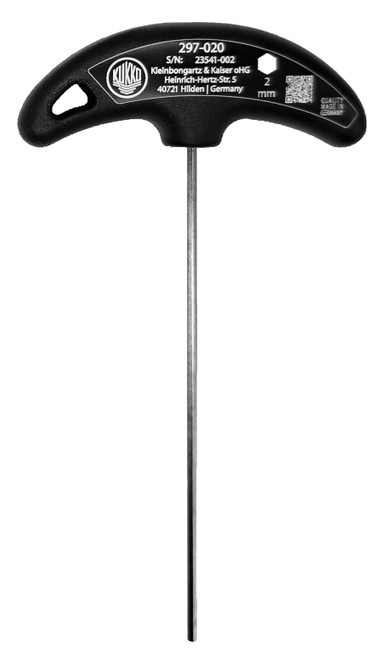
A T handle Allen wrench gives you a full-hand grip and a long shaft, so you can spin a cap screw out of a deep counterbore and still lean on it to break it loose. At BRAIGG, this section carries KUKKO's metric T handle hex key lineup: the series 297 keys in 2 to 8 mm, the compact series 236 with an impact-resistant polypropylene handle, and a 7-piece set that lives in its own workshop stand. Most KUKKO tools are made in Germany, and both series here are.
Why use a T handle Allen wrench
An L-shaped key is cheap and fits anywhere, but it's slow. You turn a quarter turn, reset, and turn again. A T handle Allen wrench lets you spin the screw like a screwdriver once it's loose, then use the crossbar for leverage when it's tight. The long shaft also reaches socket head cap screws sunk in counterbores, set screws inside pulley hubs, and bolts behind brackets that an L-key can't swing past.
Typical jobs: machine guards and fixtures, conveyor and packaging equipment, gearbox covers, bicycle and motorcycle work, and assembling extruded aluminum framing, where you may run dozens of cap screws in a row.
Choosing a T handle Allen wrench: series 297 vs 236
Both KUKKO series are metric, and KUKKO states that hardness and torque meet ISO standards for both. The difference is the handle and finish.
- Series 297: nickel-plated shafts for corrosion resistance and an ergonomic one-piece (1K) T-handle that KUKKO built for higher torque and less hand fatigue. Sizes 2, 2.5, 3, 4, 5, 6 and 8 mm. This is the one to pick if the keys live in a damp shop or a service truck.
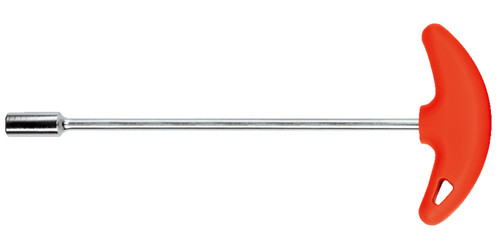
- Series 236: a handle made of impact-resistant polypropylene, which KUKKO describes as affordable and compact. A good choice if you want several sizes at each workstation.
Buying a T handle hex key set
If you use more than two or three sizes, a T handle hex key set saves you from hunting. The KUKKO 7-piece set in a workshop stand keeps every key upright on the bench, so you can see at a glance which one is missing. That matters on an assembly line or a shared bench, where a single lost key holds up the job.
Picking the right size
For metric socket head cap screws to ISO 4762, the key size follows the thread: an M4 screw takes a 3 mm key, M5 takes 4 mm, M6 takes 5 mm, M8 takes 6 mm and M10 takes 8 mm. Set screws and button heads use smaller keys for the same thread, so check the screw before you reach for the tool.
Don't swap metric and inch keys. Some pairs look close: 5/64 in is 1.98 mm, almost the same as 2 mm. Others aren't. A 5/32 in key (3.97 mm) in a 4 mm socket is loose enough to round it out under torque, and 3/16 in (4.76 mm) won't fit a 5 mm screw properly. Keep a separate inch set for SAE fasteners.
Use and care
- Push the key all the way into the socket before you turn. A key sitting halfway in rounds the corners of the screw and the key.
- Break tight screws loose with a short, steady pull on the crossbar, not by jerking it. If a screw won't move, soak it with penetrant and try again rather than hanging your weight on the handle.
- Wipe oil and chips out of the screw socket first. Debris keeps the key from seating.
- Retire a key once its tip is rounded or twisted. A worn tip ruins every screw it touches.
Need L-keys, ball end hex keys or Torx keys? You'll find them in our hex and Torx keys section, along with a non-sparking hex key set for hazardous areas. The rest of the family is under hex keys and screwdrivers. When a T handle Allen wrench is too slow for long runs of fasteners, our screwdrivers section is the next stop.
Frequently asked questions
What is a T handle Allen wrench used for?
It drives hex socket screws, such as cap screws, set screws and button heads, where you want both speed and leverage. The T-shaped handle lets you spin a loose screw quickly and pull hard on the crossbar to break a tight one free. The long shaft reaches screws sitting deep in counterbores or behind brackets.
Are KUKKO T handle hex keys metric or SAE?
They're metric. The series 297 keys come in 2, 2.5, 3, 4, 5, 6 and 8 mm. Don't use them on inch fasteners: a 4 mm key in a 5/32 in socket, or a 5/32 in key in a 4 mm socket, has enough play to round the corners once torque goes on.
What's the difference between KUKKO series 236 and 297?
Series 297 has nickel-plated shafts for corrosion protection and an ergonomic T-handle designed for higher torque and less fatigue. Series 236 uses an impact-resistant polypropylene handle that KUKKO describes as affordable and compact. KUKKO states that both meet ISO standards for hardness and torque.
What size hex key fits an M6 cap screw?
A standard M6 socket head cap screw to ISO 4762 takes a 5 mm hex key. M5 takes 4 mm, M8 takes 6 mm and M10 takes 8 mm. Set screws and button head screws often take a smaller key than a cap screw of the same thread, so test-fit before you put force on it.
Is a T-handle hex key better than an L-key?
For repeated screws and deep counterbores, yes: it's faster and easier on your hand. An L-key still wins in very tight spots where the T-handle can't turn, and its short leg can give more leverage on a seized screw. Most mechanics keep both: T-handles for daily work and an L-key set for awkward spots.