
-
-
CGW Abrasives
CGW Thin Reinforced Cut-Off and Notching Wheels, 3/32", Type 27
Choose options for price
-

CGW Abrasives
CGW AI Edge Aluminum Cut-Off Wheel, 4-1/2" x .045" x 7/8", Type 27
Choose options for price
-
-

-

-
Cut-Off Wheels
Choose cut-off wheels based on the metal, the tool and the cut you need to make. A thin wheel for trimming tube on an angle grinder is a different choice from a 14 inch wheel for a stationary chop saw. BRAIGG carries CGW options for steel, stainless and non-ferrous metals, with flat and depressed center profiles in the range. Check diameter, thickness, arbor and maximum RPM together before ordering. This section covers cutting and selected notching wheels. For weld removal and surface work, see the separate grinding wheels category.
Match cut-off wheels to the metal first
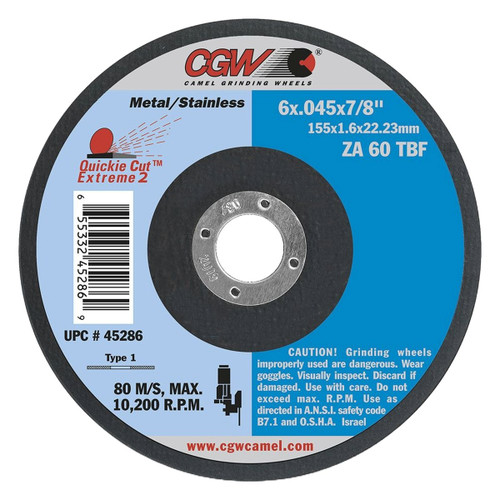
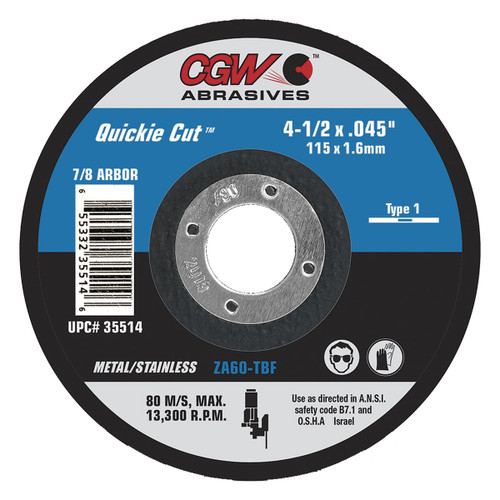
For steel and stainless, CGW Quickie Cut wheels use a blend of zirconia and aluminum oxide grain. The family includes Type 1, Type 1 Flex and Type 27 options. Read the selected size rather than assuming every diameter comes in every profile. CGW also offers a reinforced .045 inch Type 1 wheel for ferrous metals, with thicker stock among its recommended applications.
Aluminum needs a different selection. The AI Edge aluminum cut-off wheel uses aluminum oxide grain engineered for non-loading cutting in aluminum, copper and bronze. Its specification is 4-1/2 inches by .045 inch with a 7/8 inch arbor, Type 27. Choose a cutting wheel for metal by its stated application, not grain name alone: two aluminum oxide products can be formulated for different workpieces.
Type 1 or Type 27: check the shape and guard
Type 1 identifies a flat wheel. Type 27 has a depressed center around the mounting area. That shape changes how the hub, guard and workpiece fit together, but it does not make every Type 27 product a grinding wheel. A Type 27 cutting disc still needs to be used for the operation stated on its label.
When choosing a cut-off wheel for angle grinder use, check which wheel type the tool manufacturer permits and which guard and mounting arrangement it requires. Do not remove the guard to make a wheel fit. Keep a cutting-only wheel in the cut rather than using its side to dress an edge. If the next operation is broad surface grinding, change to the correct abrasive instead of trying to finish everything with one wheel.
Thickness changes the cut, not just the part number
The Quickie Cut range includes thin .035 and .045 inch options, along with other thicknesses depending on size and style. A narrow wheel removes less material across the cut, but it still needs a supported workpiece and a straight path. Do not twist the grinder to correct a wandering cut. Stop and reset the approach.
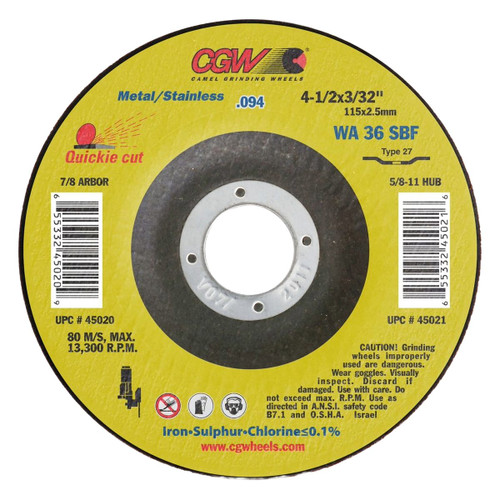
For notching, look at the specifically designated 3/32 inch reinforced cutting and notching wheels. These Type 27 wheels come in 4-1/2 and 6 inch diameters with 7/8 inch arbors. They are labeled for notching. That does not mean any thicker cutting disc can handle side pressure. Follow the selected wheel's operating instructions.
Keep chop saw and gas saw wheels separate
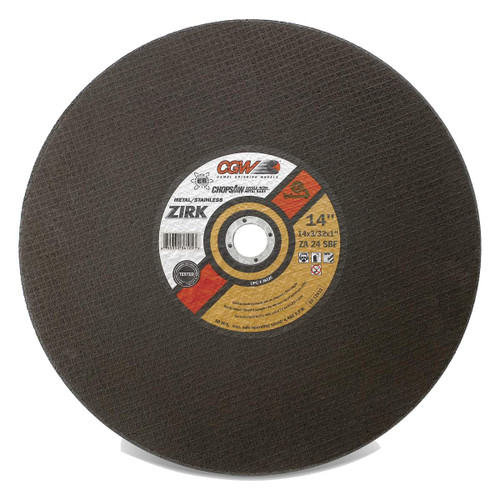
Two cut-off wheels marked 14 inches are not necessarily interchangeable. CGW's standard 14 inch chop saw wheel measures 3/32 inch thick, has a 1 inch arbor and is rated at 4,400 RPM maximum. It uses aluminum oxide for metal and steel. The specialty chop saw option shares those dimensions and speed rating, with iron and heavy bar stock as its stated applications.
The 14 inch gas saw wheel is 5/32 inch thick with a 20 mm arbor and a 5,500 RPM maximum rating. It is made for gas-powered cut-off saws cutting metal and steel. Match the machine type as well as the dimensions. A matching outside diameter does not mean the wheels are interchangeable.
Check the setup before cutting
Read the speed marking on the wheel and the tool. The tool's rated speed must not exceed the wheel's maximum RPM. Check for damage before mounting, secure the stock against movement and arrange support so the cut does not close and pinch the wheel. Use the required guard, eye protection and any other safety gear specified by the tool and wheel manufacturers.
Most smaller cut-off wheels here are available individually or by the box, while the 14 inch saw wheels come individually or in boxes of 10. Check the selected product for its exact box quantity. After cutting, use flap discs for suitable blending work. Browse the wider abrasives department when the job also calls for stripping, deburring or finishing.
Frequently asked questions
What is the difference between Type 1 and Type 27 cut-off wheels?
Type 1 is flat, while Type 27 has a depressed center around the mounting area. Choose the shape permitted by your tool manufacturer with the required guard and mounting hardware. The shape alone does not identify the operation: a Type 27 wheel labeled for cutting is not automatically suitable for side grinding.
Which cut-off wheel should I choose for aluminum?
Choose a wheel specifically intended for aluminum rather than assuming a steel-cutting wheel will suit it. CGW AI Edge uses aluminum oxide grain engineered for non-loading cutting in aluminum, copper and bronze. The option here is a 4-1/2 inch Type 27 wheel, .045 inch thick, with a 7/8 inch arbor.
Can I grind with the side of a cutting disc?
Do not side-grind with a cutting-only wheel. Use it for the operation on its label and follow the manufacturer's instructions. Some products are specifically designated for cutting and notching, but that does not extend permission to every wheel of similar thickness. Change to a suitable grinding wheel for broad surface stock removal.
Are the 14 inch chop saw and gas saw wheels interchangeable?
Do not treat them as interchangeable. The standard CGW chop saw wheel here has a 1 inch arbor, 3/32 inch thickness and 4,400 RPM maximum rating. The gas saw wheel has a 20 mm arbor, 5/32 inch thickness and 5,500 RPM maximum. Match the intended machine, mounting dimensions and speed rating.
What should I check before mounting cut-off wheels?
Check the permitted wheel type, diameter, thickness, arbor and maximum RPM against the tool's instructions. Inspect the wheel for damage and use the required guard and mounting arrangement. Secure and support the work so it cannot shift or pinch the wheel during the cut. Wear eye protection and any other safety gear the manufacturers specify.