
-

CGW Abrasives
CGW Green Wheel Zirconia Grinding Wheel, 4-1/2" x 1/4" x 7/8"
Choose options for price
-
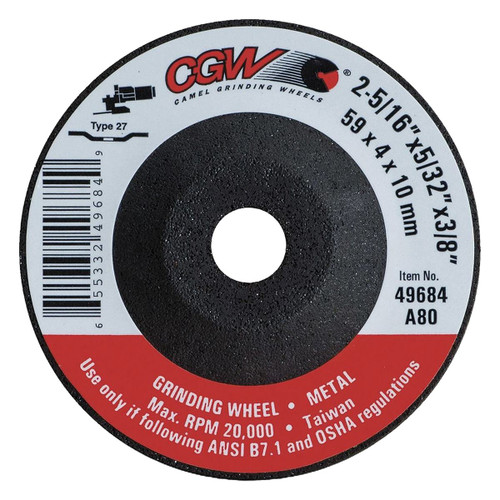
CGW Abrasives
CGW Mini Depressed Center Grinding Wheel, 2-5/16" x 5/32" x 3/8"
Choose options for price
-
-
-

-
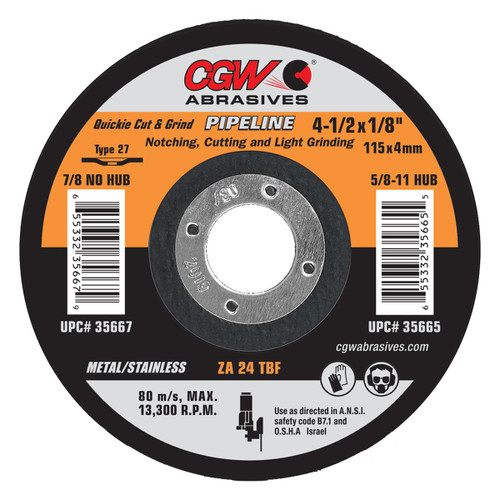
CGW Abrasives
CGW Zirconia Pipeline Grinding Wheel, 4-1/2" x 1/8" x 5/8"-11
Choose options for price
-

CGW Abrasives
CGW White Aluminum Oxide Stainless Steel Grinding Wheel, 7" x 1/4" x 5/8"-11
Choose options for price
-

-
Grinding Wheels
Choose grinding wheels for the metal and the amount of stock you need to remove. BRAIGG carries CGW depressed center wheels for stock removal, pipeline wheels for root passes and bevels, and resin cones for recessed areas. Choose the grain and bond for the material, then check thickness and mounting details against the tool. This category is for portable grinding applications. For a stationary machine, go to bench grinder wheels instead. The guide below explains soft and hard bonds, then covers plain arbors and threaded hubs.
Choose grinding wheels by bond as well as grain
A bond grade describes how firmly the wheel holds its abrasive grain, not how hard the workpiece is. A softer bond releases worn grain more readily. A harder bond retains grain longer. Neither is automatically better for every job, and extra pressure is not a substitute for choosing the right wheel.
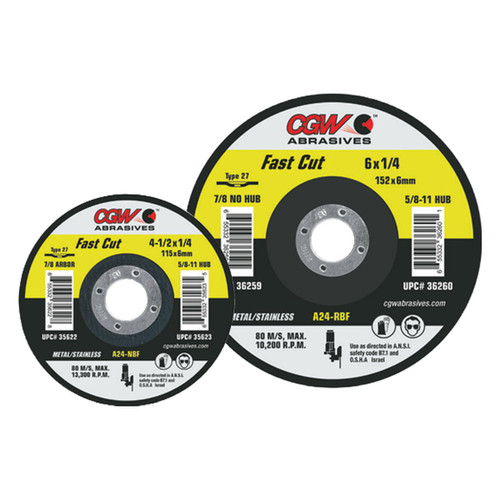
CGW Fast Cut wheels pair aluminum oxide with a soft N bond for fast stock removal. The family also includes a 6 inch R-bond option. CGW's separate 1/4 inch R-bond line comes in 5 and 6 inch diameters and is specified for longer wheel life with stock removal. Read the option carefully: the Fast Cut family name alone does not tell you which bond you selected.
Match the abrasive to steel, stainless or aluminum
When choosing a grinding wheel for metal, identify the metal first. Aluminum oxide appears in several products here, but their formulations differ. For stainless, the white aluminum oxide wheel is CGW's contaminant-free option. It uses an N bond and measures 7 inches by 1/4 inch with a 5/8-11 threaded hub. Keep stainless abrasives separate from wheels already used on ordinary steel to reduce contamination risk.
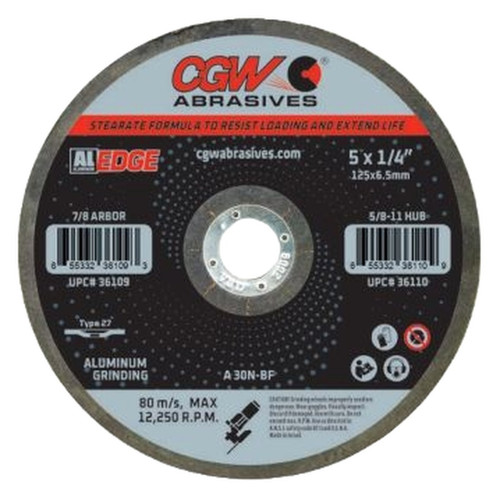
Zirconia is another choice. The Green Wheel uses zirconia grain and is engineered for cooler working; its specification is 4-1/2 inches by 1/4 inch with a 7/8 inch arbor. For aluminum weld removal, consider the AI Edge grinding wheel. Its non-loading aluminum oxide formulation and soft N bond are intended for aluminum and other non-ferrous metals, including copper and zinc. Check the application even when two wheels use the same grain.
Decide between 1/4 and 1/8 inch thickness
The 1/4 inch wheels in this range cover stock-removal work. For root passes and bevel cleaning, consider a thinner pipeline wheel. CGW's 4-1/2 inch zirconia pipeline wheel is 1/8 inch thick with a 5/8-11 threaded hub, and its stated uses include root-pass grinding, bevel cleaning and light notching on steel, cast iron and stainless.
The Ultra Pipeline T-Bond wheels use aluminum oxide with a hard T bond that holds its shape on edges. CGW specifies them for cutting and light grinding. These grinding wheels are 1/8 inch thick, with a 6 inch plain-arbor option and a 7 inch threaded-hub option. Follow the operation listed for the selected product rather than assuming every grinding wheel can be used for cutting.
Check the Type 27 profile and mounting connection
A Type 27 grinding wheel has a depressed center around the mounting area. Check its diameter and thickness against the tool's permitted wheel sizes, then check the connection. A 7/8 inch arbor hole is not the same mounting arrangement as a 5/8-11 threaded hub. Do not choose by outside diameter alone or improvise a mounting setup to use the wheel already on your shelf.
Maximum RPM also belongs in that check. The tool's rated speed must not exceed the wheel's marked maximum. Use the manufacturer's required guard and mounting hardware, inspect the wheel before use and wear eye protection with the other specified protection. When comparing grinding wheels for angle grinder use, confirm the tool accepts the selected wheel type before considering the job itself.
Use a grinding cone for recessed work
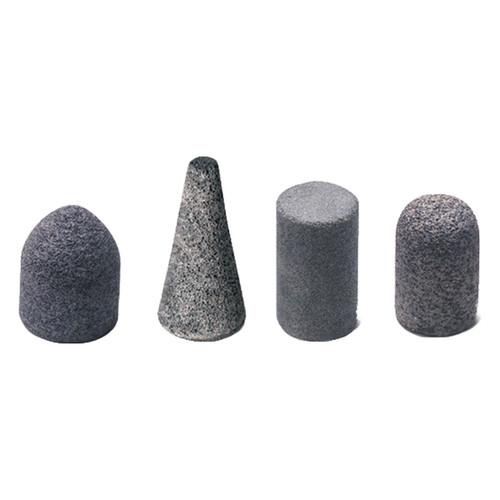
A flat wheel may not reach an inside corner or weld fillet cleanly. The CGW Type 18 resin cones and plugs are aluminum oxide tools for grinding and finishing metal in hard-to-reach areas. The listed plug measures 2 inches in diameter by 3 inches long, with a 5/8-11 threaded insert. Choose 16 grit for more aggressive removal or 24 grit for a slightly smoother finish. Confirm the tool and setup are suitable for this shape; matching threads alone are not enough.
Grinding wheels here are sold individually or by the listed box quantity, which varies by product and size. For separating stock, browse cut-off wheels. For blending after stock removal, consider flap discs. Find strip wheels, wire brushes and sanding supplies in the full abrasives department.
Frequently asked questions
What is the difference between N, R and T bond grades?
Bond grade describes grain retention rather than the hardness of the workpiece. In these CGW products, N is the softer option used for fast stock removal, while R and T are harder bonds. The Ultra Pipeline T-bond wheels are specified for holding shape on edges during cutting and light grinding. Choose within the product's stated applications.
Are 1/8 inch and 1/4 inch grinding wheels used the same way?
Do not choose by thickness alone. The 1/4 inch products here include stock-removal wheels, while the 1/8 inch pipeline lines have more specific uses. CGW's zirconia pipeline wheel is listed for root passes, bevel cleaning and light notching. Ultra Pipeline T-Bond wheels are specified for cutting and light grinding. Follow the selected product's instructions.
What does a 5/8-11 hub mean compared with a 7/8 inch arbor?
A 5/8-11 hub is a threaded connection, while a 7/8 inch arbor specification describes the wheel's mounting hole. Each requires the mounting arrangement specified by the grinder manufacturer. Check that connection separately from outside diameter, thickness and RPM rating. A wheel fitting inside the guard does not by itself mean it is compatible.
Which grinding wheel should I use on stainless steel?
Choose a product specifically listed for stainless and check the job's contamination requirements. CGW's white aluminum oxide Type 27 wheel is the contaminant-free option here, with an N-grade bond and a 7 inch diameter. Other listed choices include the zirconia pipeline wheel and Green Wheel. Avoid using a wheel on stainless after it has been used on ordinary steel.
When should I choose a grinding cone instead of a wheel?
Consider a resin cone or plug when the work is recessed, such as an inside corner, casting or weld fillet that a wheel cannot reach appropriately. The CGW Type 18 plug here is 2 inches in diameter and 3 inches long, in 16 or 24 grit. Confirm the tool permits the shape and mounting setup before use.