
Bench Grinder Wheels
Bench grinder wheels need to match the machine before you choose a grit. Read the grinder's permitted wheel diameter, width and arbor, then decide how much metal you need to remove. BRAIGG carries CGW vitrified brown aluminum oxide wheels for bench and pedestal grinders in 6, 8 and 10 inch diameters. The family covers stock removal, sharpening, deburring and shaping, with 36, 60 and 80 grit choices in the sizes listed below. These are bonded grinding wheels, not wire wheels, and each wheel is sold individually. Check the exact option rather than buying by diameter alone.
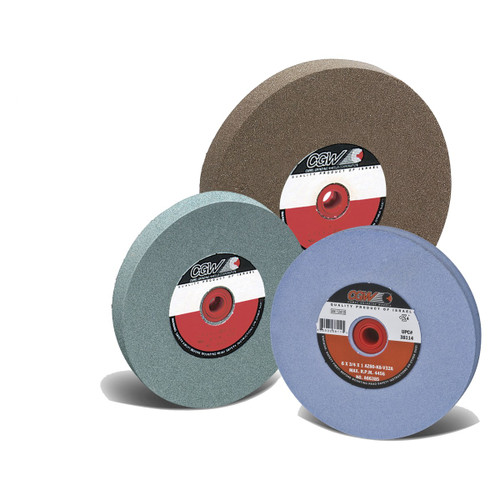
Match bench grinder wheels in all three dimensions
The first dimension is outside diameter, the second is wheel width and the third is the center bore. All three matter. A wheel can have the right outside diameter yet be too wide for the machine or have a bore that does not match the approved mounting arrangement. Check your grinder's instructions and identification plate before choosing a replacement.
The CGW bench and pedestal wheel family has the following combinations. Do not assume every grit comes in every size.
| Diameter x width x bore | Grit | Grade | CGW part |
|---|---|---|---|
| 6 x 3/4 x 1 inch | 36 | O | 38007 |
| 6 x 1 x 1 inch | 36 | O | 38012 |
| 6 x 1 x 1 inch | 60 | M | 38014 |
| 6 x 1 x 1 inch | 80 | M | 38015 |
| 8 x 1 x 1-1/4 inch | 36 | O | 38022 |
| 10 x 1 x 1-1/4 inch | 36 | O | 38027 |
For a 6 inch bench grinder wheel, check the width carefully: there are two choices here. That distinction is easy to miss when replacing a wheel from memory. Measure or read the existing specification with the machine safely isolated, then confirm it against the grinder manual. An old wheel's worn diameter is not the machine's original wheel-size specification.
Choose 36, 60 or 80 grit for the operation
CGW recommends 36 grit for fast stock removal and 60 or 80 grit for sharpening and finer work. A coarse bench grinding wheel is useful when there is substantial material to remove, but it leaves a rougher finish that may need further work. Choose based on the finish required, not simply the shortest grinding time.
The 60 and 80 grit options here are both 6 x 1 x 1 inch. The listed 8 and 10 inch wheels are 36 grit only. When finer work is required on a different machine size, do not fit an incompatible wheel merely to get the grit you want. Recheck the machine requirements and select a wheel that satisfies both the task and the equipment.
Understand O and M grade markings
Grit number describes grain size; grade describes how firmly the bond holds that grain. They are separate characteristics. In conventional wheel grading, M is softer than O. A softer grade releases worn grains more readily, while a harder grade retains them more firmly. That does not mean the abrasive grain itself is softer or harder.
These bench grinder wheels use brown aluminum oxide grain in a vitrified bond. The listed 36 grit wheels are O grade, while the 60 and 80 grit wheels are M grade. Use those markings to identify the correct replacement, but do not treat grade alone as a complete material recommendation. Check the application along with dimensions and grit.
Inspect before mounting and dress when needed
Standard practice for a vitrified bench grinding wheel includes inspection and a ring test before mounting, performed according to the wheel manufacturer's instructions. Do not mount a cracked, damaged or suspect wheel. A ring test does not replace a visual inspection or the other checks required by the manufacturer.
Confirm the wheel's marked maximum RPM is at least the grinder's rated speed. Follow the machine instructions for mounting, guards and work-rest adjustment, and wear eye protection. Never force a wheel onto the spindle. If the bore does not match the approved mounting arrangement, stop rather than improvising a fit.
A glazed or loaded face can rub instead of cutting. Dressing with a suitable dresser, following the wheel and grinder instructions, exposes fresh grain and restores the working face. Use light, controlled passes and pause to check the work. Pushing harder against a dull face adds heat without fixing the underlying condition.
Keep stationary and handheld grinding separate
Bench grinder wheels are not replacements for handheld grinder accessories. For weld work with an angle grinder, browse handheld grinding wheels; for grinding and blending with coated flaps, see flap discs. Return to the abrasives department for other cutting and finishing operations. Choose the machine and operation first, then buy the matching consumable.
Frequently asked questions
What size bench grinder wheels does BRAIGG carry?
The CGW family includes 6, 8 and 10 inch diameters. The 6 inch wheels have a 1 inch bore, with 3/4 or 1 inch widths depending on the option. The 8 and 10 inch wheels are 1 inch wide with a 1-1/4 inch bore. Confirm every dimension against your machine before ordering.
Should I choose 36, 60 or 80 grit?
CGW recommends 36 grit for fast stock removal and 60 or 80 grit for sharpening and finer work. Here, 60 and 80 grit are available in the 6 x 1 x 1 inch size. The listed 8 and 10 inch options are 36 grit. Select a compatible size before deciding on grit.
What is the difference between M and O grade?
Grade indicates how firmly the bond retains abrasive grains, rather than grain size. M is softer than O in conventional wheel grading. In this family, the 60 and 80 grit wheels are M grade and the 36 grit wheels are O grade. Check grade alongside dimensions, grit and the intended application.
Do I need to ring-test a new bench grinding wheel?
A ring test is standard pre-mounting practice for appropriate vitrified grinding wheels, alongside visual inspection. Follow the wheel manufacturer's test procedure and mounting instructions. Never use a wheel that is cracked, damaged or otherwise suspect. A satisfactory ring test does not waive checks for correct fit, speed rating, guards and mounting condition.
When should I dress a bench wheel?
Dress the wheel when its working face becomes glazed, loaded or uneven, following the wheel and grinder manufacturers' instructions. Dressing exposes fresh grain and restores the face. Use a suitable dresser and correct setup rather than trying to overcome poor cutting with heavier pressure. Stop and investigate unusual vibration instead of continuing to grind.
Are these bench wheels sold by the box?
No. These CGW bench and pedestal grinding wheels are sold individually. Select the required diameter, width, bore and grit for each wheel you need. Do not assume a pair is included or that two wheels mounted on the same machine must have the same grit; follow the grinder's requirements for each position.