
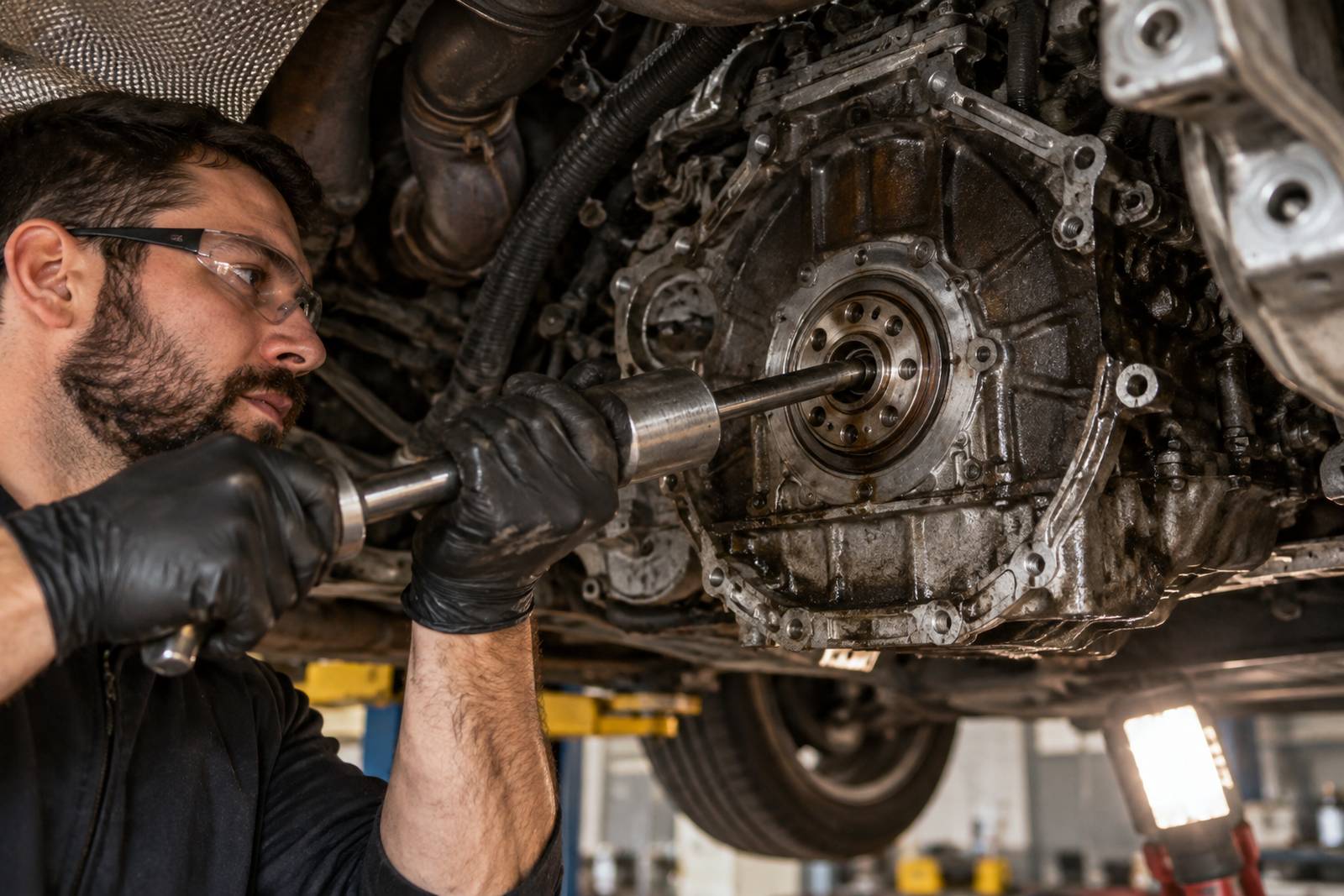
What is a pilot bearing?
The pilot bearing supports the tip of a manual transmission's input shaft. Depending on the engine, it may sit in the crankshaft or in the flywheel. Check the service manual before removing the flywheel just for access. A bronze bushing has no rolling elements; a needle bearing has small rollers inside a thin shell, while a ball bearing has separate inner and outer rings.
That construction changes the pulling point. Do not assume a hook behind the inner ring will remove every bearing intact. Look into the bore with a light and check the extractor instructions for the part you actually have.
How to remove a pilot bearing: measure before pulling
Wipe away grease and measure the bearing's inside diameter with calipers. Then check the depth to the intended gripping edge and the room behind it. Diameter alone isn't enough. An extractor can fit through the opening yet run out of reach before its lip engages.
For example, the KUKKO 224-1 internal extractor with slide hammer has a 12 to 35 mm range, about 0.47 to 1.38 in, and 38 mm reach, about 1.50 in. The KUKKO series 21 includes the 21-1, with a 12 to 16 mm range, about 0.47 to 0.63 in, and 25 mm reach, about 0.98 in. Neither range guarantees a fit on a particular engine.
If the bearing sits against the back wall, check the KUKKO 21-E segment extractors, intended for flush-mounted bearings and outer rings. Match the individual model's reach and gripping geometry. Browse Pilot Bearing & Blind Hole Pullers once you have those measurements.
Six steps for removal with a slide hammer
These steps explain how to remove a pilot bearing after safe access is established. They do not replace the vehicle's transmission-removal instructions. Support the vehicle on rated stands or a suitable lift, and support the transmission separately during removal.
- Expose and inspect the bearing. Remove the transmission and clutch components as directed by the service manual. Check for a retaining feature before applying force. Keep the clutch disc away from grease and loose debris.
- Clean the opening. Remove enough grease to see the bearing and its back edge. Note any existing damage to the crankshaft bore so you can distinguish it from fresh scoring afterward.
- Seat the extractor. Insert it closed, then expand it as its instructions specify. Confirm that the gripping edge engages the bearing or bushing, not the surrounding housing. A light hand pull should not dislodge it.
- Connect the hammer. Use the specified adapter and thread engagement. Choose compatible slide hammers by the extractor manufacturer's guidance, not simply the heaviest one available. Check clearance for the full working stroke.
- Pull along the bore axis. Wear eye protection and use a suitable puller guard to contain fragments without obstructing the sliding weight. Keep fingers clear of the stops. Start with controlled strokes; stop to inspect if the extractor slips or the bearing tilts.
- Inspect the empty bore. Recover loose needles, shell pieces and grease. Check for scoring before installing the replacement. Follow the specified installation depth, orientation and lubrication instructions rather than copying the old bearing's position blindly.
How to remove a pilot bearing without a puller
If your search was “how to remove pilot bearing without tool,” the grease method still requires a suitable driver. It is not tool-free. It relies on grease trapped behind the bearing and a close-fitting, solid drift that acts as a piston. A loose drift lets grease escape instead of building useful pressure.
Where the assembly allows this method, pack grease behind the bearing and into its opening, then insert the drift and tap it with a hammer. Refill as the bearing moves. Use a driver intended to be struck, not a brittle alignment tool or an improvised hardened shaft. Wear eye protection and keep expelled grease away from the clutch.
Stop if grease simply leaks through the bearing or the part doesn't move. A broken needle bearing with an empty shell may no longer trap grease. Harder blows won't fix that leak. Clean up and use an extractor that can engage the remaining shell.
When the bearing breaks apart or the puller slips
Knowing how to remove a pilot bearing also means knowing when to stop and reset. Slipping jaws may indicate the wrong gripping point, insufficient reach or damaged bearing material. Release the load and inspect. Spreading harder can deform a thin shell without improving the grip.
If only an outer ring remains, look at bearing race pullers and confirm that the selected tool can engage that ring. Do not chisel against the crankshaft bore. For the same access problem in other housings, see how to remove a bearing from a blind hole.
Before the clutch goes back in
Inspect the cleaned bore for visible damage and confirm the replacement part against the vehicle application. Drive a housing-mounted ball bearing by its outer ring, not through its inner ring and rolling elements. A bushing needs a driver suited to its face. Use the vehicle procedure for the final depth and any lubrication; adding grease by habit can contaminate nearby clutch surfaces.
Frequently asked questions
How do I remove a pilot bearing from the crankshaft?
Expose the bearing according to the vehicle service procedure, measure its opening and select an internal extractor with enough reach. Seat its gripping edge on the bearing, connect a compatible slide hammer and pull along the crankshaft axis. Stop if it slips, tilts or breaks apart. Inspect and clean the bore before installing the replacement.
Do I need to remove the flywheel first?
Not in every application. Some pilot bearings are accessible through the flywheel's center opening after the clutch is removed; others are mounted in the flywheel or require a different access sequence. Check the vehicle service manual before taking off additional parts. You also need clearance to insert the extractor and operate its slide hammer straight.
Can I remove a pilot bearing with grease?
Sometimes, if grease can be trapped behind the bearing and a close-fitting solid drift can pressurize it. Leakage through the bearing or around the drift defeats the method. Use a driver intended for hammer blows and wear eye protection. If the grease escapes without moving the bearing, stop and switch to a suitable extractor.
What size extractor should I use?
Measure the inside diameter, required reach and space behind the bearing. Compare all three with the individual extractor's specifications. A diameter range alone does not establish fit, and a larger hammer cannot make an undersized gripping edge engage properly. For separate extractors and hammers, also verify the specified connection and any required adapter.
What if the needle bearing comes apart?
Stop pulling and remove loose needles before continuing. Inspect the remaining outer shell and identify a tool that can engage it without biting into the crankshaft bore. A flush-mounted extractor or suitable race puller may be needed, depending on the available edge. Do not assume the grease method will work once the shell is empty.