
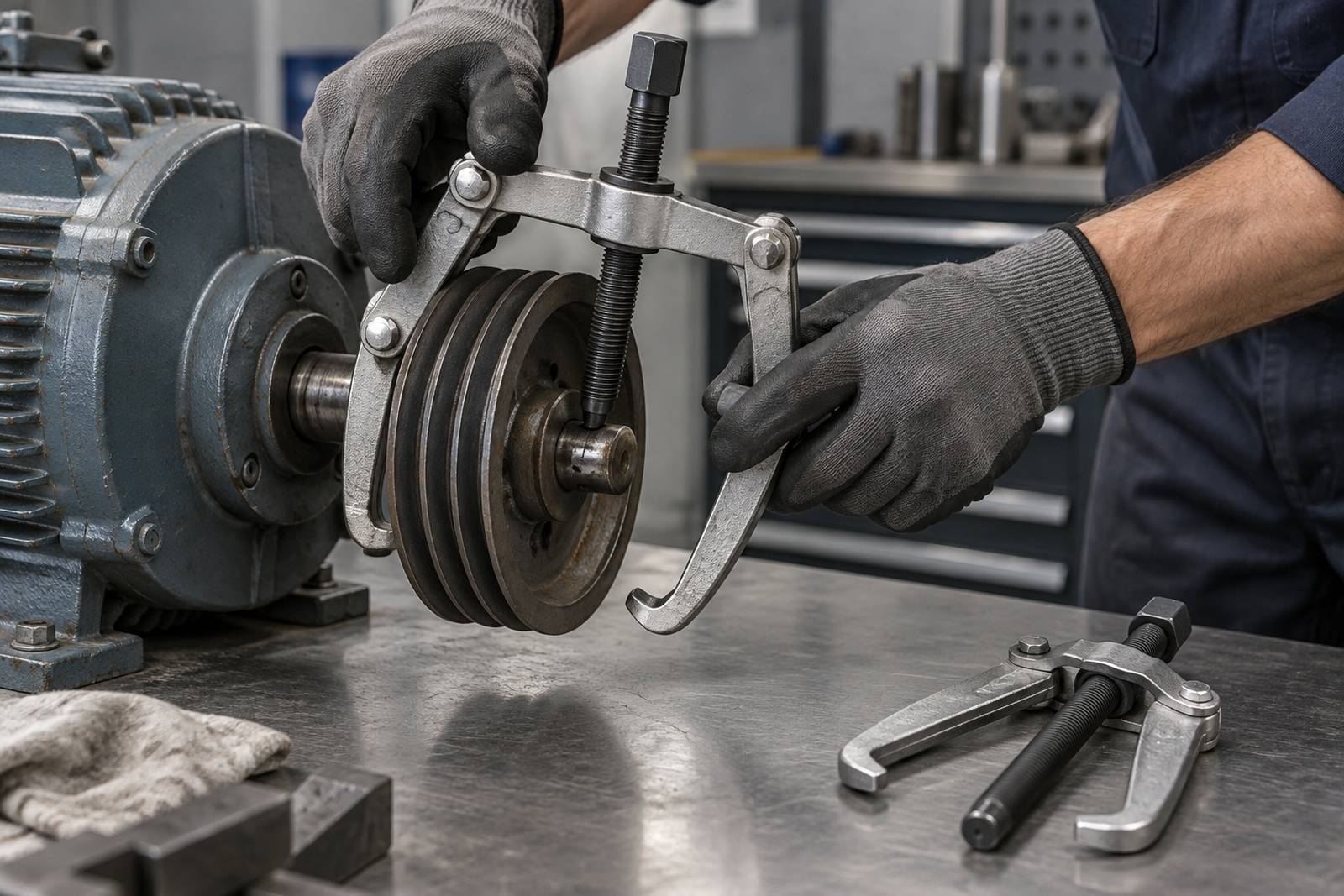
2 jaw vs 3 jaw puller at a glance
| 2 jaw puller | 3 jaw puller | |
|---|---|---|
| Grip on round parts | Two contact points, 180 degrees apart | Three contact points, 120 degrees apart |
| Self-centering | Needs care to stay square | Centers itself on the part |
| Fit in tight spaces | Better, slimmer profile | Needs clearance on three sides |
| Slip risk under load | Higher on a tight press fit | Lower |
| Typical jobs | Gears near a housing, slotted fans, flat parts | Bearings, pulleys, flanges, hubs |
Why a 3 jaw puller holds better
Think about where the force goes. Two jaws sit on opposite sides of the part, so if one jaw catches a bit lower or the part has a burr, the whole puller can rock on that axis. As the spindle loads up, the rocking turns into a jaw walking off the edge. That's how knuckles get skinned and parts get flung.
With three jaws 120 degrees apart, there's no easy axis to tip around. The jaws pull the crossbar square to the shaft, the spindle stays centered and the load is shared around the part instead of hitting two spots. KUKKO's own description of its 3 jaw VARIO puller (series 130) makes the same point: even load distribution and a particularly secure hold.
That matters most on a tight press fit. A 3 jaw bearing puller spreads the pull around the inner or outer race, so you are less likely to cock the bearing on the shaft and gall it. The same goes for a 3 jaw pulley puller on a cast pulley: three gentle contact points are kinder to a thin rim than two.
When a 2 jaw puller is the right call
A 3 jaw puller is no help if you can't get the third jaw in. Common cases:
- Gears next to a housing or another gear. A 2 jaw gear puller can slide in from two sides where a third jaw would hit metal. Narrow jaws, like on KUKKO's 20-S series, are made for exactly these cramped spots.
- Parts with two slots or windows. Some fan wheels and hubs have just two openings to reach through. KUKKO's 201-S tab puller grips through two slots.
- Flat, oval or irregular parts. A lever arm, a flat cam or a narrow bracket only offers two sides to pull on.
- Quick, light pulls. A small 2 jaw bearing puller is fast to set on a loose bearing or a small gear on a motor shaft.
A 2 jaw gear puller can pull plenty of force. The KUKKO 20 Classic 2 jaw line covers spreads from 0 to 750 mm and tension forces of 2.5 to 15 t across the series. The difference isn't strength. It's how stable the setup stays as the load builds.
Combination pullers: both in one tool
If you only want to buy one, look at a combination puller. Its crossbar takes either two or three jaws. KUKKO's 2/3 jaw combination puller (series 114) has self-centering, spring-loaded jaws, and the jaws reverse for internal pulls. The series 203 puller with reversible jaws also switches between two and three jaws on the same crossbar, with swiveling jaws that flip to change reach.
The catch: changing the setup takes a minute, and a dedicated 3 jaw puller is usually stiffer for its size. In a busy shop, keeping a dedicated 3 jaw puller and a narrow 2 jaw puller side by side makes for a faster setup.
How to choose: 4 checks before you buy
- Measure the spread. Spread is the widest part the jaws can open around. Measure the outside diameter of the bearing, gear or pulley and pick a puller with some margin. Don't run a puller at its absolute maximum spread, where the jaws sit at their steepest angle. KUKKO lists spread in mm; 100 mm is about 3.9 in, 200 mm about 7.9 in.
- Measure the reach. Reach is how deep the jaws can grab behind the part, measured from the crossbar to the jaw tips. Measure from the shaft end to the back face of the part. A pulley set deep on a long shaft needs long jaws or an extended-reach model.
- Check clearance on all sides. Look for room for three jaws. If something blocks one side, go with two jaws or a narrow-jaw model.
- Think about force. For a seized wheel hub or a big bearing, a mechanical spindle may not be enough. Our hydraulic pullers add a hydraulic ram so you aren't leaning on a breaker bar.
Pulling safely with either type
- Wear eye protection. A part that lets go under load, or a cracked jaw, can fly.
- Keep the spindle centered on the shaft. Use the center point and check that the crossbar stays square as you tighten.
- Set the jaws behind a solid face, on the inner race of a bearing if you can, not on a thin pulley web or a plastic part.
- Cover the puller and the part with a heavy cloth or a guard when pulling something that's really stuck.
- If the spindle gets hard to turn and nothing moves, stop. Add penetrating oil, give it time, then move up to a heavier or hydraulic puller instead of a longer cheater bar.
On a 3 jaw gear puller, snug all three jaws by hand before you put a wrench on the spindle. KUKKO's Alligator 3 jaw puller (series 12) does this for you. Its jaws open and close only with the tensioning key, which clamps them centered on the part so they can't drift.
Where to start
Browse every jaw puller we carry, from small 2 jaw models to heavy 3 jaw universal pullers. For bearings tight against a shoulder where no jaw fits behind, read bearing separator vs bearing puller. For bearings in a bore, see how to remove a bearing from a blind hole. Our guide on how to choose a bearing puller walks through the whole lineup, and the KUKKO brand page has the background on the maker.
Our rule of thumb: buy the 3 jaw puller first, because it handles most bearing and pulley jobs better. Add a narrow 2 jaw puller the first time a gear sits too close to a housing for three jaws.
Frequently asked questions
Is a 2 jaw or 3 jaw puller better?
For most round parts, a 3 jaw puller is better. The three jaws center the puller, share the load around the part and are less likely to slip. A 2 jaw puller wins when space is tight, when the part has only two slots to reach through, or when the part is flat or oval and three jaws can't grip it.
Can a 3 jaw puller be used as a 2 jaw puller?
Only if it has a combination crossbar. Pullers like KUKKO series 114 and 203 accept either two or three jaws on the same crossbar, so you can remove one jaw for tight spots. On a dedicated 3 jaw puller with a fixed yoke, don't just leave one jaw off. The load will be uneven and the puller can tip.
What do spread and reach mean on a jaw puller?
Spread is the largest diameter the jaws can open around. Reach is how far the jaws can grab behind the part, measured from the crossbar to the jaw tips. Measure the part's outside diameter and the distance from the shaft end to the back of the part, then pick a puller with some margin on both.
Why does my 2 jaw puller keep slipping off?
Usually the puller is not square to the shaft, so one jaw carries more load and walks off. Set both jaws at the same depth, center the spindle tip on the shaft and tighten slowly while watching the crossbar. Narrow or flat parts slip more easily. If you have room, a 3 jaw puller holds much better.
Should I use a jaw puller or a bearing separator?
Use a jaw puller when the jaws can hook behind the bearing or gear. If the part sits tight against a shoulder with no gap for the jaw tips, use a bearing separator. Its thin knife edges wedge in behind the part, and you pull on the separator instead of the part's edge.
Do I need a hydraulic puller instead of a 3 jaw puller?
Not for most jobs. A mechanical 3 jaw puller and a wrench handle typical bearings and pulleys. Step up to a hydraulic puller for large, rusted or heavily press fit parts like wheel hubs and big gears, where turning the spindle by hand takes more force than is safe.