
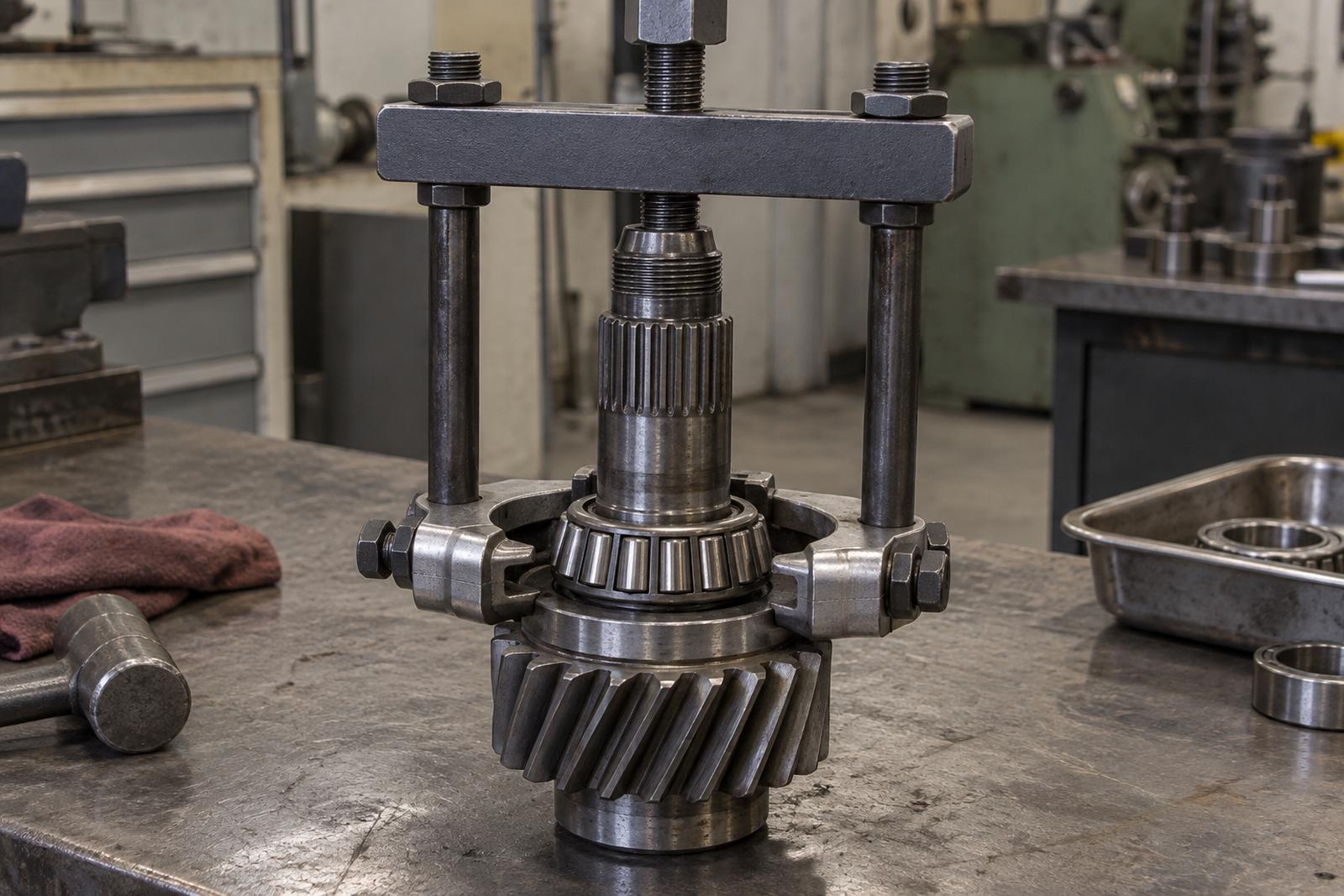
What a bearing puller does
A jaw-type bearing puller has a center spindle and two or three hooked jaws. You hook the jaws behind the part, center the spindle on the shaft end and turn it. The spindle pushes on the shaft while the jaws pull the part off. It sets up in seconds and works on anything with an edge you can catch: bearings with clearance behind them, pulleys, gears and bushings.
The limit is that the jaw tips need room. A KUKKO 2-jaw rolling bearing puller has slim, straight jaws for that reason, but even the smallest jaw needs a few millimeters of clearance behind the bearing.
What a bearing separator does
A bearing separator, often called a bearing splitter tool, is two steel halves with beveled knife edges. You slide them together behind the bearing and draw them closed with two bolts. As they tighten, the edges wedge into the gap between the bearing and the shoulder and push the bearing a little way off its seat. Now there is a solid plate behind the bearing, and you have something to pull on.
A separator does not pull by itself. You screw a puller frame to it, with two threaded rods and a crossbar with a center spindle, or you set the separator on the bed of a hydraulic shop press and push the shaft out.
Side by side
| Jaw puller | Bearing separator | |
|---|---|---|
| Needs a gap behind the part | Yes | No, it makes its own |
| Grips | Outer edge, at 2 or 3 points | All the way around, close to the inner ring |
| Setup time | Fast | Slower, two bolts plus a frame |
| Works with a shop press | No | Yes |
| Best for | Exposed bearings, pulleys, gears | Bearings flush on a shoulder, gears on shafts, thin flat parts |
Why the separator is easier on the bearing
Jaws hooked on the outer ring of a shaft-mounted bearing pull through the balls. The separator bears on the face of the bearing right next to the bore, close to the inner ring that holds the press fit, so less force goes through the rolling elements. KUKKO goes a step further with its TRI-PULL three-segment separator (series 13), which seats three segments behind the inner ring of spherical and tapered roller bearings. The 13-1 covers 12 to 50 mm and the 13-3 covers 50 to 160 mm.
How to use a bearing separator
- Pick the size. The separator's range has to cover the shaft at the small end and the bearing's outside diameter at the big end. KUKKO's series 15 bearing separators run from the 15-00 at 6 to 40 mm up to the 15-6 at 75 to 330 mm (about 13 in).
- Clean the gap. Wire brush rust and grime from the shoulder so the knife edges seat square.
- Close it evenly. Turn the two bolts a little at a time, side to side. Uneven tightening cocks the bearing and can score the shaft.
- Attach the frame. Screw the rods of a puller such as the KUKKO series 18 separator puller into the separator, and keep the crossbar parallel to it.
- Center and pull. Put the spindle tip on the shaft center, protect the shaft end, and turn slowly. For big or rusted parts, a hydraulic spindle makes this far easier.
Wear eye protection the whole time, and lay a heavy cover over the setup once it is under real load. If a separator slips under load, it lets go with a lot of force.
Faster setups and hydraulic options
If turning two bolts feels slow, KUKKO's bearing separator with quick-clamping spindle (series 17) closes both jaws concentrically with a single pressure spindle. For heavy work, the Y-15 hydraulic bearing separators run up to 80 to 420 mm, and the 18-B hydraulic puller pairs with separators. More choices are in hydraulic pullers.
A hybrid: the jaw-style separator
The KUKKO Cobra 2-jaw bearing separators (series 210) have jaws that turn 180 degrees: standard claws on one side and separator claws on the other. A side clamp squeezes the claws under the part. If most of your work falls in between, it is a good single tool.
So which do you buy?
If you mostly pull pulleys, gears and bearings with room behind them, start with jaws and our guide on how to choose a bearing puller. If you rebuild gearboxes, transmissions or motors where bearings sit hard against shoulders, you need a bearing separator tool. Most shops end up owning both. See the full range in bearing pullers and separators, or look at puller sets if you want several sizes at once.
Frequently asked questions
Is a bearing splitter the same as a bearing separator?
Yes. Bearing splitter and bearing separator are two names for the same tool: a pair of steel halves with knife edges that bolt together behind a bearing or gear. Some catalogs also call it a separating device. It needs a puller frame or a shop press to finish the job.
Can I use a bearing separator in a hydraulic press?
Yes, and many shops do. Clamp the separator behind the bearing, rest the separator on the press bed or on parallel blocks, and press the shaft down and out. Catch the shaft so it can't fall, keep the setup square, and wear eye protection.
Will a bearing separator damage the bearing?
It is usually gentler than jaws on the outer ring, because it bears near the inner ring that holds the press fit. The knife edges can mark the face of the bearing or the shoulder, though, so expect some marks. Close the halves evenly to avoid cocking the bearing on the shaft.
What size bearing separator do I need?
The separator's range must close down around the shaft and open past the bearing's outside diameter. Measure both. KUKKO's series 15 ranges run from 6 to 40 mm for small motor work up to 75 to 330 mm for large gears and industrial bearings.
Do I need a puller with a bearing separator?
Yes, unless you are using a press. The separator only grips the part. A puller frame with two rods and a center spindle screws into it and does the pulling. KUKKO pairs its series 15 and 17 separators with the series 18 separator puller.