
Open End Wrenches
An open end wrench slides onto a nut from the side, which is why it still beats a socket on line fittings, jam nuts and anything with tubing or a rod in the way. At BRAIGG, we stock five Wright Tool families here. There are full polish double head wrenches in SAE and metric, larger satin double heads, a 15 and 60 degree double angle wrench, and a single head 30 degree service wrench. Sizes run from 3/16" x 1/4" all the way up to 2-1/4" and 52mm.
Where an open end wrench beats everything else
The open jaw is the whole point. You can get onto a fastener that has no clear path from above: a nut on a threaded rod, a hydraulic fitting with hose on both sides, a locknut on a tie rod sleeve. It also works fast. Once a nut is loose, you can flip the wrench over and keep turning without lifting it straight off the stud.
The weak spot is grip. An open end wrench bears on two flats near the corners, so heavy force can spread the jaws or round the nut. A good habit is to break a tight fastener loose with a box end wrench or a 6 point socket and save the open end for running it down. On soft brass or aluminum line fittings, use a flare nut wrench instead. It slips over the line like an open end but grips like a box.
Double head open end wrenches in SAE and metric
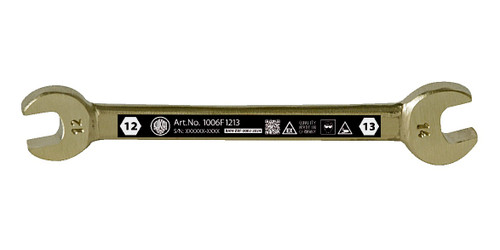
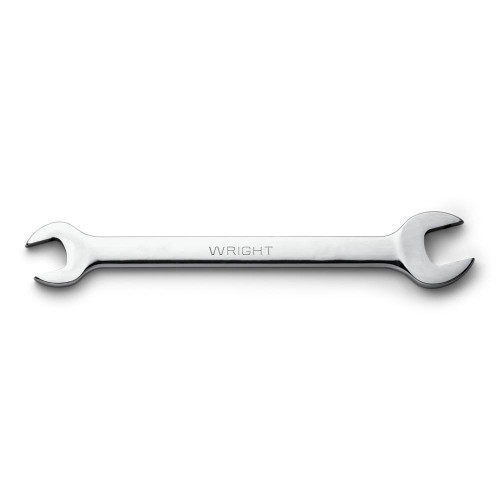
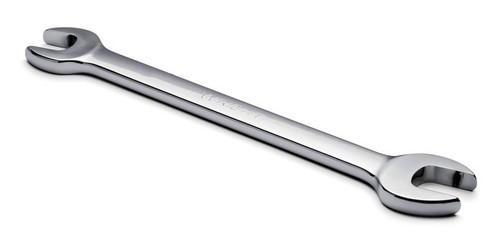
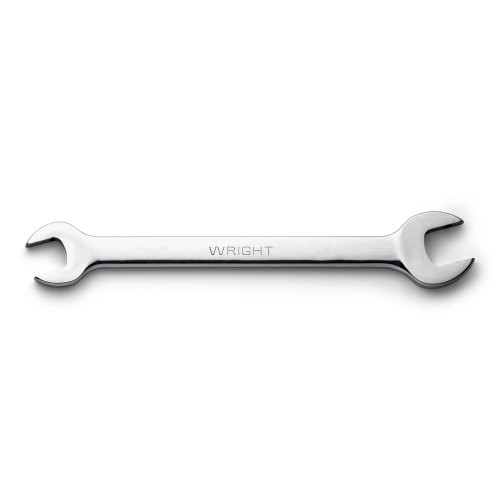
The classic double head has a different size on each end, with the heads angled 15 degrees off the handle. Wright's full polish SAE family covers 19 size pairs from 3/16" x 1/4" to 1-1/16" x 1-1/4". Some sizes appear twice, such as 5/8" x 11/16" and 5/8" x 3/4", so you can pick the pair that matches the nut and bolt on your job. The full polish metric family adds 11 pairs from 6mm x 7mm through 24mm x 26mm. For bigger fasteners, the satin double head line continues with 1-1/4" x 1-5/16", 1-3/8" x 1-7/16" and 1-1/2" x 1-5/8".
On an open end wrench, full polish wipes clean easily, which helps when you're handling oily parts all day. Satin has a duller finish that some people find easier to hold onto.
15 and 60 degree double angle wrenches
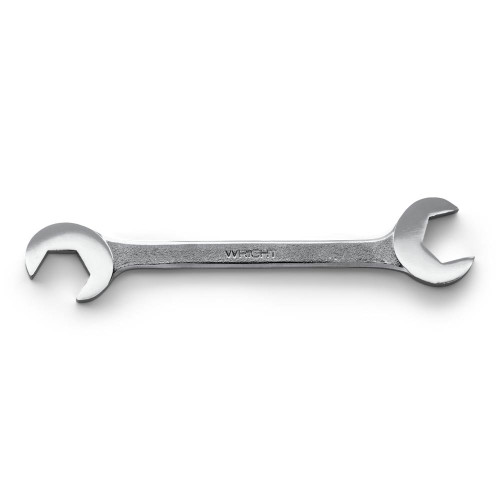
This style puts the same size on both ends. One head sits at 15 degrees to the handle and the other at 60 degrees. In a cramped spot where you can only swing the handle a short distance, switching between the two ends lets you keep turning the nut. Wright offers it in 25 sizes from 11/32" to 2". That includes in-between sizes like 1-3/16" and 1-11/16" that most mechanics' sets skip. It's a good open end wrench to own for pump packing glands, valve stems and equipment frames where clearance is always tight.
30 degree service wrenches for big nuts
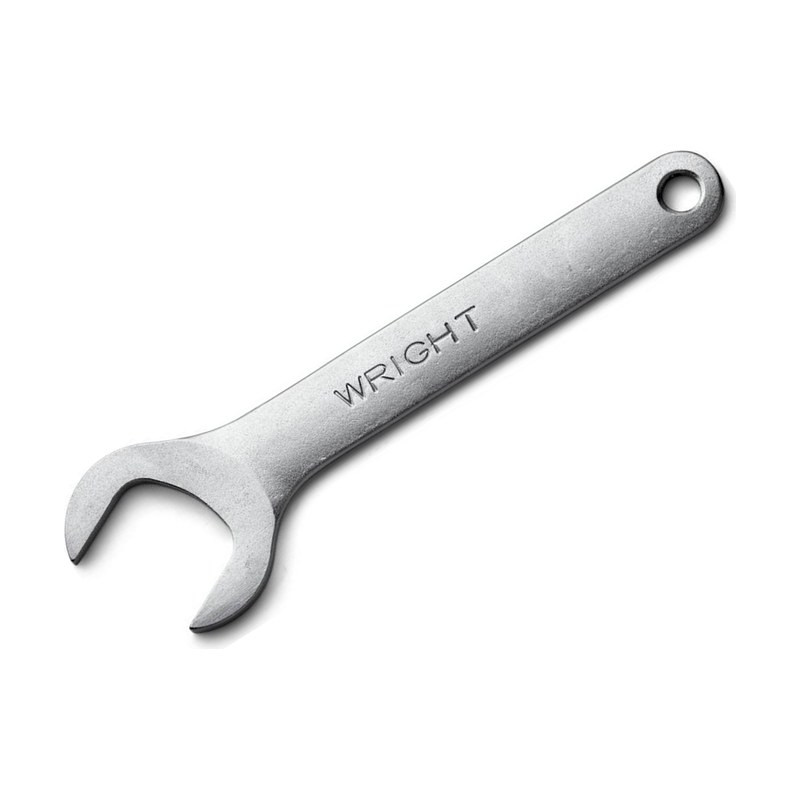
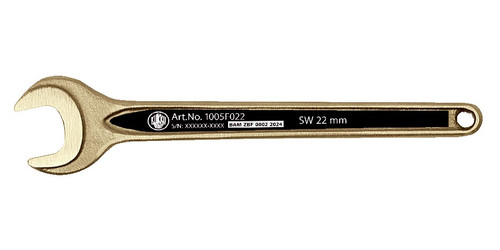
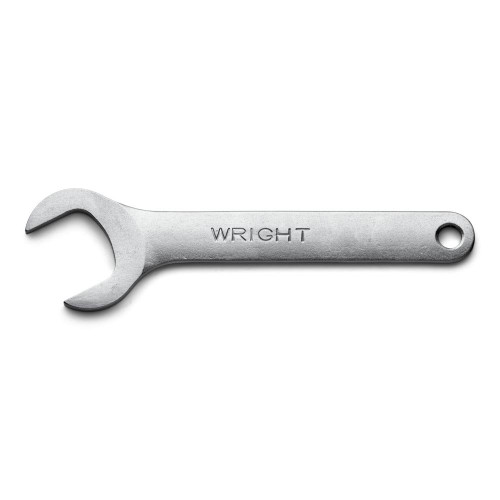
The Wright service wrench has a single head set at 30 degrees, and its length is built for leverage on large fasteners. The SAE run goes from 3/4" to 2-1/4", and the metric run goes from 19mm to 52mm. You'll see these on heavy equipment, ag machinery and plant maintenance work, anywhere a nut is too big for a normal toolbox wrench. If you're working steel framing, look at our structural wrenches too. For nuts that need a hammer, see striking and slugging wrenches.
How to pick the right size and keep it from slipping
Fit matters more with open end wrenches than with any other style. If the jaw is a hair loose, the force goes into the corners instead of the flats. Don't swap SAE and metric unless the sizes are a true match. Our SAE to metric chart shows which ones are close enough. Push the jaws all the way onto the nut and keep a steady pull instead of jerking. If the open end wrench starts to cock on the nut, stop and reseat it before the corners round. If you're comparing styles, our guide to the types of wrenches covers the options.
Want a matched run of sizes in one purchase? The double head and double angle families also come as kits in our wrench sets.
Frequently asked questions
What is an open end wrench used for?
It turns hex nuts and bolts from the side, so it works where a socket or box end can't reach over the top. Common jobs include line fittings, jam nuts on threaded rod, tie rod adjusters and fasteners with a hose or cable in the way. It is also quick for running a loosened nut on or off.
Why is the head of an open end wrench angled?
The angle lets you flip the wrench over between swings. Turn the wrench over and the jaw lands on a new pair of flats, so you can keep turning a nut in a tight spot with a short arc. Standard double head wrenches use a 15 degree angle, and double angle wrenches add a 60 degree head on the other end.
Should I use an open end or box end wrench on a tight bolt?
Use the box end or a 6 point socket to break a tight or rusted fastener loose. An open end wrench grips only two flats, so heavy force can spread the jaws and round the corners. Once the nut is free, switch to the open end to spin it off quickly.
What is a service wrench?
It is a single head open end wrench with the jaw set at 30 degrees, made for large nuts that need more leverage than a standard double head. Wright's 30 degree service wrench comes in SAE sizes from 3/4 inch to 2-1/4 inch and metric sizes from 19mm to 52mm.
Do you carry metric open end wrenches?
Yes. The Wright full polish metric double head comes in 11 pairs from 6mm x 7mm to 24mm x 26mm. For large metric nuts, the 30 degree service wrench runs from 19mm to 52mm. Matched metric kits are listed with our wrench sets.