
How KUKKO part numbers relate to a series
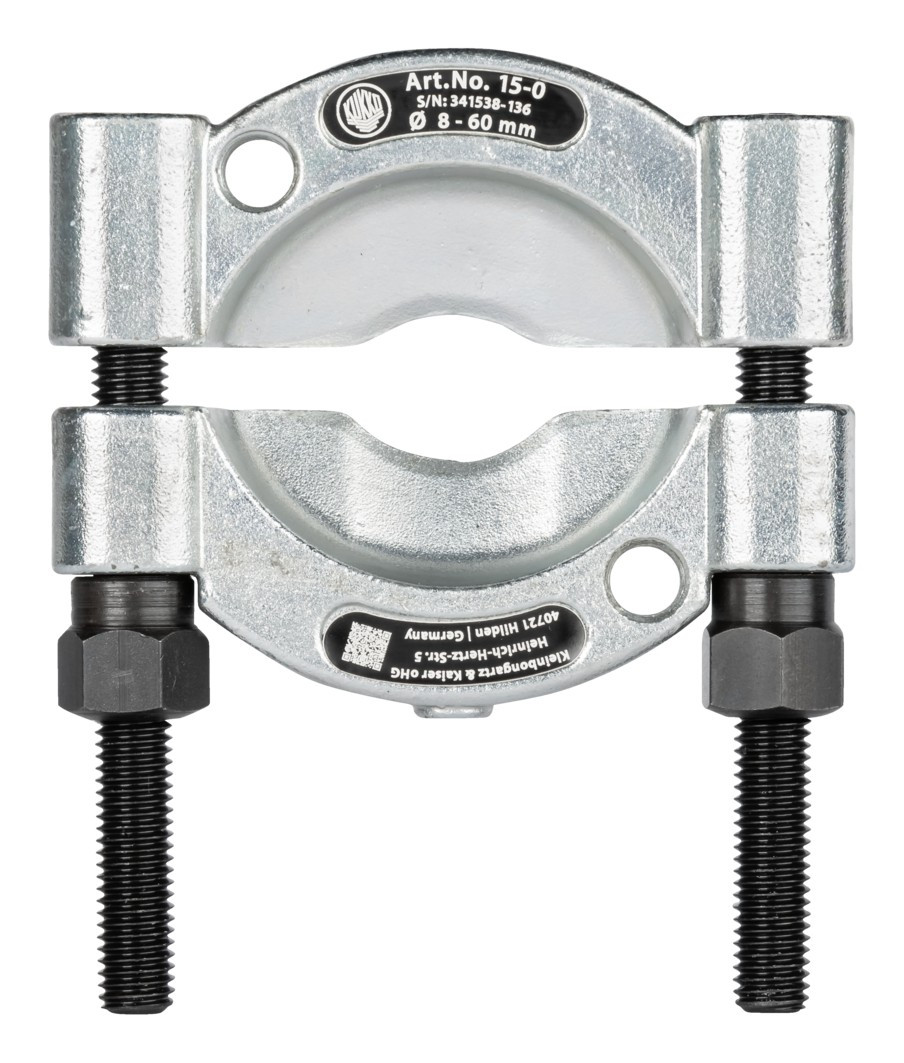
Think of the series as a shelf label and the item as the specific tool on that shelf. Series 15 contains bearing separators, with listed items including 15-0, 15-00, 15-1 and others. Series 18 contains separator pulling devices. A separator and the device that pulls on it are different parts of a setup, even when both appear in the same job.
Do not treat the last digit as a measurement. The series index identifies families and items, but it does not establish a universal formula translating a suffix into spread, reach or capacity. Use the individual specification to answer those questions. Our puller size guide explains which job measurements to take before selecting an option.
A working index of KUKKO part numbers
The table links to tool families and gives examples of their item numbers. It is a starting index, not a complete list of every size. Follow the relevant family link, then check the complete item number against the description and available size information.
| Series | Tool family | Example item numbers |
|---|---|---|
| 15 | Bearing separators | 15-0, 15-00 |
| 18 | Separator pulling devices | 18-0, 18-4 |
| 20+ | Quick-adjustable two-jaw universal pullers | 20-1+, 20-10+2 |
| 21 | KUKKO 21 internal extractors | 21-0, 21-00, 21-01 |
| 22 | KUKKO 22 counter supports for internal extractors | 22-1, 22-2 |
| 23 | Deep-groove ball bearing inner ring extractor chuck | 23 |
| 54 | Double-edged mechanical nut splitters | 54-2, 54-3 |
| 70 | KUKKO 70 PULLPO ball bearing pullers | 70-1, 70-2 |
| 800 | KUKKO 800 short hydraulic spindles | 800, 801, 802, 804 |
| K-22 | Ball bearing puller sets with counterstay and sliding hammer | K-22-A, K-22-B |
| K-15 | Bearing separator sets | 15-A, 15-B |
| K-Y-165 | Y-165 hydraulic spreaders | K-Y-165-15-10-P |
Keep every zero, plus sign and suffix
Write KUKKO part numbers exactly as they appear in the catalog or on the tool. In series 21, the entries 21-0, 21-00 and 21-01 are distinct. In series 20+, examples include 20-1+ and 20-10+2. Removing a zero or dropping the characters after the plus sign loses identifying information.
The series and item do not always share an identical beginning. The short hydraulic spindle family is series 800, but its listed items include 801, 802 and 804 as well as 800. Similarly, the K-15 separator set family includes item numbers such as 15-A and 15-B. Searching only the family label may not identify the particular tool in your hand.
What K- and Y- can tell you, and what they cannot
Several K- families in this index are sets. For example, K-22 contains ball bearing puller sets, with K-22-A and K-22-B among the listed items. That is a useful pattern to recognize, not a universal definition. K-A-KT identifies small parts cases, and K-L-Boxx-VS identifies replacement locks. A K- prefix alone does not prove that an item contains a complete pulling setup.
The index also includes the K-Y-165 family, named Y-165 hydraulic spreaders, with item K-Y-165-15-10-P. Here the Y- designation appears on hydraulic equipment. It is not enough evidence to decode every Y-marked item, infer pressure ratings or decide which pump or hose fits. Read the named product and its specifications instead.
Find the exact part on BRAIGG
- Copy the full item number. Include letters, zeros, hyphens, slashes and plus signs. If a marking is worn, note the uncertain character rather than silently dropping it.
- Search by that item number. Use the manufacturer identifier rather than only a phrase such as bearing puller. Check the tool name as well as the number when reviewing a result.
- Open the family page and verify the option. Match the item to its size information and description. A family page can cover multiple catalog items, so its title alone is not a size confirmation.
- Check the intended assembly. For a spare jaw, spindle or support, confirm listed compatibility with the original tool before applying load. Similar appearance is not a fitment specification.
When you know the job but not the number
Start with Pullers & Extractors to identify the operating method. The KUKKO puller selection guide separates external jaws, internal extraction and hydraulic options. For closely fitted bearings, see KUKKO separators and nut splitters to distinguish separating from pulling or splitting.
KUKKO part numbers are the final identification check, not a substitute for measuring the job. Once you have found the likely family, return to the selected item's dimensions and instructions. The KUKKO brand hub connects the wider range if the worn tool is a clamp, plier or another tool rather than a puller.
Frequently asked questions
How do I read KUKKO part numbers?
Start by separating the series from the individual item. The series identifies a family, such as series 15 bearing separators. The full item number, such as 15-0 or 15-00, identifies a catalog entry. Keep every character and use the item's specifications rather than assuming the suffix directly states a dimension.
Are KUKKO series numbers the same as item numbers?
Sometimes they match, but you cannot assume they always do. Series 23 has a listed item 23, while series 800 includes items 800, 801, 802 and 804. Use the family label to find the general product, then verify the full item number for the particular entry you need.
Does K- always mean a KUKKO puller set?
No. K-22 is a ball bearing puller set family, but the index also uses K- in small parts case and replacement lock families. Some set families have item numbers without K-, such as 15-A in series K-15. Check the product name and listed contents instead of relying on the prefix alone.
Can I leave out the plus sign or extra zeros when searching?
Keep them. The index lists separate entries such as 21-0, 21-00 and 21-01, and it includes identifiers such as 20-10+2. Shortening the number removes information that distinguishes catalog items. Copy the complete identifier first, then check the family description and the selected option's specifications.
How do I find a replacement KUKKO jaw or spindle?
Record the original tool's full item number and any separate identifier on the worn component. Search using that information, then confirm the replacement's listed compatibility with the tool. A matching series fragment or similar thread appearance is not enough to establish that a load-bearing replacement is suitable.
Does Y- identify every hydraulic KUKKO tool?
The index includes a Y-165 hydraulic spreader family under K-Y-165, but that observation is not a universal decoding rule. Series 800 contains short hydraulic spindles without a Y- prefix. Identify hydraulic equipment by its product description and specifications rather than using the letters alone to infer its operation or capacity.