
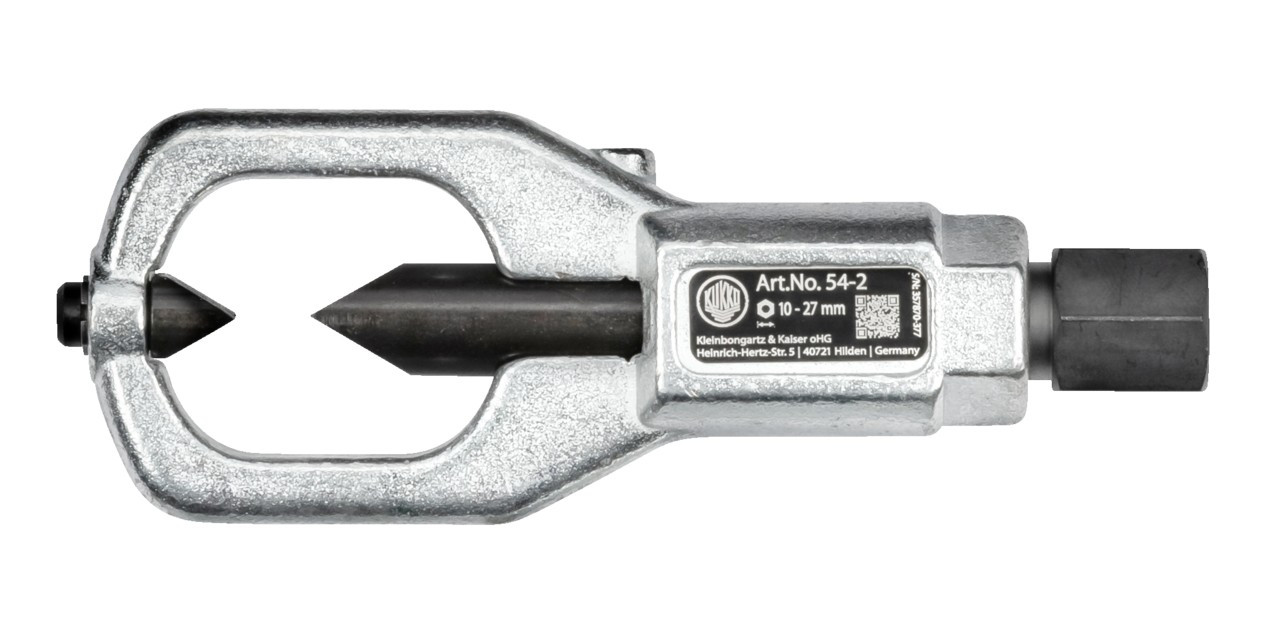
Choose a KUKKO nut splitter for the nut and the access
Measure across the nut's flats. That is not the same as the bolt's thread diameter. Then check room around the nut for the frame, blade and spindle. A range that covers the nut does not prove the tool will fit beside a bracket or inside a recess.
The series 55 single-blade mechanical splitter has five listed ranges: 4 to 10, 10 to 18, 19 to 27, 27 to 36 and 32 to 50 mm. Across its models, the family spans roughly 0.16 to 1.97 in. KUKKO describes this single-blade style for limited space around the nut. Choose the individual model, not the family's combined range.
The series 54 double-edged mechanical splitter is offered in 10 to 27 mm and 17 to 36 mm ranges, about 0.39 to 1.06 in and 0.67 to 1.42 in. Its two cutting edges work together to split the nut. Both series 54 and 55 list suitability for nut material with tensile strength up to 800 N/mm². This is a material limit, not a pulling-force rating.
Browse Nut Splitters for the available forms. A KUKKO nut splitter should not be treated as suitable for every nut material just because its opening fits. Verify the selected model's stated limits before loading the blade.
Mechanical or grease-hydraulic KUKKO nut splitter?
With the series 56 single-blade splitter, grease hydraulics replace the direct mechanical action of series 55. Its listed ranges are 7 to 24, 22 to 36 and 27 to 46 mm. The smallest model starts at about 0.28 in; the largest accepts up to about 1.81 in. KUKKO lists nut property classes 5, 6, 8 and 10 for this series. Do not transfer that list to another splitter.
For a KUKKO nut splitter setup, seat the frame squarely and align the blade according to the tool instructions. Wear eye protection and shield nearby people from fragments. Stop after the nut splits; extra spindle travel is not useful. Read how to use a nut splitter for the preparation and removal sequence. Inspect the exposed bolt threads afterward rather than assuming they survived undamaged.
A bearing separator grips behind a fitted part
Choose a KUKKO bearing separator to address limited clearance behind a fitted part. Its separating edges can get behind a closely seated bearing, inner ring or other fitted component where ordinary hooks do not have enough room. It is not a nut-cutting tool.
The series 15 bearing separator works with series 18 pullers. The series 17 version uses a quick-clamping spindle and also pairs with series 18. Select a matched size and connection; membership in those series alone does not make every size interchangeable.
Use the bearing separators category when there is a usable edge behind the part. Check the opening, connecting threads and pulling length. The separator vs bearing puller guide explains the difference between creating a grip behind the part and supplying the axial force to remove it.
Internal extractors and sliding hammers
If the component is inside a bore, change the gripping method. KUKKO series 21 internal extractors expand inside suitable bearings or rings and work with compatible counter supports or sliding hammers. Begin with the bore diameter and required engagement, not the outside diameter of the housing.
With a KUKKO slide hammer such as the series 22-0 sliding hammer, impacts supply the pulling action through a compatible series 21 extractor. KUKKO recommends this approach where a counter support has no suitable reaction surface or where that surface is too delicate. Check attachment compatibility and leave room for the hammer's stroke. Keep your fingers away from the sliding weight and its stops.
Find the grip in Pilot Bearing & Blind Hole Pullers and the pulling devices in Slide Hammers. Neither a larger hammer nor a tighter internal grip will fix a mismatched extractor diameter.
Screw and stud extractors turn the fastener
A broken threaded fastener calls for torque rather than a straight axial pull. KUKKO's series 49 fine-groove screw extractors are listed for broken bolts and screws with right-hand threads. Match the extractor to the specified fastener range and follow its preparation instructions. Do not assume the same extractor is intended for left-hand threads.
Where a stud remains exposed, the series 53 tight-space stud extractor uses internal teeth and a knurled wheel to grip it externally. Browse Screw & Stud Extractors or read how to use a screw extractor to choose the approach. For other fitted-part removal jobs, return to Pullers & Extractors. Check what the tool will grip before deciding how to apply force.
Frequently asked questions
How do I size a KUKKO nut splitter?
Measure the nut across its flats and choose an individual model whose stated range covers that dimension. Then check clearance for the frame, blade and spindle around the installed nut. The bolt thread diameter is not the splitter size, and an opening that fits does not establish material suitability.
What is the difference between series 54 and series 55?
Series 54 is a double-edged mechanical nut splitter, while series 55 uses a single blade. Their model ranges differ, so choose by the individual listing. KUKKO describes series 55 for confined space around the nut. Both families list a nut-material tensile-strength limit of 800 N/mm².
Does a bearing separator include everything needed to pull a bearing?
Not necessarily. Series 15 and series 17 separators are intended to work with compatible series 18 pullers. The separator grips behind the bearing; the pulling arrangement moves it off the shaft. Check the supplied parts, size and connection before ordering rather than assuming the separator alone is a complete kit.
When should I choose a KUKKO slide hammer?
A sliding hammer is an option when a compatible internal extractor can grip the component but a counter support lacks a suitable reaction surface. KUKKO describes series 22-0 for use with series 21 extractors in that situation. Check the matching connection, engagement and available stroke before attempting removal.
Is a screw extractor the same as a stud extractor?
No. The series 49 screw extractor is listed for removing broken screws and bolts with right-hand threads through a prepared hole. The series 53 stud extractor grips an exposed stud externally. Choose based on what remains accessible, then follow the selected tool's sizing and preparation instructions.