
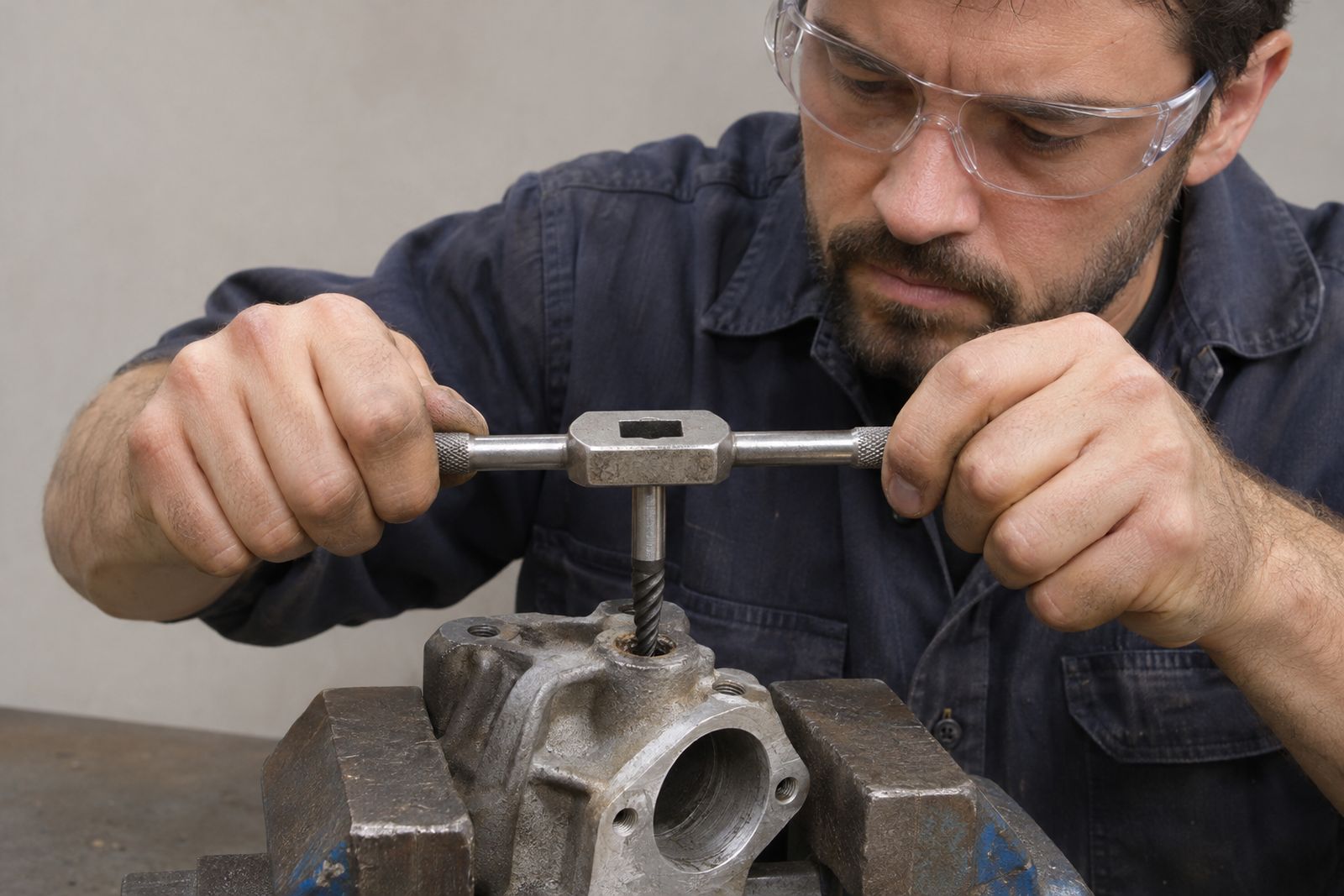
What is a screw extractor?
A tapered spiral extractor grips the inside of a prepared hole. As it turns in the loosening direction, its grooves engage the surrounding metal. It is different from an external stud tool, which clamps material still standing above the surface. Check those options in Screw & Stud Extractors.
KUKKO series 49 fine-groove and 49-0 wide-groove tools are intended for broken right-hand-thread fasteners. KUKKO identifies the wide-groove design for soft materials such as brass and aluminum. Do not assume that means every steel bolt in an aluminum casting calls for a wide-groove tool. The fastener material matters.
Try a left-hand drill bit first
If you are deciding how to remove a broken bolt with right-hand threads, consider a left-hand drill before engaging an extractor. Norseman says its left-hand spiral drills often loosen the broken fastener during drilling. Their counterclockwise cutting rotation is also the direction that backs out a conventional right-hand-thread bolt. If the bolt comes out at this stage, you do not need to engage an extractor.
For that attempt, prepare and center the break as described in the steps below. Fit a genuine left-hand cutting bit and set a reversible drill to counterclockwise rotation. Check the machine's instructions and confirm the chuck holds the bit securely in reverse. A standard right-hand bit does not become a left-hand cutting tool just because you reverse the motor.
Keep the drill on the bolt's axis, use cutting lubricant suited to the material and control depth. If the bolt remains fixed, stop at the pilot diameter and depth required for the selected extractor. Do not keep enlarging the hole in hopes of making the bolt turn.
Find individual sizes under left-hand drill bits or compare Norseman left-hand jobber drill sets. The Norseman BR-10 pairs left-hand drills with spiral extractors; the BR-10SQX pairs left-hand drills with square extractors. Both are 10-piece sets. Check the chosen tool's instructions before drilling: knowing how to use a screw extractor includes preparing the hole for that exact tool, even when the first attempt uses a left-hand bit.
How to use a screw extractor: numbered steps
1. Identify the damage and secure the work
Isolate the equipment so nothing can start or move. Clamp a loose part firmly, wear eye protection and protect open passages from chips. Inspect the break. A projecting stud may accept an external-grip tool, but if the break lies below the housing face with nothing sound to clamp, an external tool has no way to hold the fastener. Confirm that the thread is right-handed before using an extractor intended for that direction.
2. Check the extractor range and instructions
Choose by the original fastener's thread diameter, not the broken head's width. The KUKKO 49-0-S set covers 3 to 24 mm threads, approximately 1/8 to 15/16 in. That is a fastener range, not a drilling chart. Read the required pilot diameter, depth and engagement method for the exact tool before proceeding.
3. Prepare the break and mark the center
Remove loose rust and debris so you can see the fastener's outline. Apply penetrating fluid where it can reach corroded threads and allow time for it to work; it is not a guaranteed cure. Mark the center accurately with a center punch. If an angled fracture prevents a stable starting point, do not chase it sideways with the drill. Correct the starting surface or get machining help.
4. Drill the specified pilot hole
Keep the drill aligned with the bolt's axis. Use a depth stop when appropriate, account for the space behind the bolt and clear chips as you work. Stop to check that the hole remains centered. The surrounding threads are not a guide surface. If the hole wanders toward the housing, continuing can turn fastener removal into a thread repair.
5. Engage the extractor without side load
Clean loose chips from the pilot hole. Fit the chosen extractor and seat it according to its instructions, including any specified light tapping. Keep it square to the fastener. Do not hammer harder to make the wrong hole diameter work. Attach the recommended hand-turning tool with enough clearance to rotate without leaning against the housing.
6. Turn slowly and watch the fastener
Apply steady counterclockwise hand force for a right-hand-thread fastener. Keep the handle centered so you are turning the extractor rather than bending it. Watch for actual bolt movement, not just handle movement. If the tool twists, slips or feels springy while the fastener stays fixed, unload and reassess. Do not attach an impact wrench or add a long extension to force it.
7. Remove the fastener and inspect the hole
Once the fastener begins backing out, keep turning slowly and stop at sudden resistance. After removal, clear chips from the area and inspect the internal threads for damage. A new bolt should not be driven into debris left from drilling, particularly where an open passage behind the hole could carry those chips into the rest of the assembly. A visibly damaged thread needs assessment before the assembly returns to service.
How to use a screw extractor without guessing the pilot size
The most useful rule in how to use a screw extractor is also easy to miss: use its own drilling instructions. An M10 bolt has a nominal 10 mm thread diameter. Drilling a 10 mm hole is not the extraction procedure. The pilot hole must leave material for the extractor to grip without cutting into the housing threads.
No universal pilot size or depth is given here. KUKKO's supplied product tables identify fastener coverage and drive dimensions, but those figures do not establish a pilot-hole chart. If the exact tool's chart is missing, get the instructions before drilling. Guessing from a similar-looking extractor is not enough.
How to remove a stripped bolt without making it worse
Check what “stripped” means before choosing a tool. Rounded external flats may still allow an external gripping method, while a damaged internal recess may require a centered pilot hole. Neither situation is identical to a bolt broken below the surface. Understanding how to use a screw extractor includes recognizing when drilling is unnecessary.
If a seized nut is holding an otherwise usable stud, consider sacrificing the nut instead. Read how to use a nut splitter for that separate method. A chisel-style splitter is not an internal screw extractor.
How does a screw extractor work when the bolt is seized?
The extractor supplies grip, not a cure for corrosion or damaged threads. A tapered tool can engage firmly while the bolt still refuses to turn. Keep increasing torque and you may break the extractor first. Stop before that happens. A badly seized bolt, an off-center hole or a broken tool inside the hole may need specialist machining.
For a refresher on how to use a screw extractor, return to the numbered steps before the next attempt. Browse the wider pullers and extractors range when the job calls for a different removal method.
Frequently asked questions
How does a screw extractor work?
A tapered spiral extractor bites into a pilot hole drilled in the damaged fastener. Turning it counterclockwise grips and loosens a right-hand-thread bolt. It still needs a centered hole, the specified fit and a fastener that can move before the tool is overloaded. Grip alone does not overcome every seizure.
What is a screw extractor used for?
An internal screw extractor removes a damaged or broken fastener when there is no useful head or exposed end to grip. The tapered types discussed here enter a drilled pilot hole. An external stud tool works differently: it clamps a projecting end, so drilling may be unnecessary when enough sound material remains.
What pilot-hole size should I drill?
Use the diameter and depth specified for the exact extractor, not the nominal bolt diameter or the drive-square measurement. The supplied KUKKO facts do not provide a verified pilot-hole chart. If the chart is missing, obtain the instructions before drilling rather than copying a number from another tool.
Can I turn a screw extractor with an impact wrench?
Use the specified hand-turning tool rather than impact blows. Steady hand pressure lets you feel resistance and stop if the extractor begins twisting without moving the fastener. A hardened extractor broken in the pilot hole makes removal harder and may require machining that ordinary drilling cannot accomplish easily.
How do I remove a broken extractor from a stud?
Stop applying torque and assess the remaining access. A hardened extractor lodged in the pilot hole is a different problem from the original broken bolt. Ordinary drilling may not remove it effectively. Specialist machining may be necessary, especially when preserving the surrounding threads matters. Do not force another extractor into the obstruction.
Should I try a left-hand drill before a screw extractor?
For a broken right-hand-thread bolt, it is worth considering. Norseman says left-hand spiral drills often loosen a bolt during drilling, so an extractor may not be needed. Use a genuine left-hand bit in counterclockwise rotation, keep it centered and stop at the selected extractor's specified pilot size if the fastener does not move.