
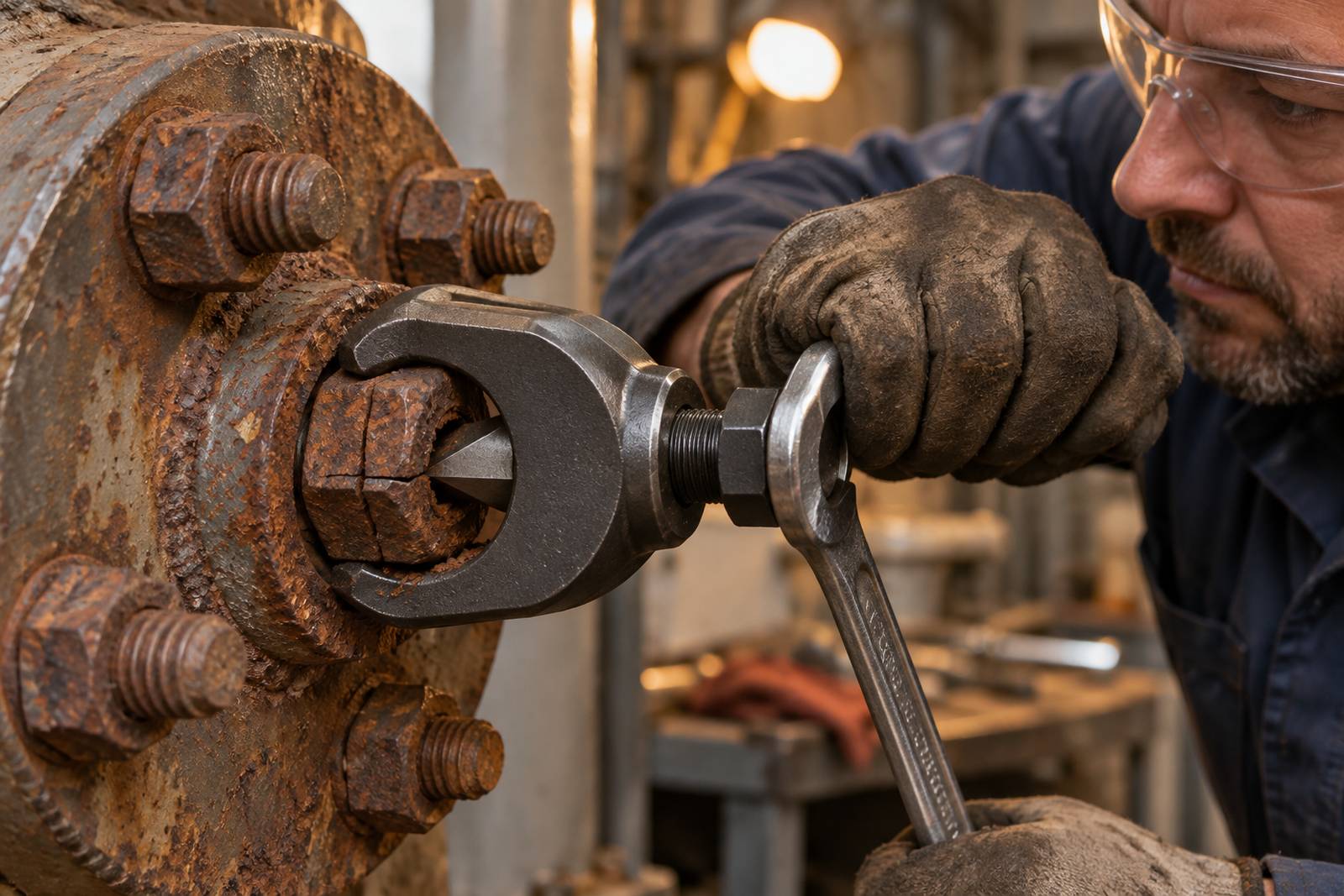
When to reach for a nut splitter
Use one when the nut is scrap anyway and the stud or bolt is worth saving. Typical cases are rusted exhaust manifold nuts, flange bolts on pumps and pipework, U-bolt nuts on trailers, and nuts with corners rounded off by a worn wrench. Cutting the nut off with a grinder works too, but it's slow, it throws sparks and it's easy to nick the threads. A nut splitter tool does the job cold.
It won't help on a plain bolt head screwed into a blind hole, since there's no nut to split. For broken studs and snapped screws, see our screw and stud extractors instead.
Pick the right nut splitter tool
Every splitter has a size range. Measure the nut across the flats, or check which wrench fits it, and pick a splitter that covers that size. KUKKO lists ranges in mm. Rough inch equivalents: 10 mm is about 3/8 in, 27 mm about 1-1/16 in, 36 mm about 1-7/16 in and 50 mm about 2 in.
| Type | KUKKO example | Nut range | Best for |
|---|---|---|---|
| Double-edged mechanical | Series 54 | 10 to 27 mm, 17 to 36 mm | Open access, one-step split |
| Single-blade mechanical | Series 55 | 4 to 10 mm up to 32 to 50 mm | Tight spots next to a wall or flange |
| Grease-hydraulic | Series 56 | 7 to 24, 22 to 36, 27 to 46 mm | Larger nuts, classes 5 to 10, less effort |
| Pump-hydraulic set | Y-57 | 19 to 24 mm up to 60 to 75 mm | Big, high-strength nuts in industry |
Two things decide the type. First, room around the nut. A double-edged splitter has chisels on both sides of the ring and splits the nut in one pass, but it needs clearance all the way round. A single-blade splitter is slimmer on one side, so it fits a nut sitting close to a casting or the next nut on a flange.
Second, nut strength. The KUKKO mechanical nut splitter models are rated for nuts up to 800 N/mm² tensile strength. Harder nuts, such as property class 10, call for a hydraulic nut splitter like the series 56, which KUKKO rates for classes 5, 6, 8 and 10. The Y-57 pump-hydraulic sets handle all classes and put up to 90 tons on the chisel. Check the marking on the nut face before you start. Forcing a mechanical chisel into a nut that's too hard dulls or chips the edge.
How to use a nut splitter, step by step
- Put on safety glasses. The nut can let go with a crack and throw flakes of rust and steel.
- Clean the nut. Knock off loose scale with a wire brush so the chisel lands on solid metal, not rust.
- Back the chisel out fully and slip the splitter ring over the nut.
- Set the chisel on a flat, never on a corner. On a corner, the chisel has the most steel to cut and tends to slide. On a double-edged splitter, the two chisels should sit on opposite flats.
- Square the tool. Keep the ring flat against the work and the chisel at right angles to the stud, so the edge cuts toward the stud and not into the threads at an angle.
- Tighten the spindle with a combination wrench or a socket and ratchet. Go steadily. The resistance builds, then drops with an audible crack when the nut splits.
- Stop as soon as it cracks. Driving the chisel further only risks hitting the threads.
- Retract the chisel. KUKKO mechanical splitters have what they call Pullback Technology to make retracting the chisel from the split nut easier.
- Open and remove the nut. With a single-blade splitter, a stubborn nut may need a second split on the opposite flat. Then a cold chisel or a wrench opens the gap, and the nut spins off.
Run a thread file or a die over the stud, then fit a new nut. The KUKKO K-55-B set includes a thread file for exactly this cleanup.
Using a lug nut splitter on wheels
A seized or rounded lug nut is a common reason people search for a lug nut splitter. It works the same way, with two catches. Many lug nuts are recessed in the wheel, so check that the ring and spindle clear the wheel opening before buying. And keep the ring and chisel clear of the rim, because an alloy wheel scars easily. Once the nut is off, replace the stud if the threads took any damage. Torque the new lug nuts to spec with a torque wrench.
Common mistakes
- Using a splitter that's at the very top of its range. The chisel bottoms out before the nut splits. Go up a size.
- Setting the chisel on a corner. It slides and chews the nut without splitting it.
- Using a hammer or an impact wrench on the spindle. Turn it by hand with a wrench so you feel the crack.
- Running a dull chisel. Replacement chisels are a normal wear part; the KUKKO K-54-B set comes with two spares and two ring wrenches.
Mechanical vs hydraulic nut splitter
For automotive and general shop work up to about 36 mm, a mechanical splitter turned with a wrench is enough. Pipe flanges, heavy equipment and steel structures bring larger and harder nuts, and that's where a hydraulic splitter earns its place: the grease-hydraulic series 56 needs little effort, and the Y-57 pump sets reach 75 mm nuts. Browse all our nut splitters, or see the KUKKO page for the rest of the puller and extractor line.
Frequently asked questions
Does a nut splitter damage the bolt threads?
Not when it's used correctly. The chisel cuts into the nut from the side and stops short of the stud. Damage happens when the chisel is driven on after the nut has already cracked, or set at an angle. Stop as soon as you hear the crack, then clean the threads with a thread file before fitting a new nut.
What size nut splitter do I need?
Measure the nut across the flats, or find the wrench that fits it, and pick a splitter whose range covers that size with room to spare. KUKKO ranges are in mm, for example 10 to 27 mm or 17 to 36 mm. For reference, 27 mm is about 1-1/16 in and 36 mm is about 1-7/16 in.
Can a nut splitter cut hardened nuts?
It depends on the splitter. KUKKO's mechanical nut splitters are rated for nuts up to 800 N/mm² tensile strength. For harder nuts such as property class 10, use a hydraulic model: KUKKO rates its grease-hydraulic series 56 for classes 5, 6, 8 and 10, and its Y-57 pump-hydraulic sets for all classes.
Single-blade or double-edged nut splitter?
A double-edged splitter has two chisels on opposite sides and splits the nut in one pass, so it's faster on nuts with open access. A single-blade splitter is slimmer and fits nuts that sit close to a wall, casting or neighboring nut. It may need a second split on the opposite flat to free the nut.
Can I use an impact wrench on a nut splitter?
We don't recommend it. Turning the spindle by hand with a wrench lets you feel the moment the nut cracks and stop before the chisel reaches the threads. An impact wrench drives straight through that point and can damage the stud, the chisel or the splitter itself.
How do I remove a nut that a nut splitter won't fit?
If there's no room for the ring, try heat, penetrating oil and a 6 point socket first, or a nut-cracking cold chisel and hammer on one flat. Cutting with a grinder is the last resort; protect the threads and nearby parts. A broken stud left behind calls for a stud extractor.