
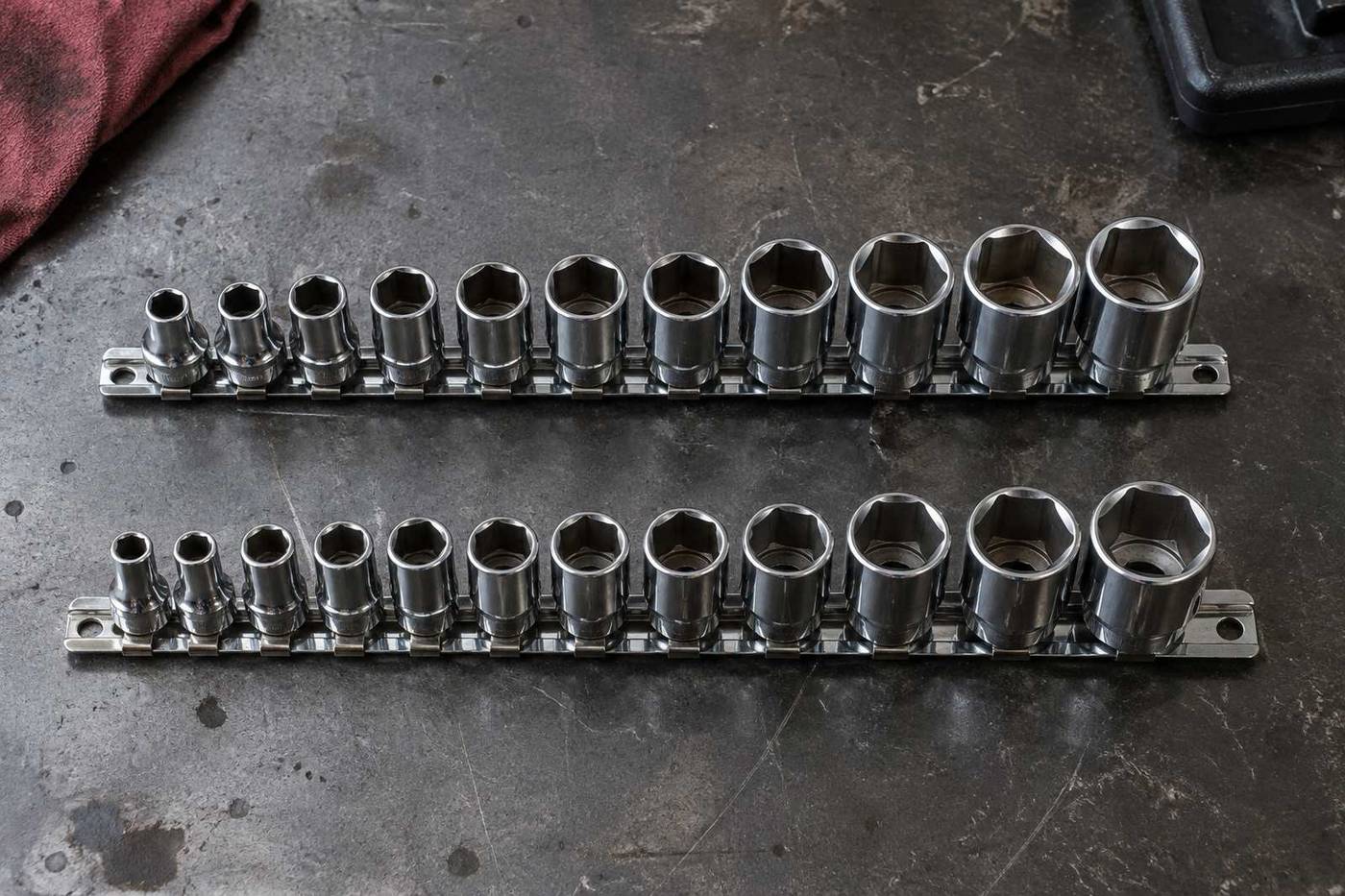
SAE socket size chart with decimals and millimeters
To read socket sizes in order, start with the smallest opening and work upward. SAE (also called standard, fractional or imperial) sizes often step up in 1/16 inch increments, with intermediate sizes such as 11/32 inch. Here is each size as a decimal and in millimeters, rounded to two places.
| SAE socket | Decimal inches | Millimeters |
|---|---|---|
| 1/4" | 0.2500 | 6.35 |
| 5/16" | 0.3125 | 7.94 |
| 11/32" | 0.3438 | 8.73 |
| 3/8" | 0.3750 | 9.53 |
| 7/16" | 0.4375 | 11.11 |
| 1/2" | 0.5000 | 12.70 |
| 9/16" | 0.5625 | 14.29 |
| 5/8" | 0.6250 | 15.88 |
| 11/16" | 0.6875 | 17.46 |
| 3/4" | 0.7500 | 19.05 |
| 13/16" | 0.8125 | 20.64 |
| 7/8" | 0.8750 | 22.23 |
| 15/16" | 0.9375 | 23.81 |
| 1" | 1.0000 | 25.40 |
| 1-1/16" | 1.0625 | 26.99 |
| 1-1/8" | 1.1250 | 28.58 |
| 1-1/4" | 1.2500 | 31.75 |
Notice the gaps. Between 1/2 (12.70 mm) and 9/16 (14.29 mm) there's room for both 13mm and 14mm, and neither lines up with an SAE size. That's why a socket size chart rarely gives you a perfect match.
SAE to metric conversion: nearby sizes
This socket size chart covers the sizes people actually mix up. The table below takes common metric sizes, converts them to inches, and compares each with a nearby common SAE socket. A positive difference means the metric size is bigger than the SAE one. A smaller nominal opening may not seat fully; a larger one adds clearance. Actual fit also depends on manufacturing tolerances and fastener condition, so the difference alone does not justify a substitution.
| Metric | Inches | Nearest SAE | Metric minus SAE | Verdict |
|---|---|---|---|---|
| 8mm | 0.315 | 5/16" (0.3125) | +0.06 mm | Very close, but not identical. Use the specified size. |
| 10mm | 0.394 | 3/8" (0.3750) | +0.48 mm | Do not swap. The 3/8 is too small to go on a 10mm nut. |
| 11mm | 0.433 | 7/16" (0.4375) | -0.11 mm | Close, but not an approved substitution. Keep both sizes. |
| 13mm | 0.512 | 1/2" (0.5000) | +0.30 mm | Do not swap. A 1/2 won't fit 13mm, and 13mm is loose on 1/2. |
| 14mm | 0.551 | 9/16" (0.5625) | -0.29 mm | Do not swap. A 9/16 is loose on 14mm, and a 14mm won't fit 9/16. |
| 16mm | 0.630 | 5/8" (0.6250) | +0.13 mm | Close, but different nominal sizes. Use the matching socket. |
| 17mm | 0.669 | 11/16" (0.6875) | -0.46 mm | Do not swap. An 11/16 has nearly half a millimeter of slop on 17mm. |
| 19mm | 0.748 | 3/4" (0.7500) | -0.05 mm | Very close, but not identical. Use the specified size. |
| 22mm | 0.866 | 7/8" (0.8750) | -0.23 mm | Do not swap. A 7/8 is loose enough on 22mm to round corners. |
| 24mm | 0.945 | 15/16" (0.9375) | +0.19 mm | Do not swap. The 15/16 is too small for 24mm. |
| 27mm | 1.063 | 1-1/16" (1.0625) | +0.01 mm | Very close, but not identical. Use the specified size. |
| 32mm | 1.260 | 1-1/4" (1.2500) | +0.25 mm | Do not swap. A 1-1/4 is too small for 32mm. |
Does a nearby size mean you can swap?
No socket size chart can account for a worn fastener, plating or the tolerances of a particular socket. A 3/4 inch opening is 19.05 mm, while 19mm is nominally 19.00 mm. Likewise, 5/16 inch is 7.9375 mm and 1-1/16 inch is 26.9875 mm. Those are close to 8mm and 27mm, but close is not the same as interchangeable under load.
Seat the correct socket fully before pulling. If it rocks noticeably, check the marking and try the matching size rather than leaning harder. Rust, rounded corners and high tightening torque leave less room for a poor fit. Never hammer an undersized socket onto a head as a way of making the conversion work.
The 13mm and 1/2 pair deserves its own warning because people try it constantly. A nominal 1/2 inch opening is 12.70 mm, 0.30 mm smaller than 13mm. That same difference adds clearance when you put a 13mm socket on a 1/2 inch head. Keep both on the rail.
SAE vs metric: how to tell which you have
In the SAE vs metric question, the fastener decides, not the vehicle's age or where it was built. Plenty of older domestic equipment has metric bolts in it, and some new machinery still uses inch hardware. Try the size you think it is first. If the socket is snug with no rocking, you've got it. If a 1/2 feels loose and a 9/16 is looser still, try a 13mm. If the 13mm slides on with no rock, you've found it.
Bolt heads give a clue too. Metric bolts usually carry property class numbers like 8.8 or 10.9 on the head. SAE grade bolts use radial lines instead.
6 point vs 12 point sockets and fit
Once you have the correct size, our 6 point vs 12 point sockets guide explains which opening suits the fastener. A 6 point socket is a useful first choice for a worn hex head. A 12 point gets onto a hex fastener in more positions, which helps in tight spots; contact location also depends on the socket's internal design. If you're dealing with a slightly rounded head, reach for a 6 point in the exact size. Never use a 12 point in the "almost" size.
Building a set that covers both systems
If you work on a mix of equipment, you need both. A socket size chart helps identify differences, but it does not replace missing sizes. Wright makes 6 point and 12 point hand sockets in each system. The 3/8 drive 6 point standard metric line runs from 6mm to 19mm, and the 1/2 drive 12 point standard metric line goes from 9mm up to 36mm. For air and cordless guns, use metric or SAE impact sockets rather than chrome. Our guide to impact sockets vs regular sockets explains why.
If you'd rather buy once, mixed fractional and metric socket sets put both rails in the same box. The same across-flats dimensions make this a wrench size chart for combination wrenches too. When the job ends at a torque spec, pair the right socket with a click wrench and follow our torque wrench how-to.
Using this socket size chart in the shop
Keep a socket size chart within arm's reach of the toolbox. Print the socket size chart and tape it inside a toolbox lid, or keep this page open on a shop computer. One habit helps more than any chart: label both rails, and put each socket back on its own rail when you're done. Most size mix-ups happen when a 13mm ends up on the SAE rail next to the 1/2 inch socket.
Frequently asked questions
Is a 10mm socket the same as 3/8?
No. A 10mm socket measures 0.394 inch across the flats and a 3/8 socket measures 0.375 inch, a difference of about 0.48 mm. A 3/8 socket won't fit over a 10mm nut, and a 10mm socket on a 3/8 bolt is loose enough to round the corners. Use the correct size for each.
What SAE socket is closest to 13mm?
The closest SAE size is 1/2 inch, which equals 12.70 mm. That's 0.30 mm smaller than 13mm, so a 1/2 socket won't go over a 13mm head. A 13mm socket will fit a 1/2 inch head, but with enough play to slip under load. Keep both sizes in your set.
Is 19mm the same as 3/4?
No, though they are very close. A nominal 3/4 inch opening equals 19.05 mm, only 0.05 mm larger than 19mm. This socket size chart shows the difference, not a guarantee of interchangeability. Use the size specified for the fastener, particularly when it is tight, damaged or being tightened to a torque specification.
How do you convert millimeters to inches for sockets?
Divide the millimeter size by 25.4, because one inch is exactly 25.4 mm. For example, 17mm divided by 25.4 is about 0.669 inch. A nearby common SAE size is 11/16, which is 0.6875 inch, so those two are not interchangeable. To go from inches to millimeters, multiply by 25.4.
Can I use SAE sockets on metric bolts?
Use the socket that matches the fastener's specified size. Some pairs, such as 19mm and 3/4 inch, are close numerically, but fit depends on tolerances and condition as well as nominal size. A conversion table does not make a substitute safe under load. Keep SAE and metric sockets for mixed equipment.
What does SAE mean on a socket?
SAE stands for the Society of Automotive Engineers and, on sockets, simply means inch sizes measured in fractions, like 1/2 or 9/16. You'll also see them called standard, fractional or imperial. Metric sockets are sized in millimeters across the flats of the fastener. The marking identifies the opening across the flats, not the drive square that fits your ratchet.