
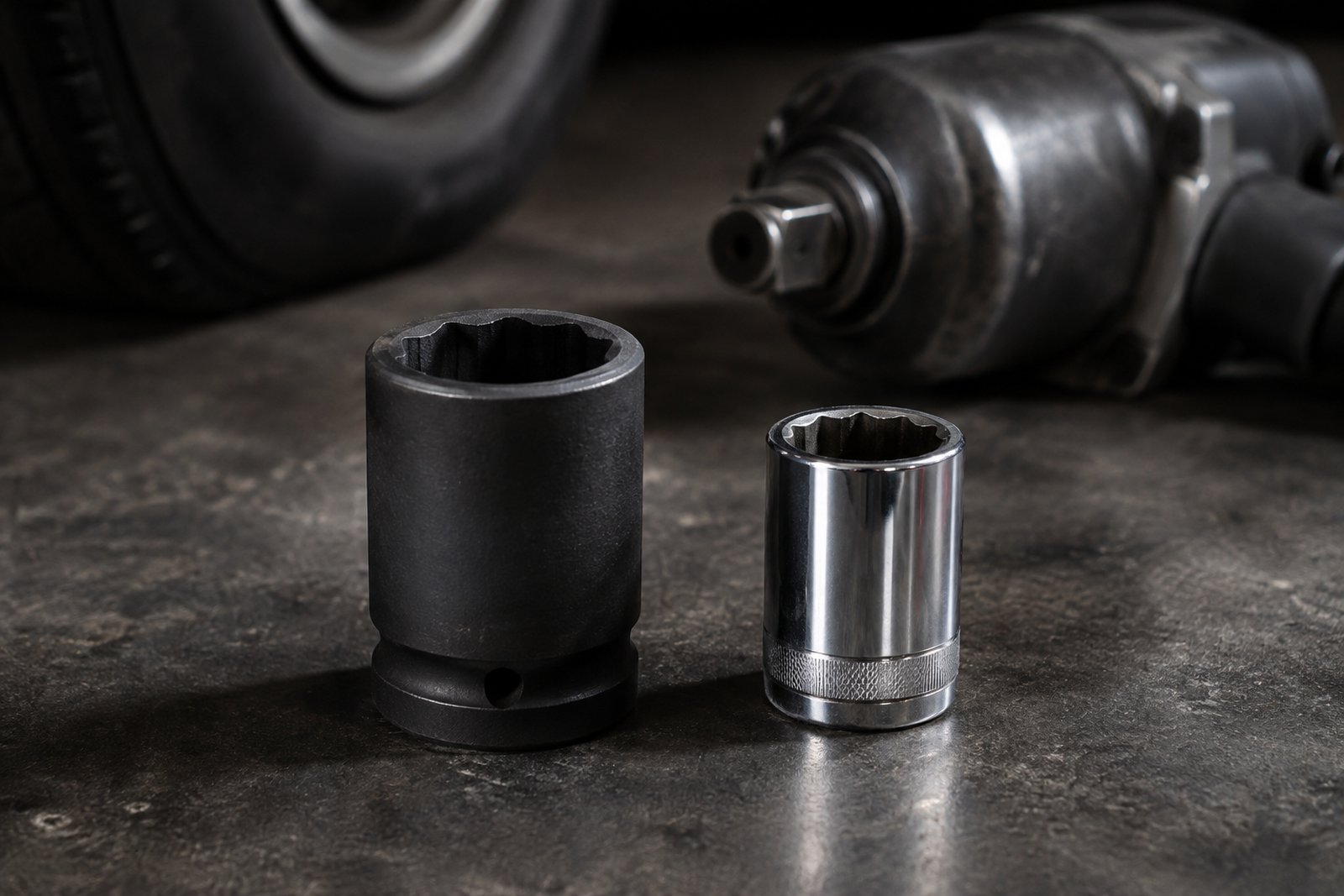
Impact sockets vs regular sockets at a glance
| Impact socket | Regular (hand) socket | |
|---|---|---|
| Typical steel | Chrome-molybdenum | Chrome-vanadium |
| Heat treat | Tougher, slightly softer, absorbs shock | Harder, more brittle under impact |
| Wall | Thicker | Thinner, fits tighter spots |
| Finish | Black oxide or phosphate | Chrome plated |
| Drive end | Cross hole for pin and O-ring retainer | Usually no cross hole |
| Point style | Mostly 6 point | 6 point and 12 point |
| Use with | Impact wrenches, also hand tools | Hand ratchets, breaker bars, torque wrenches |
Steel: chrome vanadium vs chrome molybdenum
The biggest difference is inside. Most hand sockets are chrome-vanadium steel heat treated hard. Hard steel resists wear and holds tight tolerances, which suits the steady pressure from a ratchet. Under the repeated hammer blows of an impact wrench, though, hard steel can crack.
By contrast, impact sockets are usually chrome-molybdenum steel heat treated to be tougher instead of harder. The steel flexes slightly with each blow and returns, rather than fracturing. That's the core of chrome vanadium vs chrome molybdenum for sockets: one is built to resist wear, the other to absorb shock.
Impact sockets vs regular sockets: wall thickness and fit
Impact sockets carry more steel, especially around the drive end. The extra wall spreads the impact load. The trade-off is size. A thick-walled impact socket may not fit into a recessed lug or next to a casting where a thin chrome socket slides right in. Keep a set of each, and use the thin-walled chrome sockets with a hand ratchet in tight spots.
Chrome vs impact sockets: finish and the retaining pin hole
Chrome plating looks good and wipes clean, but it can chip and flake under impact loads. Impact sockets use a black oxide or phosphate finish that won't flake off. Most impact sockets also have a cross hole through the drive end. A pin goes through the hole and the anvil, and an O-ring holds the pin in place, so the socket can't walk off the gun at speed. That matters on 3/4 and 1 inch drive guns, where a loose socket is a heavy projectile.
Don't judge by color alone. Wright makes some hand sockets in a black industrial finish, like its 3/8 drive 6 point standard black industrial line, and those are still hand sockets. Check the product name or the stamping on the socket.
Why chrome sockets don't belong on an impact wrench
Wright's support FAQ says hand sockets should not be used on hydraulic or impact guns. A chrome socket on an impact gun can split, and the pieces fly off at high speed. Even if it doesn't fail outright, the hammering opens up the drive square and the hex, and a worn socket rounds fasteners. Wear eye protection whenever you run an impact wrench, whatever socket is on it.
Can you use impact sockets on a ratchet?
Yes, with the matching drive and socket size. You can use impact sockets on a hand ratchet or breaker bar, and plenty of mechanics do on rusty suspension bolts. Just remember they're bulkier. Check clearance around the nut and make sure the socket seats fully before pulling. Chrome vs impact sockets is not a choice based on color alone: the tool's rating decides what can go on an impact wrench.
When to use each
- Impact sockets: lug nuts, axle nuts, suspension bolts, anything driven with an air or cordless gun. Deep impact sockets reach nuts on long studs.
- Chrome sockets: engine and interior work with a ratchet, tight clearances, final torque with a torque wrench.
- Either: breaking a fastener loose with a breaker bar.
Why most impact sockets are 6 point
Our 6 point vs 12 point sockets guide covers opening shape in more detail. Point count does not establish impact suitability; a 12 point impact socket and a 12 point hand socket have different intended uses.
Look through any impact socket line and nearly everything is 6 point. That's on purpose. A 6 point socket drives on the flats of the hex, and under the snap of an impact wrench a correctly fitted opening helps limit slipping and corner damage. A 12 point hand socket is handy on a ratchet because it catches the fastener in more positions, but that convenience counts for little when a gun spins the socket for you. Wright does offer 12 point impact sockets in 3/4 drive metric for the jobs that call for them, such as 12 point flange nuts.
Deep impact sockets and drive size
Deep impact sockets are the right pick for nuts on long studs, U-bolts and wheel studs that stick out past the nut. Match the drive size to the tool: a 1/2 inch gun takes 1/2 drive sockets, and using a reducer to run a 1/2 drive socket from a 3/4 inch gun can overload the smaller drive. When comparing impact sockets vs regular sockets for big equipment, step up the drive size rather than leaning on adapters. Wright's large drive lines go to 1-1/2 and 2-1/2 inch drive for mining, rail and heavy construction.
Wright impact sockets and hand sockets at BRAIGG
Our impact sockets run from 3/8 drive up to 2-1/2 inch drive, in SAE and metric, standard and deep. The 1/2 drive 6 point standard impact line, for example, runs from 3/8 inch to 1-1/2 inch. For hand work, browse our chrome hand sockets and pair them with one of our ratchets. Need help matching a metric size to SAE? See our socket size chart.
When you weigh impact sockets vs regular sockets for a new toolbox, buy chrome for hand work and impact sockets for anything with a trigger. It's the rule we give anyone setting up a first toolbox.
Frequently asked questions
Can you use regular sockets on an impact wrench?
No. Regular chrome sockets are hard and thin walled, built for steady hand force. The repeated blows of an impact wrench can crack them, and fragments can fly. Wright advises strongly against it. Use impact sockets on any air or cordless impact tool, and wear eye protection.
Can you use impact sockets on a ratchet?
Yes. Impact sockets work on hand ratchets, breaker bars and torque wrenches when the drive and fastener sizes match. Their thicker walls may not fit in tight spaces or recessed fasteners, so check clearance and full seating. Many mechanics use impact sockets by hand on rusty or seized bolts.
Why are impact sockets black?
Impact sockets get a black oxide or phosphate finish because chrome plating can chip and flake under repeated impact. Color isn't a guarantee, though. Some hand sockets, including Wright's black industrial line, are black too, so check the markings. Confirm that the socket is intended for impact use before putting it on a powered tool.
Are impact sockets stronger than regular sockets?
They are tougher, not necessarily harder. Impact sockets are usually chrome-moly steel heat treated to absorb shock without cracking. Chrome-vanadium hand sockets are harder and resist wear well under steady force. Each is stronger at its own job, which is why you shouldn't swap them on power tools.
What is the hole in an impact socket for?
The cross hole in the drive end takes a retaining pin that passes through the socket and the impact wrench anvil. An O-ring around the socket holds the pin in. This keeps the socket from coming off the gun, which is most important on large 3/4 and 1 inch drive tools.