
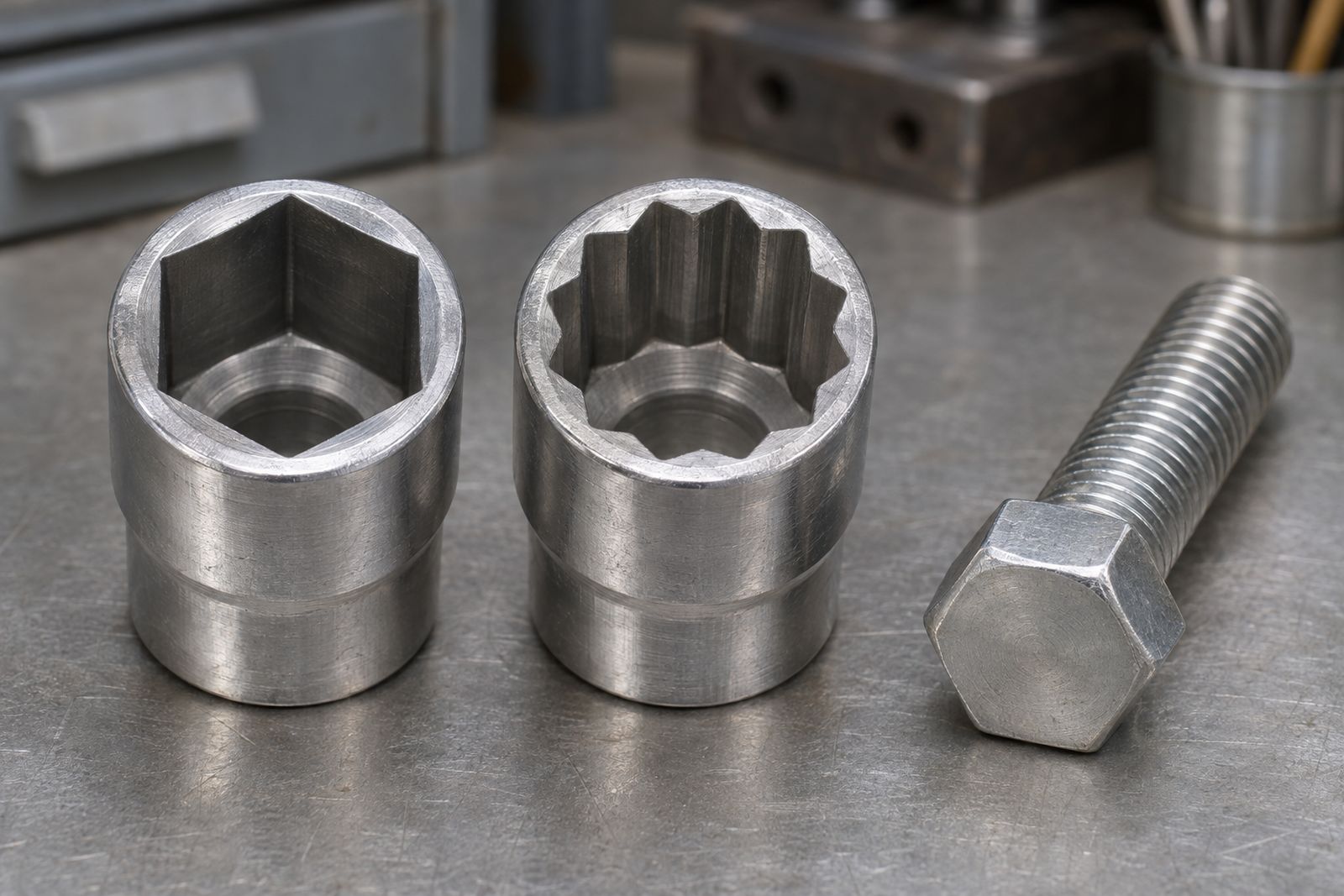
6 point vs 12 point socket: what changes at the bolt?
A 6 point opening follows the six-sided shape of a hex nut or bolt head. A 12 point opening has twice as many engagement positions. Both can turn a sound hex fastener of the correct size, but their internal profiles and clearances affect where force reaches the head.
On a tight hex fastener, a well-fitting 6 point socket generally provides broad engagement along the flats with less opportunity to ride over damaged corners. A conventional 12 point profile can concentrate load nearer the corners. That does not mean every 12 point socket bears directly on the very tips: manufacturers use different broach shapes, including profiles that move contact inward along the flats.
The practical 6 point vs 12 point socket decision is therefore about fit as well as geometry. Clean packed dirt from the head, seat the socket fully and check for rocking before applying force. Stop if it slips. More leverage on a poor fit can remove the corners you still need.
Can you use a 12 point socket on 6 point bolt heads?
Yes, on an intact hex head of the matching size, particularly for ordinary hand-tool work. Keep the socket square to the bolt and use its full engagement depth. If corrosion has thinned the head or earlier attempts have rounded it, start with a snug 6 point socket instead.
A badly rounded head may need a dedicated extractor rather than either standard opening. Do not hammer on a socket of the wrong size as a routine substitute for selecting the right tool. Our socket size chart helps identify SAE and metric sizes, but a close conversion is not permission to use a loose fit.
Starting positions: 30 degrees versus 60 degrees
A 6 point socket can seat on a hex head every 60 degrees. A 12 point socket can seat every 30 degrees. That extra choice can help when a fixed handle or non-ratcheting box wrench would otherwise start against an obstruction.
Those numbers describe indexing positions, not the return swing required by a ratchet. Once a socket is seated, the ratchet mechanism determines how far the handle must move to pick up another tooth. Changing from six points to twelve does not turn a coarse ratchet into a fine-tooth one.
Keep that distinction in your 6 point vs 12 point socket comparison. If a nearby bracket blocks the handle, check the handle position and ratchet action separately. Also check socket length and outside clearance; a different internal opening will not fix a socket body that cannot reach the head.
What about a 6 point socket on 12 point bolt heads?
It is not the matching tool. An external 12 point fastener needs the correct 12 point socket or wrench in the specified size. Do not assume a six-sided opening will work because it fits ordinary hex bolts. Check the equipment service instructions when the head profile is unfamiliar.
Point count also does not identify every profile. External Torx and spline heads have different shapes. Match the actual fastener, rather than choosing a socket just because its opening looks similar from across the bench.
6 point vs 12 point wrench: the same trade-off?
For a box end, much of the same reasoning applies. A 6 point box end is a useful choice for a stubborn hex fastener; a 12 point box end offers more starting positions and fits matching 12 point heads. On a non-ratcheting wrench, the 30-degree indexing can matter when you must lift and reposition it repeatedly.
The point count describes the box end, not an ordinary open end. Nor does it establish the return angle of a ratcheting wrench. Choose the head style and mechanism for the available room, then confirm a secure fit before pulling.
6 point vs 12 point impact sockets
Most impact sockets for ordinary hex fasteners use a 6 point opening. Impact-rated 12 point sockets also exist for applications that need them. In either case, impact suitability comes from the socket's specified construction and rating, not its point count or dark finish.
Never use a hand socket on an impact wrench. For the 6 point vs 12 point socket choice on an impact job, first match the fastener profile, then confirm that the socket and drive accessories are rated for that use. Read impact sockets vs regular sockets for the construction and safety differences.
Where Wright Drive 2.0 fits
Wright Drive 2.0 is one manufacturer's approach to contact geometry. Wright says its 6 point design moves contact away from corners to improve grip on undersized or previously rounded fasteners. Wright says its 12 point design also moves load away from the corners and increases flat contact compared with conventional 12 point designs.
That is a profile-design claim, not a reason to ignore damage or use the wrong size. Check the Wright Tool range for a socket that matches your application. For a general hand-tool drawer, start with the sizes you service in hand sockets or socket sets. Choose impact sockets when using an impact wrench, and add matching 12 point sizes where your equipment calls for them.
Frequently asked questions
Which is better, a 6 point or 12 point socket?
For a tight or worn hex fastener, start with a snug 6 point socket. A 12 point socket offers more starting positions on a sound hex head and is the matching choice for external 12 point fasteners. Neither point count compensates for the wrong size, shallow engagement or a damaged socket.
Can you use a 12 point socket on a 6 point bolt?
Yes, if the hex head is sound and the socket is the correct size. Seat it fully and keep the drive square to the bolt. If the socket rocks or slips, stop rather than adding leverage. A correctly sized 6 point socket is usually the better starting choice for a stubborn or worn hex head.
Can a 6 point socket fit a 12 point bolt?
Use a matching 12 point socket for an external 12 point bolt. A 6 point opening is not the correct mating profile. Check the equipment instructions for the required size and head type, since an external Torx or spline fastener also needs its own matching tool rather than an ordinary hex socket.
Does a 12 point socket need only 30 degrees of ratchet swing?
No. Thirty degrees is the spacing between its seating positions on a hex head. A 6 point socket has positions 60 degrees apart. Once either socket is engaged, the ratchet mechanism sets the return swing needed to catch another tooth. Point count and ratchet tooth count describe different parts of the tool.
Are all 6 point sockets safe for an impact wrench?
No. A 6 point hand socket is still a hand socket and must not be used on an impact wrench. Choose a socket specifically rated for impact service in the correct drive, size and fastener profile. Check the rating of extensions and other drive accessories too; color alone does not establish suitability.