
What you'll need
- A torque wrench whose range puts your spec between 20% and 100% of the scale. Browse our torque wrenches by drive size and range.
- A correctly sized socket that seats fully. See 6 point vs 12 point sockets for matching the opening to the fastener. Standard length hand sockets are the right choice for most jobs.
- The torque spec and tightening sequence from the service manual.
- Clean threads, and lubricant only if the spec calls for it.
How to use a torque wrench, step by step
Step 1: Pick the right wrench for the spec
Check the maker's rated accuracy band. Wright's micro-adjustable click wrenches are rated from 20% to 100% of full scale. For a 25 ft-lb spec, a 3/8 drive wrench that reads 20 to 100 ft-lb is a fine fit. A 250 ft-lb wrench is not, because 25 ft-lb falls below the bottom of its rated band. For lug nuts and suspension bolts, a 1/2 inch drive click wrench such as the Wright 4478 (50 to 250 ft-lb) covers those jobs when the specified torque falls within its range. For higher settings, the Wright 6448 3/4 drive wrench (120 to 600 ft-lb) provides a larger drive and range. Match the wrench to the service manual, not the vehicle category alone.
Step 2: How to set a torque wrench
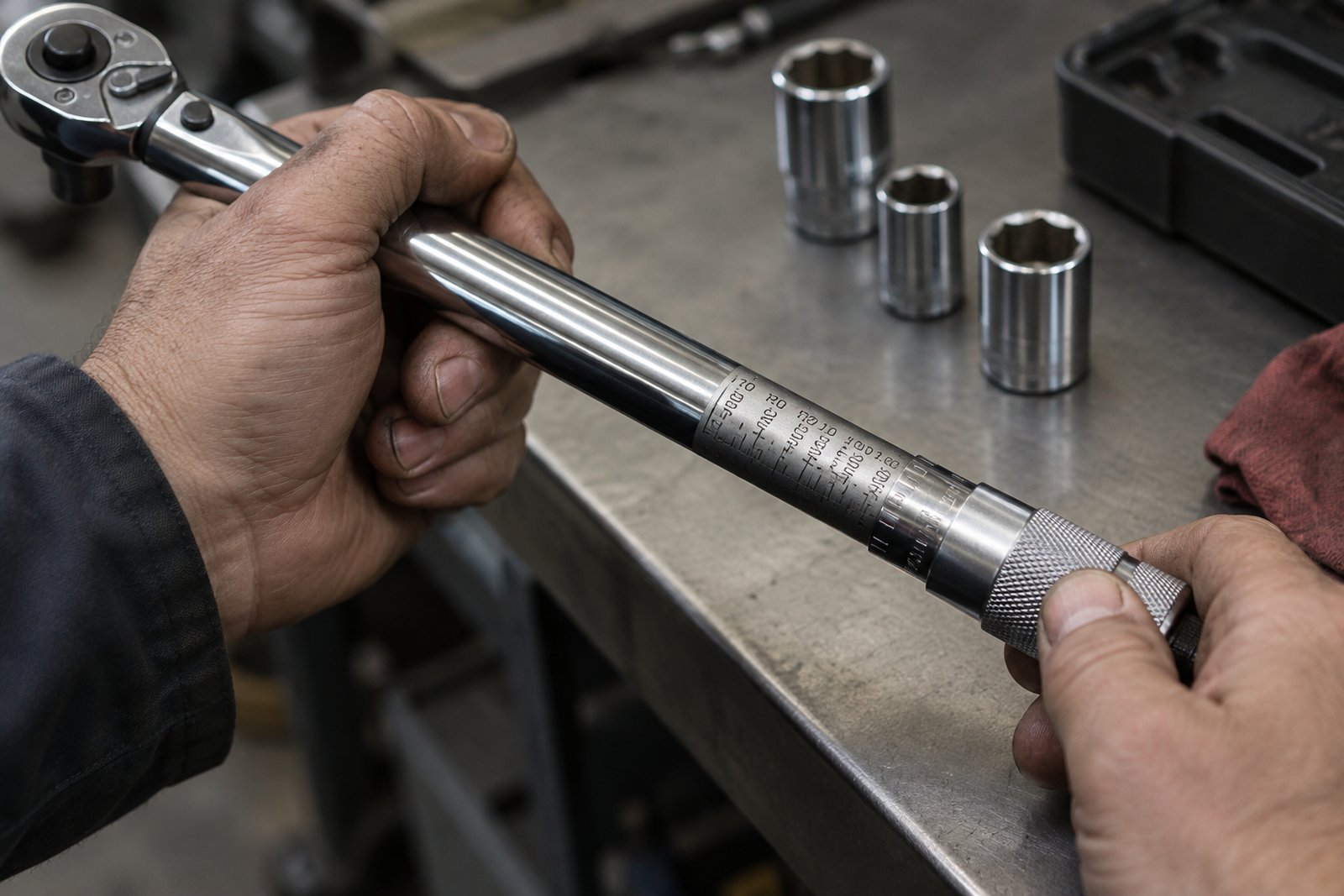
Most click torque wrench designs use a micrometer style scale. There's a main scale on the body, marked every 5 or 10 units, and a thimble scale around the handle that adds single units. To set 85 ft-lb on a wrench with a 10 ft-lb main scale:
- Release the handle lock. On Wright wrenches, pull the lock ring down.
- Turn the handle until the 80 line on the main scale is just visible at the edge of the thimble, with the 0 on the thimble lined up on the center line.
- Keep turning until the 5 on the thimble sits on the center line. That's 80 plus 5, or 85 ft-lb.
- Lock the handle so the setting can't move while you work.
Check the units before you start. Many wrenches show ft-lb on one side and newton-meters on the other, and inch-pound wrenches look almost identical to foot-pound ones. Setting 30 on the wrong scale is one of the most common torque mistakes in any shop.
How to read a torque wrench
On a micrometer click wrench, add the main-scale value to the handle-scale increment. The example above reads 80 + 5 = 85 ft-lb; it is not 80.5 ft-lb. Check the units and graduation size on your own model before copying the example. Wright's 4478 uses 1 ft-lb increments, while the 6448 uses 5 ft-lb increments. A click wrench shows the setting, not a live torque reading. On a dial wrench, read the live needle as you pull; a follower needle, if fitted, records the peak.
Step 3: Snug the fastener first
Run the bolt or nut down by hand or with a ratchet until it seats. A torque wrench is for the final pull, not for spinning fasteners on, and never for breaking one loose. Use a breaker bar for that job. Clean, undamaged threads matter more than most people think. Rust, old thread locker and damaged threads all eat up part of the torque in friction, so the fastener ends up with less clamping force than the reading suggests.
Step 4: Pull smoothly to the click, then stop
Hold the wrench by the center of the handle grip, since that's where it was calibrated. Pull at a right angle to the handle with a smooth, steady motion. When you reach the set torque, the head breaks over with a click you can hear and feel. Stop right there. Don't jerk the wrench, and don't click it a second time for luck. A second hard pull can push the fastener past spec. With a dial wrench, watch the needle and ease off as you reach the number.
Step 5: Follow the sequence in stages
Wheels, cylinder heads, intake manifolds and flanges all need even clamping. Tighten in the pattern the manual gives, usually a star or crisscross, and in stages. For lug nuts, that often means about half the spec on the first pass and full spec on the second. On parts with a long sequence, like cylinder heads, follow every pass and any angle steps exactly as written.
How to use a torque wrench extension or crowfoot
Check the wrench manufacturer's instructions before adding accessories. Wright's FAQ does not recommend adaptors under any circumstances. The geometry below explains common extension corrections generally; it is not approval to use an adaptor on a Wright wrench. A straight socket extension along the drive axis does not change the effective handle length when the head is supported and the pull stays square. A crowfoot or other adapter that adds length along the wrench is different. It increases the leverage, so the fastener sees more torque than the wrench shows. Use this formula to find the setting:
Wrench setting = desired torque × L ÷ (L + E)
L is the wrench's effective length, measured from the center of the drive to the center of the handle grip. E is the length the adapter adds, measured from the center of the drive to the center of the fastener. Example: you need 50 ft-lb, the wrench's effective length is 18 inches, and a crowfoot wrench adds 2 inches. The setting is 50 × 18 ÷ 20, or 45 ft-lb. If you turn the crowfoot 90 degrees to the handle, the added length drops out and no correction is needed.
How to use a torque wrench: care and calibration
When the job is done, turn a click wrench down to the lowest mark on its scale. Leaving the spring compressed at a high setting for weeks can let it take a set, and the wrench starts reading wrong. Wipe it down, keep it in its case and don't drop it. Part of knowing how to use a torque wrench is knowing when it needs a check. Wright recommends recalibration every six months or 5,000 uses, whichever comes first, in its support FAQ. ISO 6789 gives a default interval of 12 months or 5,000 cycles when no other control procedure is specified; follow Wright's shorter interval for its tools. Have the wrench checked after a drop or overload rather than waiting for the next date. Wright micro-adjustable click wrenches have individual serial numbers and certificates of calibration traceable to NIST.
Common mistakes when learning how to use a torque wrench
- Using the torque wrench to loosen fasteners.
- Reading the wrong scale or the wrong units.
- Holding the wrench by the head end or pulling at an angle.
- Working below 20% of the wrench's range.
- Lubricating threads when the spec is for dry threads, or the other way around.
- Letting an impact gun do the final tightening.
If you work on cars every day, our auto repair tools page groups sockets, wrenches and torque tools by the jobs you do most.
Frequently asked questions
Do you hold a torque wrench at the end of the handle?
Hold it at the center of the handle grip, where the manufacturer calibrated it. Many click wrenches have a marked grip or a pivot point for this reason. Holding the wrench closer to the head reduces leverage, so the fastener ends up looser than the setting, while pulling on a cheater bar over the handle does the opposite.
Should you click a torque wrench twice?
No. Once the wrench clicks, the fastener is at the set torque, so stop pulling. A second firm pull can add more torque, especially if you jerk the handle. If you are not sure the first click happened, back the fastener off and tighten it again rather than clicking over and over.
What should you set a torque wrench to when storing it?
Turn a click wrench down to the lowest mark on its scale, not below it and not to zero unless the maker says so. That takes most of the load off the internal spring. Leaving it at a high setting for long periods can weaken the spring and make the wrench read wrong.
How often does a torque wrench need calibration?
For Wright tools, recalibrate every six months or 5,000 uses, whichever comes first, according to Wright's FAQ. ISO 6789 gives a default of 12 months or 5,000 cycles when no other procedure is specified; it does not replace Wright's shorter interval. Have a wrench checked after a drop, overload or mechanism repair.
Can a torque wrench be used to loosen bolts?
No. Breaking a fastener loose can take far more torque than the wrench is rated for, and it can damage the mechanism or throw off the calibration. Loosen with a breaker bar or ratchet. Many click wrenches will click in reverse for left-hand threads, but that is for tightening, not loosening.
Do extensions affect torque wrench readings?
A straight socket extension along the drive axis does not change effective handle length when used squarely. A crowfoot extending along the handle does, so some manufacturers permit a geometry correction. Follow your wrench maker's instructions first: Wright's FAQ does not recommend adaptors under any circumstances. A correction formula is not permission to ignore that advice.