
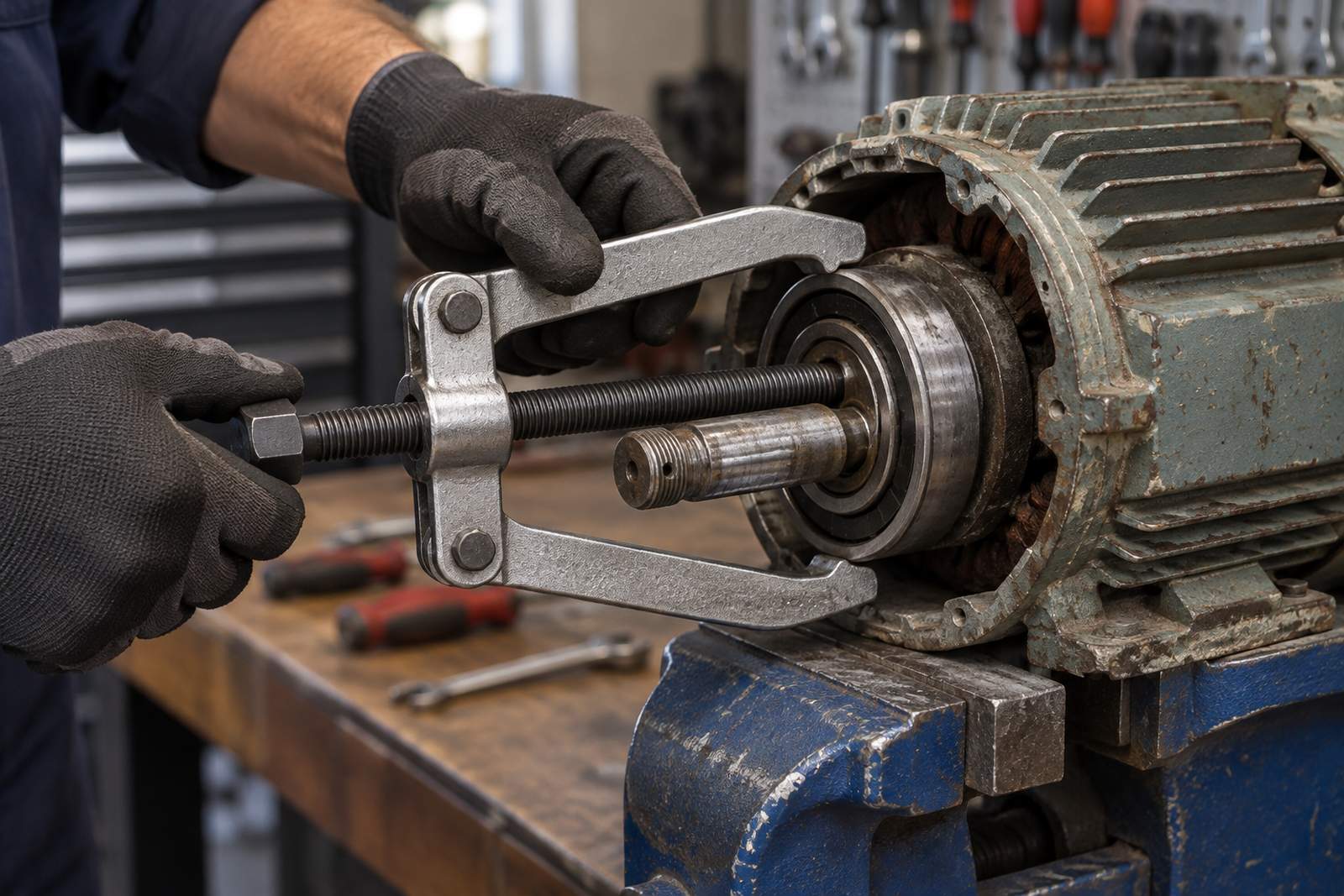
Step 1: figure out which ring is tight
A bearing is press fit on one ring and usually a slip or light fit on the other. On a shaft, the inner ring is the tight one. In a housing, it is the outer ring. Pull on the ring that is pressed on. Hook just the outer ring of a shaft-mounted bearing, and every bit of force goes through the balls. You can dent (brinell) the races or crack the cage. That is fine on a bearing you are throwing away. It is not fine when you plan to reuse it or when the shaft is worth saving.
Step 2: measure spread and reach
Every jaw-type bearing puller tool is sized by two numbers. Spread is the widest diameter the jaws can open around. Reach is how far the jaws extend from the crossbar down to the hooks. Measure the bearing's outside diameter and the distance from the shaft end to the back face you will hook. Then add some margin, because a puller at full spread holds worse than one working in the middle of its range.
For scale, KUKKO's 2-jaw rolling bearing puller (series 112) runs from the 112-1 at 55 mm spread and 45 mm reach (about 2-1/8 x 1-3/4 in) to the 112-3 at 185 mm spread and 165 mm reach (about 7-1/4 x 6-1/2 in). A small electric motor bearing fits the 112-1. A pump or gearbox bearing usually wants the larger sizes.
Step 3: choose the puller type
Jaw pullers for exposed bearings
An external bearing puller with jaws is the fastest option when the outer edge is exposed with a gap behind it. Two jaws fit in tight spaces next to a housing or a gear. Three jaws spread the load and are less likely to walk off. The KUKKO 3-jaw ball bearing puller (series 113) comes in 125 x 100 mm and 185 x 165 mm. Both the 112 and 113 use straight jaws and a cone knob that locks the jaws at a set spread. That helps when you pull the same bearing size again and again on a line of motors. Our guide to 2-jaw vs 3-jaw pullers goes deeper on that choice. General purpose models are listed under jaw pullers.
Separators for bearings tight against a shoulder
When the bearing sits hard against a shoulder or a gear, there is no gap for a jaw tip. A bearing separator has two knife-edged halves that you bolt together behind the part. Tightening wedges the edges in and starts the bearing moving. Then a puller frame pulls on the separator. KUKKO's series 15 separators cover 6 to 330 mm across the range and pair with the series 18 separator puller. If you want to know when a separator beats jaws, read bearing separator vs bearing puller.
Clamp-style pullers for stuck, flush bearings
The KUKKO Cobra 2-jaw bearing puller with side clamp sits between the two. Sharp claws get under the part, and the side clamp squeezes them in, so the part starts to lift before you turn the spindle. It is a good pick for a seized bearing with only a hairline gap.
Blind bearing pullers for bores
When a bearing sits in a housing bore with no access from behind, you need a blind bearing puller. Collet-style internal extractors expand inside the inner ring and are pulled with a slide hammer or a counter support. KUKKO's series 21 starts with a model for 5 to 8 mm bores. For a bearing on a shaft that is also seated in a housing, the KUKKO PULLPO series 70 hooks into the raceways between the balls and draws the bearing out without pulling the shaft. See how to remove a bearing from a blind hole and our internal extractors and slide hammers.
Step 4: decide on manual or hydraulic
A manual spindle turned with a wrench handles most bearings up to medium size. Once you are leaning on a long breaker bar and the spindle is groaning, stop. Big, rusted or interference-fit bearings on pumps, fans and heavy equipment are where hydraulic pullers earn their place. KUKKO also makes a hydraulic puller for bearing separators (series 18-B), so a separator setup can go hydraulic too.
Step 5: kit or single tool?
A bearing puller kit makes sense if you see a mix of sizes and styles. KUKKO sells separator sets such as the K-17 series with a quick-clamping pressure spindle and the K-13 TRI-PULL set for spherical and tapered roller bearings. A bearing puller set can also be built piece by piece. Browse puller sets or the full bearing pullers and separators category. If you pull one bearing size all day, a single dedicated tool is quicker.
Using it safely
- Wear eye protection. A jaw that slips under load can throw parts.
- Keep the spindle centered on the shaft. Use a center point or protect the shaft end so the spindle tip can't damage it.
- Drape a heavy shop rag or cover over the puller when you are near full load.
- Tighten slowly and check the jaws after the first few turns. If they start to spread, stop and reset.
- Penetrating oil and time do more than extra leverage. If the bearing will not move, go hydraulic instead of using a cheater bar.
Get those five steps right, and the bearing puller you choose will match the job instead of fighting it.
Frequently asked questions
What size bearing puller do I need?
Measure the bearing's outside diameter and how far behind the shaft end you need to hook. Pick a puller whose spread and reach are larger than those numbers, ideally so it works mid-range. For example, a bearing about 50 mm across that sits 40 mm deep fits KUKKO's 112-1 at 55 mm spread and 45 mm reach.
Should I pull a bearing by the inner or outer ring?
Pull the ring that has the press fit. On a shaft that is usually the inner ring, and in a housing it is usually the outer ring. Pulling the loose ring pushes all the force through the balls or rollers, which can dent the races and ruin a bearing you wanted to reuse.
When do I need a bearing separator instead of a jaw puller?
Use a separator when the bearing sits tight against a shoulder, gear or another part and there is no gap for jaw tips. The separator's sharp halves wedge in behind the bearing, then a puller frame does the pulling. If there is a clean gap behind the outer edge, a jaw puller is faster.
How do I remove a bearing from a blind hole?
Use a blind bearing puller. An internal extractor expands inside the bearing's bore and is pulled out with a slide hammer or a counter support that bears on the housing. For a bearing that sits on a shaft and in a housing at once, a raceway puller like KUKKO's PULLPO hooks between the balls.
Is a 2-jaw or 3-jaw bearing puller better?
A 3-jaw puller spreads the load more evenly and is less likely to slip, so use it when there is room all around the bearing. A 2-jaw puller fits between obstructions, like a bearing beside a housing wall or close to a gear. Many shops keep both in matching sizes.