
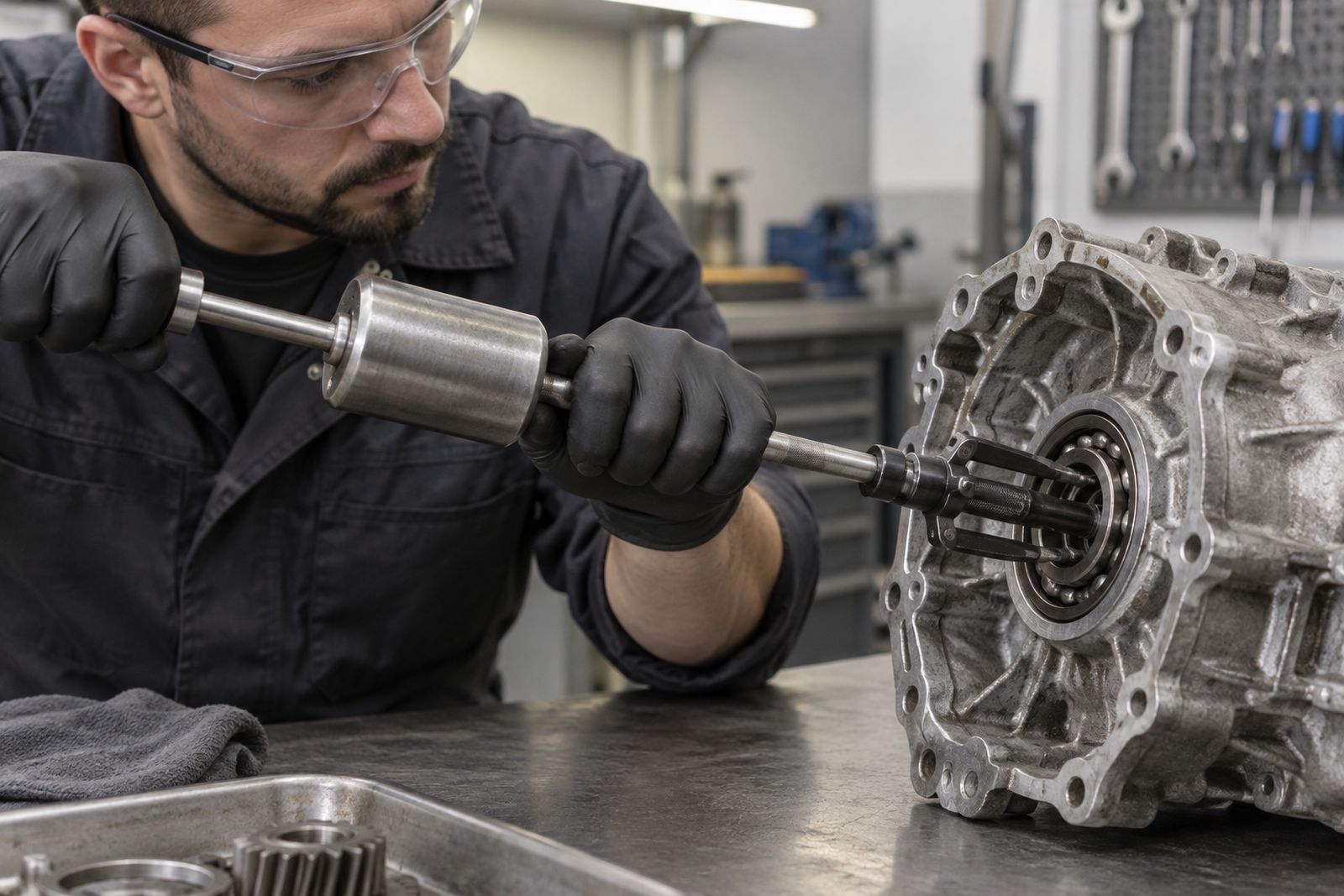
How a blind bearing puller works
A blind bearing puller is an inside bearing puller. Instead of jaws that grab the outside of a part, it has a split collet or two or three small jaws on a spindle. You push the closed tip through the bearing's bore. Turning the spreader spindle opens the tip until its lip sits behind the inner race. Now you have a solid grip on the back face of the bearing and can pull it toward you.
The pulling force comes from one of two sources. A slide hammer delivers sharp blows along the axis. A counter support (a bridge with legs that rests on the housing face) lets you pull with a threaded spindle and a wrench, which is slow and controlled. KUKKO builds its series 21 internal extractors to work with both, so one extractor head covers either method.
Tools you need
- An internal extractor sized to the bore. KUKKO's series 21 internal extractors run from 5 to 8 mm (21-0) up to 56 to 70 mm (21-8) in overlapping ranges.
- For bearings pressed flush against the bottom of the bore, a segment internal extractor (series 21-E, 4.8 mm up to 78 mm). Its finer gripping edge gets behind a race that sits tight to the back wall.
- A sliding hammer or a counter support.
- Calipers, a wrench for the spindle, eye protection and gloves.
Sizing a blind bearing puller
Measure the bearing's inner diameter, not the housing bore. A 6202 ball bearing, for example, has a 15 mm bore (about 0.59 in), so a KUKKO 21-1 (12 to 16 mm) is the best fit. Pick the blind bearing puller where your bore sits near the middle of the range. At the very top of a range the jaws are spread wide and the lip engages less of the race.
If you only have the part number, the last two digits of most metric ball bearings give the bore: multiply by 5 for codes 04 and up (6205 = 25 mm). Codes 00, 01, 02 and 03 are 10, 12, 15 and 17 mm.
Steps: remove a bearing from a blind hole
- Clean the bore. Wipe out grease and check for a snap ring or retaining plate. A blind bearing puller won't beat a circlip; take it out first.
- Insert the blind bearing puller closed. Push it through the inner race until the tip bottoms out or passes the back face. On a flush-seated bearing, only the segment type has a lip thin enough to grip.
- Spread it. Turn the spreader spindle until the jaws bite firmly on the race. Tug by hand. If it wiggles, spread a little more.
- Attach the pulling method. Thread on the slide hammer, or set the counter support over the extractor with its feet flat on the housing face.
- Pull straight. With a slide hammer, start with short, firm strokes and work up. With a counter support, turn the spindle nut steadily and watch that the bridge stays square.
- Inspect the bore. Check for scoring before pressing in the new bearing. Never reuse a bearing you pulled by its inner race; the load went through the balls.
Slide hammer or counter support?
Use a bearing puller slide hammer when there is no flat face for support legs or the housing is too delicate to load, which is how KUKKO describes the job for its 22-0 sliding hammers. Those come in 0.5 kg (200 mm stroke), 1 kg and 1.7 kg (250 mm stroke) and 5 kg (340 mm stroke). Match the weight to the job. A 0.5 kg hammer is plenty for a 15 mm bearing in an alternator end frame; a 5 kg hammer on that part will bend things.
A counter support gives you more precise work with greater force, per KUKKO. It's the better pick for a bearing in a solid iron housing with a clean, flat face, and it doesn't shock the housing. The larger KUKKO series 22 supports, from the 21-2 size up, carry a pressure bearing under the nut, so the spindle turns with less friction under load.
When space is too tight for either, an extractor with a built-in hammer helps. The KUKKO 224-1 covers 12 to 35 mm, and the 221-G covers 30 to 180 mm for jobs where there's no room for puller jaws.
Buying a blind bearing puller set instead of single sizes
If you service a variety of equipment, an internal bearing puller set saves guessing. KUKKO's K-22 ball bearing puller set with counterstay and sliding hammer covers 6 to 30 mm in 8 pieces. The K-22-E flush-mounted bearing puller set covers 4.8 to 16 mm for small bearings seated tight to the bottom. For bigger bores, the 25 set covers 12 to 46 mm with counter supports. See all of them under puller sets.
Mistakes that wreck the bore
- Prying the outer ring. Screwdrivers gouge the housing, and a scored bore won't hold the new bearing.
- Pulling at an angle. A cocked bearing jams harder. Keep the slide hammer shaft in line with the bore.
- Under-spreading. If the lip of the blind bearing puller slips off the race mid-pull, the tip can chip. Spread until it's tight, then pull.
- Too much heat. Gentle warmth on an aluminum housing helps, since aluminum grows about twice as fast as steel. A torch overdoes it and cooks seals and paint, so use a heat gun.
Blind bearing puller safety
Wear eye protection. A slide hammer can release the bearing all at once, so keep your knuckles clear of the stop and stand to one side of the line of pull. Clamp the part in a vise or bolt it down; a housing that moves soaks up the blow and the extractor can let go. When a stubborn bearing needs real force on a counter support, cover the setup with a heavy shop rag or guard in case a jaw breaks.
When it won't budge
Searching for a bearing puller blind hole tool for a seized bearing in a large housing? Sometimes it needs hydraulic force. KUKKO's Y-21-E hydraulic internal extractors (30 to 180 mm and 75 to 230 mm) work with the Y-180 hydraulic puller. For bearings on a shaft instead of in a bore, read our guide on how to choose a bearing puller, or browse internal extractors and slide hammers. Clutch work is covered in how to remove a pilot bearing.
Frequently asked questions
What is a blind bearing puller?
It's an internal puller for bearings set in a bore with no access from behind. A split collet or small jaws go through the bearing's inner race and spread to hook behind it. A slide hammer or a counter support with a spindle then draws the bearing straight out of the housing without touching the bore walls.
How do I pick the right size blind hole bearing puller?
Measure the inner diameter of the bearing with calipers and choose the extractor whose range puts that size near the middle. KUKKO series 21 extractors overlap, for example 12 to 16 mm and 14 to 19 mm, so a 15 mm bore fits either. Avoid running at the very top of a range.
Should I use a slide hammer or a counter support?
Use a slide hammer when there's no flat face for support legs or the housing is fragile. Use a counter support when the housing face is flat and solid, because it pulls with steady, controlled force from a threaded spindle. KUKKO series 21 extractors accept both, so one head does either job.
Can I reuse a bearing removed with an internal puller?
No. An internal puller grips the inner race, so the pulling load passes through the balls or rollers and into the outer ring. That can brinell the raceways even if the bearing still spins. Replace it with a new bearing, and check the bore for scoring before installing the replacement.
What if the bearing sits flush against the bottom of the bore?
Use a segment internal extractor. Its thin, fine gripping edge can slip into the small gap behind a race that's seated tight to the back wall, where a standard collet won't fit. KUKKO's 21-E series covers 4.8 mm up to 78 mm, and the K-22-E set covers 4.8 to 16 mm.