
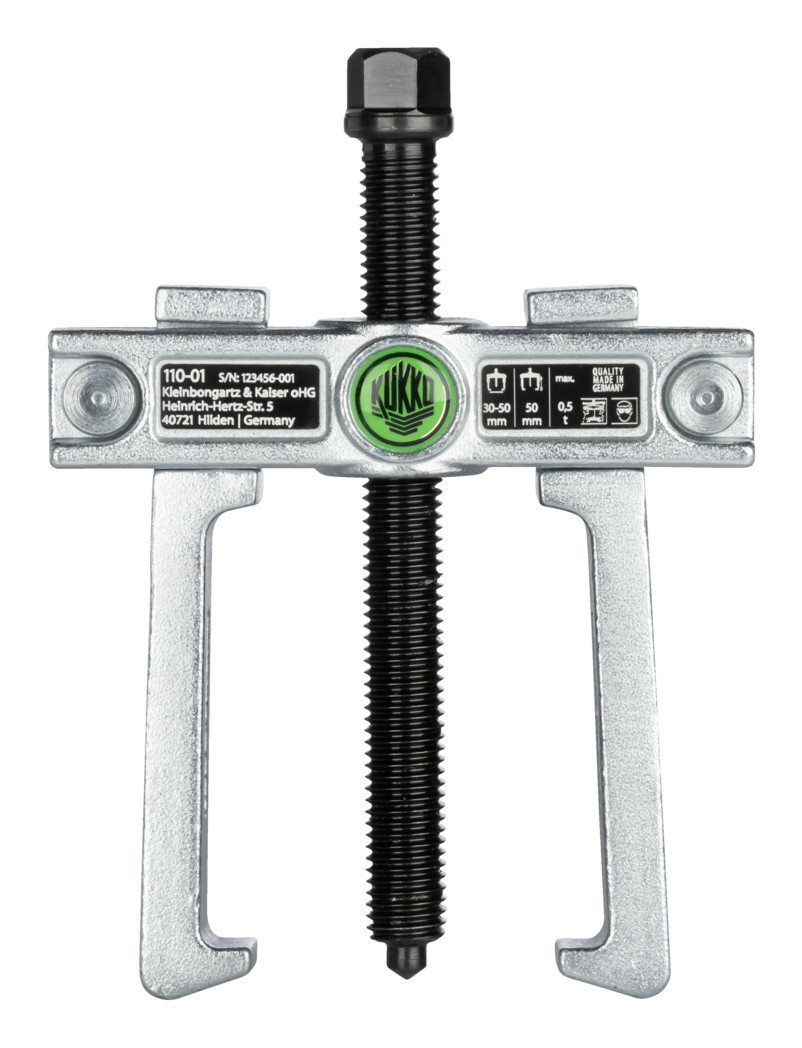
A puller-making history behind KUKKO quality
Alfred Kleinbongartz and Emil Kaiser founded Kleinbongartz & Kaiser oHG on October 1, 1919, in Remscheid, Germany. The business began as a small workshop making pullers. Its first puller catalog appeared in 1950. In 1980, KUKKO introduced the hydraulic puller systems 844 and 845. That history shows a sustained focus on extraction equipment, from early mechanical tools to hydraulic systems.
Today the company is headquartered in Hilden, Germany, and is led by owner Michael Kleinbongartz as a fourth-generation family business. Pullers and extractors remain the focus of this guide, although KUKKO also makes other tools. Calling it a puller-only manufacturer would overlook those other lines. Start with our KUKKO brand hub for the wider range.
German manufacturing without a blanket origin claim
Most KUKKO tools are made in Germany. That is the accurate description of the range, not a promise that every item has the same origin. The catalog data checked for this content lists Germany for 2,968 of 3,137 individual items, with some items listing other countries. Check the particular product rather than extending a brand-level statement to every accessory.
Manufacturing origin is one part of a buying decision. For a useful assessment of KUKKO quality, put it alongside the tool's dimensions, working method and documented features. A German-made puller with insufficient reach still cannot get its hooks behind the part.
What the jaw safety features actually do
The VARIO series 120 two-jaw puller has a spring-loaded safety device. Its description identifies the purpose: preventing jaws from slipping off the crossbar. Pressing the safety lock allows the jaws to be reversed. The VARIO series 130 three-jaw puller also documents spring-loaded anti-slip safety. These are named features on specific families, not a claim that every KUKKO puller uses the same mechanism.
The Alligator series 12-A takes another approach. Its cross hooks support jaw suspension in the sliding piece, described as Armlock Technology in the product data. This describes the jaw attachment. You still need to keep the puller aligned and stay within the selected model's limits.
KUKKO quality tools: what the specifications tell you
A practical KUKKO quality check separates spread from reach. Spread tells you about the opening across the work; reach tells you how far the jaws can extend behind it. The Techno series 110 includes an option labeled 100 mm spread by 100 mm reach, approximately 3.94 by 3.94 inches. Another listed option has 200 mm spread by 150 mm reach, approximately 7.87 by 5.91 inches. The larger opening does not imply an equally long reach.
Look for the selected item's specifications, not a maximum taken from the whole family. Read its jaw arrangement and operating method as well. Techno's product description specifies slender, always-parallel jaws and reversible external and internal operation. That gives you something concrete to check against the workpiece, especially where there is little clearance behind a gear.
Choose the pulling method before the capacity
Not every extraction job calls for jaws around the outside. A bearing in a blind housing requires a different purchase point from a gear exposed on a shaft. Our KUKKO puller guide groups the methods, while the part number and series guide helps identify the exact family and item. For a broader starting point, browse Pullers & Extractors.
Before applying load, seat every hook, center the spindle and check that the reaction point is sound. Wear eye protection and use a suitable guard or cover over the loaded puller. Stop if a jaw starts to climb or the tool tilts. Never use heat near hydraulic seals. Even with the documented KUKKO quality features, you need to watch the tool's alignment as the part begins to move.
Frequently asked questions
Is KUKKO a good choice for a bearing puller?
Choose by the bearing's location and the selected tool's dimensions. KUKKO offers documented features such as parallel jaws, reversible configurations and spring-loaded jaw retention on particular families. Those details help you assess the fit, but no brand name replaces checking spread, reach, engagement and the individual model's limits before loading it.
Are all KUKKO tools made in Germany?
No. Most KUKKO tools are made in Germany, but the catalog includes items with other countries of origin. The data checked for this content lists Germany for 2,968 of 3,137 individual items. Treat origin as an item-level fact rather than assuming every tool or accessory shares it.
Is KUKKO still a family business?
Yes. KUKKO is a fourth-generation family business led by owner Michael Kleinbongartz and headquartered in Hilden, Germany. Its origins go back to Alfred Kleinbongartz and Emil Kaiser's workshop in Remscheid, founded on October 1, 1919. That workshop began by making a small series of pullers.
What does the VARIO spring-loaded safety device do?
For the documented VARIO series 120 and 130 families, the device prevents jaws from slipping off the crossbar. The product descriptions also describe releasing the safety latch to reverse the jaws. It does not remove the need to center the spindle, seat the hooks fully and respect the selected tool's limits.
Does KUKKO make only pullers?
No. Pullers have been part of KUKKO's history since its founding, but the catalog also includes clamps, pliers, hammers and other tools. This page concentrates on extraction equipment because its jaw arrangements, retention mechanisms and size specifications give you concrete information for deciding whether a puller suits your job.
How should I assess KUKKO quality before choosing a size?
Start with the actual job measurements and the individual item number. Check spread, reach, hook access and the spindle's reaction point, then read the documented jaw retention features for that family. Keep family-wide size ranges separate from the specifications of the option you intend to use.