
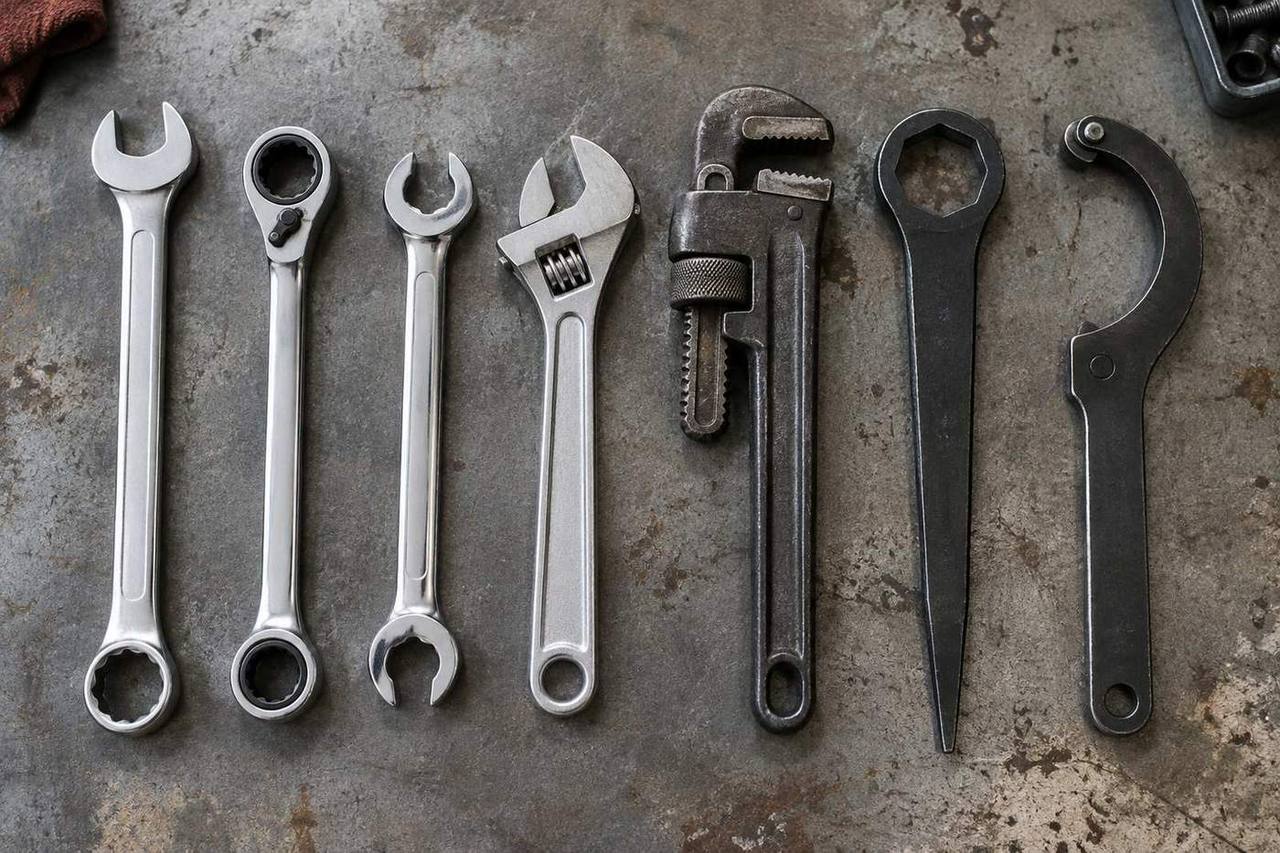
Fixed size types of wrenches for hex fasteners
Combination wrench
The combination wrench has an open end on one side and a box end of the same size on the other. Use the box end to break a nut loose, then flip to the open end to spin it off fast. If you buy one set of wrenches, buy this one. Wright's WRIGHTGRIP 2.0 combination wrenches are 12 point on the box end and run from 1/4 inch to 3-1/16 inch, plus metric sizes, in satin, full polish or black industrial finish.
Open end wrench
Two open jaws, usually different sizes, set at an angle to the handle. The angle lets you flip the wrench over and catch the next flat when you can only swing it a few degrees. Wright makes double angle open end wrenches with 15 and 60 degree heads, and 30 degree service wrenches. Open ends grab only two flats, so they're for running fasteners, not breaking tight ones.
Box end wrench
A closed ring on each end wraps all six corners of the nut, so it's far less likely to slip or round off than an open end. Offset box end wrenches raise the handle above the work so your knuckles clear the surface.
Ratcheting wrench
A box end with a ratchet built into the head. You never lift it off the nut, which speeds up work on long threads in tight spaces. Wright's ratcheting wrenches include reverse ratcheting box wrenches, laminated double box wrenches, and air conditioning and refrigeration versions with square openings for service valves.
Wrenches for tubing and hard to reach fittings
Flare nut wrench
Also called a line wrench. A flare nut wrench looks like a box end with a slot cut in it, so it slides over a brake or fuel line and grips five or six flats of the soft tube nut. An open end on a brake line fitting is the fastest way to round it. Wright's flare nut wrenches are 6 point.
Crowfoot wrench
A wrench head with no handle and a square drive hole. It goes on a ratchet or extension to reach fittings that a socket can't get over, like a line nut behind a manifold. A crowfoot wrench also lets you torque those fittings with a torque wrench. Wright crowfoot wrenches come in 3/8 and 1/2 drive, including 12 point flare nut styles and metric sizes.
Heavy duty types of wrenches for big fasteners
Striking and slugging wrench
A thick box end with a flat striking face on the handle end. You set it on the nut and hit it with a sledge. That's how flange bolts and big nuts on heavy equipment get broken loose. Wright striking wrenches come in 6 and 12 point, straight or 45 degree offset, some in safety orange so they're easy to find in a crowded work area.
Structural and spud wrench
The ironworker's wrench. A spud wrench has an open or box end on one side and a tapered pin on the other for lining up bolt holes in steel. Wright's structural wrenches include offset spud wrenches from 13/16 to 1-5/8 inch on the open end, plus a 1/2 drive construction ratchet with a spud handle.
Specialty and adjustable types of wrenches
Spanner wrench
What is a spanner wrench? In the US it means a wrench that engages notches or holes on a round collar or ring nut instead of a hex. A hook spanner catches a slot on the outside edge, a pin spanner fits a hole in the edge, and a face spanner fits two holes in the face. Wright's adjustable spanner wrenches come in hook, pin and face styles, with hook ranges from 3/4 inch up to 8-3/4 inch. You'll see them on bearing lock nuts, hydraulic cylinder glands and machine tool spindles.
Adjustable and pipe wrench
An adjustable wrench covers many sizes with one tool. Wright makes them from 4 inch to a 36 inch giant. It's the wrench to carry when you don't know what sizes the job holds, but snug the jaw tight and pull toward the fixed jaw, or it will round the nut. A pipe wrench is different: its serrated jaws bite round pipe and grip harder as you pull. Never use one on a hex nut. Both live in our adjustable and pipe wrenches category, with steel and lighter aluminum pipe wrenches up to 48 inch.
Torque wrench
A torque wrench tightens to a measured value, not a guess. Click, dial and multiplier styles are all in torque wrenches and multipliers. If you're new to them, read how to use a torque wrench before the first job.
Which types of wrenches to buy first
For a new toolbox, start with a combination wrench set in the system your work uses, SAE, metric or both. Add a 10 inch adjustable, then a ratcheting set if you work in tight spots. Brake and AC work calls for flare nut wrenches. Heavy equipment, piping and steel erection call for striking, pipe and spud wrenches. Matched wrench sets fill a drawer in one go and keep the sizes in order. Not sure if a fastener is metric? Our socket size chart works for wrenches too. You can see every category on the wrenches page.
All of the types of wrenches on this page come from Wright Tool, which has made hand tools in Barberton, Ohio since 1927.
Frequently asked questions
What are the most common types of wrenches?
In most toolboxes you'll find combination wrenches, an adjustable wrench, ratcheting wrenches and a torque wrench. Shops that work on brakes or hydraulics add flare nut wrenches, and industrial crews add striking, spud, spanner and pipe wrenches. The combination wrench is the one nearly everyone uses daily.
What is the difference between a combination wrench and an open end wrench?
A combination wrench has an open end on one side and a box end of the same size on the other. An open end wrench has open jaws on both ends, usually in two different sizes. The combination gives you the box end for breaking fasteners loose, which is why it's the more popular choice.
When should you use a flare nut wrench?
Use a flare nut wrench on brake lines, fuel lines, power steering and AC fittings. These tube nuts are soft and thin walled, and an open end wrench grips only two flats, so it rounds them easily. The flare nut wrench slips over the line and grips nearly the whole nut.
What is a spud wrench used for?
A spud wrench is an ironworker's tool. One end is a wrench for tightening structural bolts, and the other end is a tapered pin used to line up holes in beams and plates before the bolt goes in. Pipefitters and riggers use them for flange work too.
Can you use a pipe wrench on a nut?
You shouldn't. A pipe wrench has hardened serrated teeth designed to bite into round pipe, and on a hex nut those teeth chew up the corners. Use a fixed size wrench, a socket or a properly adjusted adjustable wrench on hex fasteners, and save the pipe wrench for pipe and round stock.
What is the difference between a 6 point and 12 point wrench?
A 6 point box end grips the flats of a hex and is less likely to round a tight or worn fastener. A 12 point grips in twice as many positions, so you need a smaller swing to catch the nut again. Most combination wrenches are 12 point, while flare nut wrenches are usually 6 point.