
Puller Sets
A puller set gives you the frame, the spindle and several jaw lengths in one case, so the job doesn't stall while you hunt for the right reach. At BRAIGG, this section carries 67 KUKKO sets. You'll find 2 and 3-jaw universal kits, internal bearing extractors with slide hammers, bearing separators, hydraulic sets with spreads up to 250 mm (about 9-7/8 in), and job-specific kits for wiper arms, cylinder liners and truck axles. Most KUKKO tools are made in Germany. Start with what the part sits on or in, and the set picks itself.
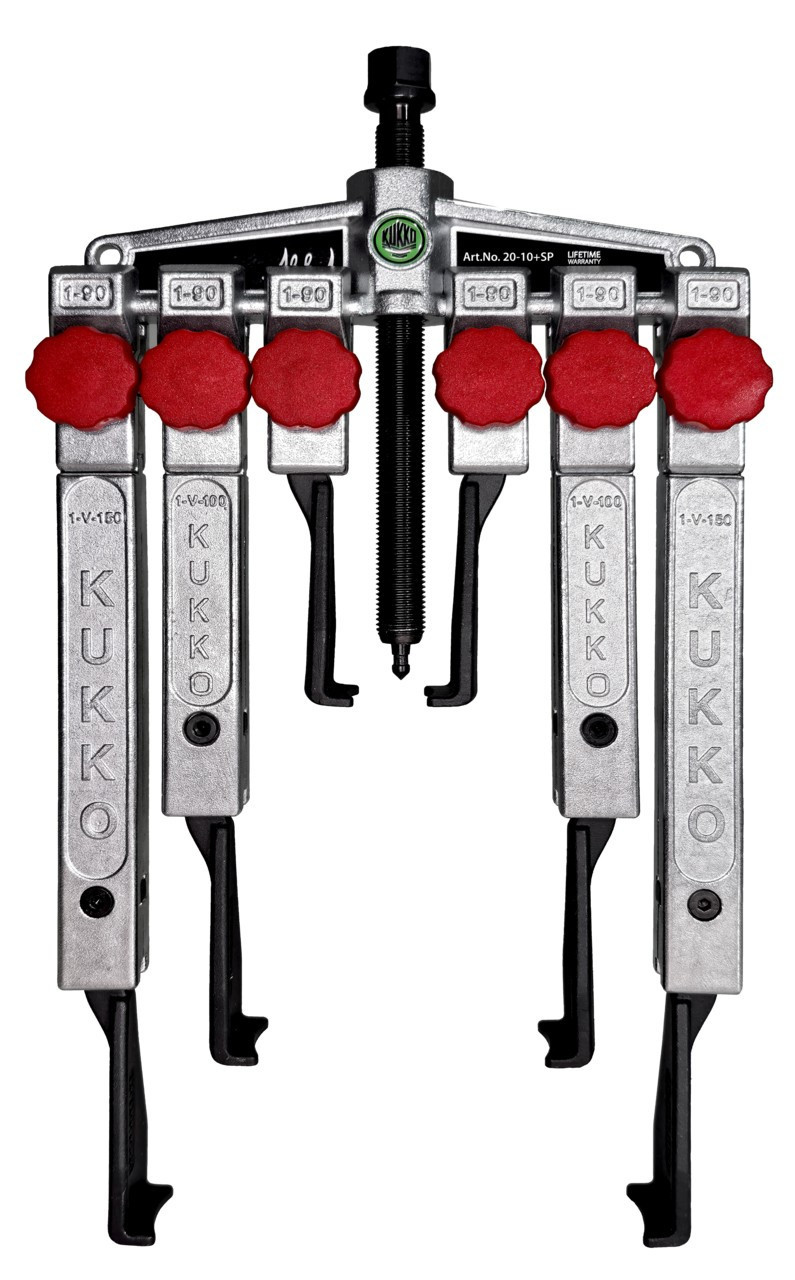
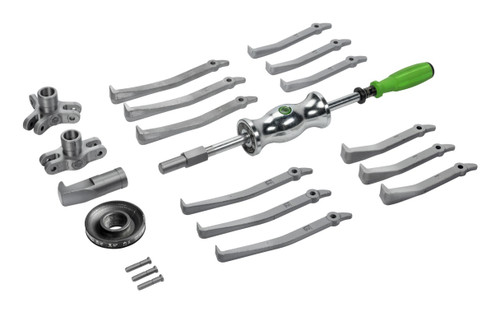
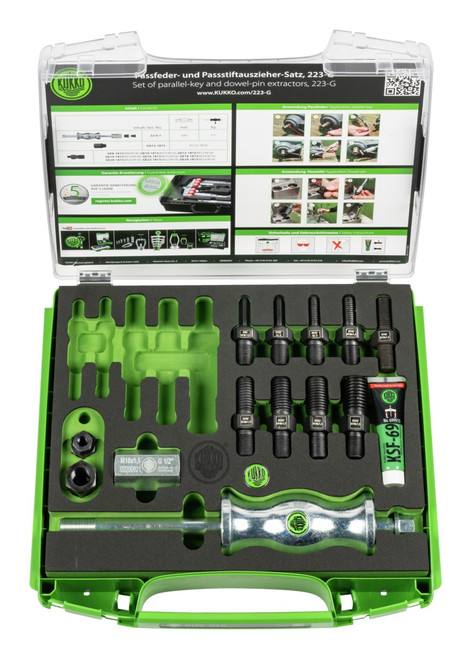
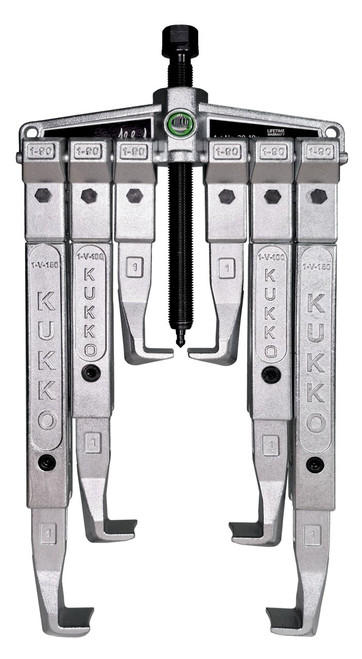
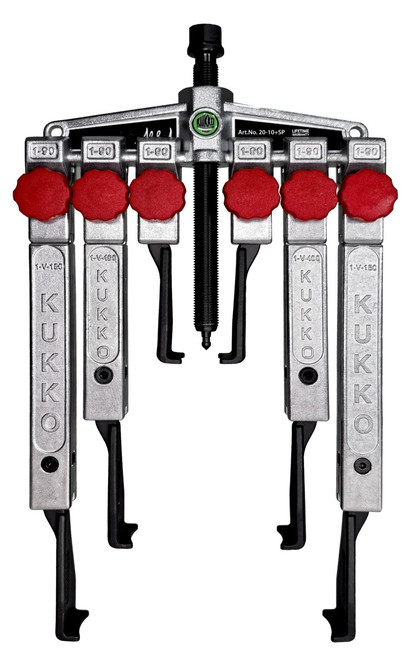
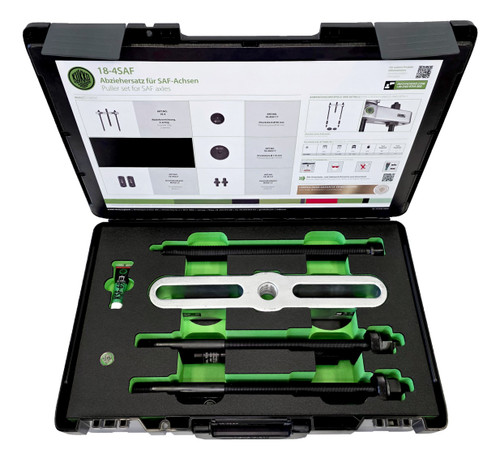

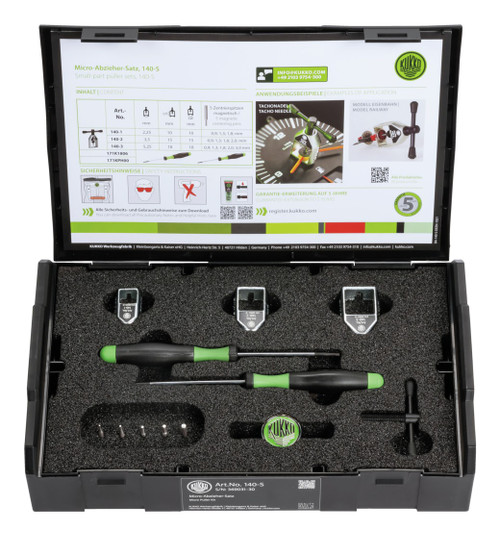
Pick a puller set by where the part sits
Every pull starts with one question: can the jaws get behind the part? That answer decides which family of set you need.
- Part on a shaft with an exposed back edge (gear, pulley, sprocket, bearing with a lip to grab): a 2 or 3-jaw universal set.
- Bearing pressed flush against a shoulder, no lip to hook: a separator set, which wedges in behind the race first.
- Bearing or bushing inside a bore: an internal extractor with a counterstay or slide hammer.
- Big, rusted or high-interference fits: a hydraulic set.
Jaw-type gear puller set options
For a gear puller set, the base KUKKO kits start at 120 mm spread by 100 mm reach (about 4-3/4 by 4 in) and step up from there. The 20-P adjustable-jaw 2-jaw set includes two pairs of jaws in different lengths, clamped with an Allen key, and the jaws slide on the crossbar, so they can grip an off-center part. The 20+SP quick-adjust set adds a third pair, uses narrow jaws for tight gaps and resets by hand knob instead of a key.
Three jaws spread the load and center themselves better on round parts like pulleys and bearings. The 30-P 3-jaw set covers the same 120 by 100 mm start size, and the 30xSP narrow-jaw sets reach deep: 130 by 350, 200 by 300 and 250 by 400 mm. If you can't decide between two and three jaws, the 13 and 15-piece 2030 combination kits let you build either from the same parts. Our guide to 2-jaw vs 3-jaw pullers covers the trade-off.
Bearing puller set choices: separators and internal extractors
A bearing puller set earns its keep when there's nothing to hook. A full bearing puller kit usually combines both tools below. The K-15 separator sets pair a split separator with a puller and two extensions. Six sizes run from 8 to 60 mm with 250 mm of reach up to 30 to 250 mm with 600 mm of reach, which is long enough to get a bearing off the middle of a shaft.
For bearings in a housing, the K-22 sets combine expanding internal extractors with a counterstay and a slide hammer, in 6 to 30 and 28 to 70 mm. Use the counterstay when the housing is solid and you can pull steadily, and the slide hammer when there's no room to brace. For bearings seated flush at the bottom of a bore, the K-22-E version has fine gripping edges and starts at 4.8 mm. The series 25 kits with counter support run from 6 to 20 mm up to 56 to 110 mm, and the 28-A and 28-B slide hammer kits cover 6 to 19 and 12 to 40 mm. More on technique in how to remove a bearing from a blind hole.
Two KUKKO kits deal with a deep groove ball bearing that sits in a housing and on a shaft at the same time. The PULLPO 70 and K-70 sets grab the balls through the gap between the races and pull the bearing without taking the shaft out. KUKKO describes the method as non-destructive to the bearing. The series 69 sets also handle that job, but the bearing is scrap afterward, so keep them for bearings you're replacing anyway.
Hydraulic and large-capacity sets
When turning the spindle by hand stops getting you anywhere, a hydraulic spindle does the pushing. The hydraulic sets here include an 11-piece kit with four pullers covering 50 to 150 mm spread and 150 mm reach, a 15-piece kit at 75 to 250 mm and 250 mm reach, and a 21-piece kit with ten pullers covering 50 to 250 mm spread and 250 mm reach. The YX8 series (Y28, Y38 and Y58) is KUKKO's heavy line for industry and commercial vehicles, offered as universal, external-puller and separator-plus-extractor sets. Single pullers live under hydraulic pullers.
Job-specific kits
- Threaded parts and dowel pins: the 223 sets cover M3 to M18 and M8 to M24, and the KS-22 slide hammer sets include a UNC thread version for inch-threaded parts.
- Wiper arms: the K-142 kits come in 5 and 8 pieces in an L-BOXX Mini.
- Diesel and truck work: K-16 cylinder liner extractors for wet liners and a 7-piece SAF axle set.
- Hazardous areas: non-sparking tool sets that include a puller.
Using a puller set safely
- Keep the spindle centered on the shaft. A cocked puller loads one jaw and can let go.
- Set the jaws as deep and as close to the hub as they'll go, then snug them evenly before you put force on the spindle.
- Wear eye protection, and throw a heavy cover or shop blanket over the puller when the part is tight. Jaws and broken races can fly.
- Stop if the spindle stalls. Add penetrant or step up to hydraulic rather than putting a cheater bar on the wrench.
Need a single jaw puller instead? See jaw pullers, and pick up replacement jaws in puller jaws and accessories. The full range sits under pullers and extractors.
Frequently asked questions
Is a 2-jaw or 3-jaw puller set better?
A 3-jaw set grips round parts more evenly and is less likely to slip, so it's the usual choice for pulleys, gears and bearings with room around them. A 2-jaw set fits where there's only space on two sides, such as a gear next to a housing wall. The KUKKO 2030 combination kits build either style from one case, if you want both.
What size puller set do I need?
Measure the outside diameter of the part and how far behind its face the jaws must reach. Choose a set whose max spread is larger than the diameter and whose reach covers the depth. KUKKO's base jaw sets are 120 mm spread by 100 mm reach (about 4-3/4 by 4 in). Larger kits go to 250 mm spread and 400 mm reach.
What is the difference between a bearing puller kit and a jaw puller set?
A jaw puller set grabs a part by its outer edge. A bearing puller kit adds tools for bearings you can't hook from outside: separators that wedge in behind a flush race, and internal extractors that expand inside the bore and pull against a counterstay or slide hammer. Many shops end up owning one of each.
Can I remove a bearing without taking the shaft out?
Yes, with a KUKKO PULLPO 70 or K-70 set, if the bearing is a deep groove ball bearing. The arms reach through the gap between the races and pull on the balls, so the bearing comes out of the housing while the shaft stays in place. KUKKO describes this method as non-destructive to the bearing.
When should I use a hydraulic puller set?
Go hydraulic for large diameters, long press fits and rusted parts where turning a mechanical spindle by hand gets too hard. The hydraulic spindle builds the force, so you aren't hanging off a long wrench. KUKKO's hydraulic kits here range from a 4-puller set at 50 to 150 mm spread up to the heavy YX8 series.
Do KUKKO puller sets include inch-thread adapters?
Most KUKKO sets are metric. For threaded parts, the KS-22 slide hammer family includes a 9-piece UNC version with inch thread adapters, while the 223 dowel pin and threaded-part sets cover metric M3 to M24. Check the thread on your part with a gauge before you order.