
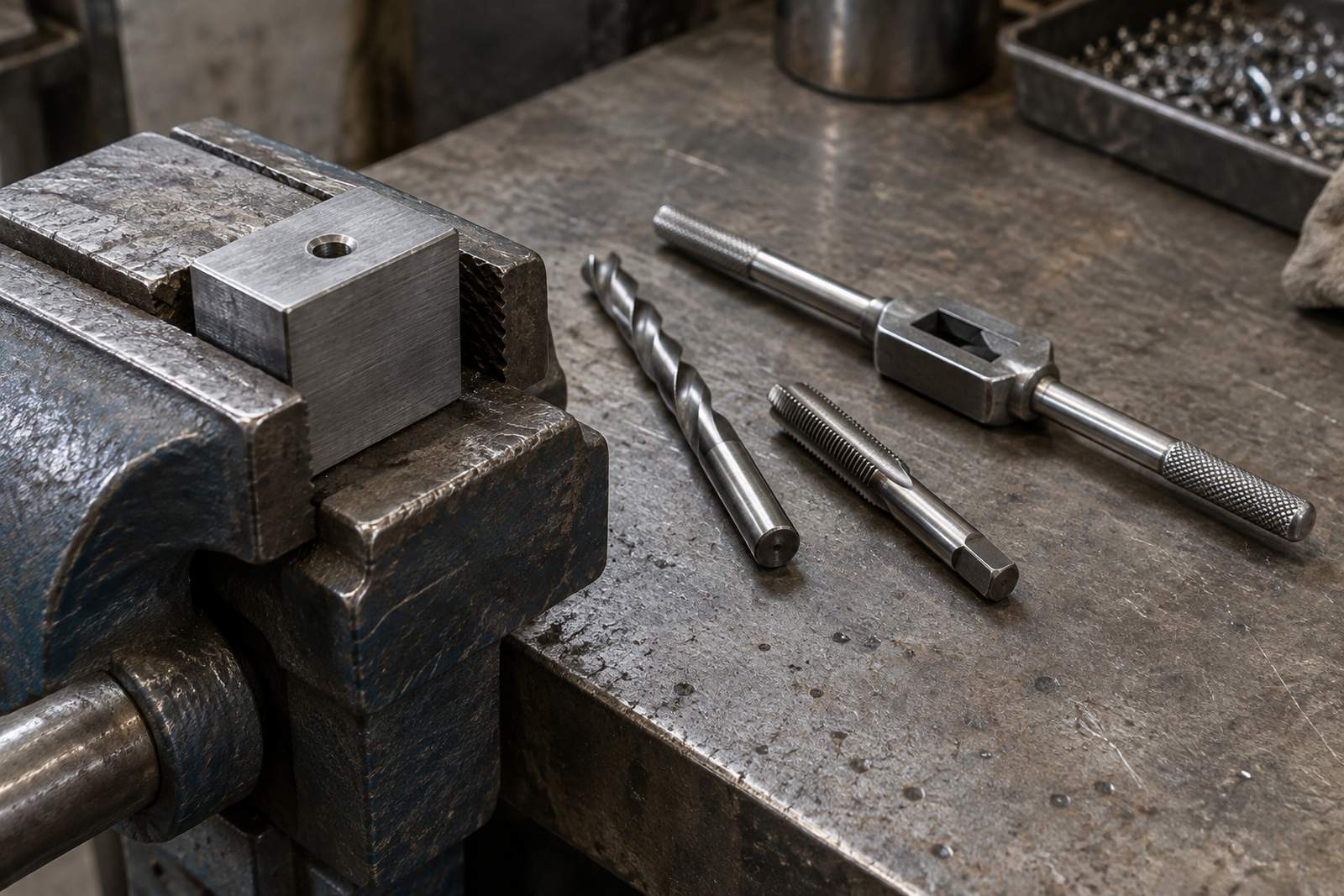
How to use this tap drill chart
A cutting tap removes metal to make internal threads. Its pilot hole must leave enough material for the thread without forcing the tap to remove too much. A clearance hole serves a different purpose: the screw passes through without engaging threads. Do not use clearance-drill dimensions for the part you intend to tap.
NC means National Coarse and NF means National Fine in the reference tables. Inch callouts show nominal screw size followed by threads per inch, or TPI. In M8 x 1.25, the 8 is nominal diameter in millimeters and 1.25 is the distance between thread crests in millimeters. Neither designation directly states the drill size.
Use the tap drill chart as a starting point, not a universal process specification. Actual thread percentage depends on the drilled hole and thread geometry. A smaller hole increases cutting load; a larger hole reduces the material left for the thread. Required thread strength, material, engagement length and tap design all matter. Check the finished thread with the inspection method required for the job.
Machine screw tap drill chart: NC and NF
The # symbol in the thread column means screw size. In the drill column it means a numbered drill. A #10 screw does not call for a #10 drill. These values are conventional cutting-tap recommendations near 75% thread, rounded to available drill sizes; they do not all produce exactly the same percentage.
| Thread (size-TPI) | Series | Tap drill | Drill diameter (inch) |
|---|---|---|---|
| #0-80 | NF | 3/64 | 0.046875 |
| #1-64 | NC | #53 | 0.0595 |
| #1-72 | NF | #53 | 0.0595 |
| #2-56 | NC | #50 | 0.070 |
| #2-64 | NF | #50 | 0.070 |
| #3-48 | NC | #47 | 0.0785 |
| #3-56 | NF | #46 | 0.081 |
| #4-40 | NC | #43 | 0.089 |
| #4-48 | NF | #42 | 0.0935 |
| #5-40 | NC | #38 | 0.1015 |
| #5-44 | NF | #37 | 0.104 |
| #6-32 | NC | #36 | 0.1065 |
| #6-40 | NF | #33 | 0.113 |
| #8-32 | NC | #29 | 0.136 |
| #8-36 | NF | #29 | 0.136 |
| #10-24 | NC | #25 | 0.1495 |
| #10-32 | NF | #21 | 0.159 |
| #12-24 | NC | #16 | 0.177 |
| #12-28 | NF | #14 | 0.182 |
The 10-32 tap drill size is #21, measuring 0.159 inch. For 10-24, the drill changes to #25 at 0.1495 inch. That is an easy pair to mix up when both taps are on the bench. Put the tap and its drill together beside the job, then return the unused tap to its case.
Fractional tap drill chart: 1/4 to 1 inch
This section covers common coarse and fine fractional threads. It is not a list of every thread series or special pitch. Decimal equivalents identify the drill's nominal cutting diameter; the six-place display preserves exact fractional conversions rather than implying that a drilled hole holds that tolerance.
| Thread (size-TPI) | Series | Tap drill | Drill diameter (inch) |
|---|---|---|---|
| 1/4-20 | NC | #7 | 0.201 |
| 1/4-28 | NF | #3 | 0.213 |
| 5/16-18 | NC | F | 0.257 |
| 5/16-24 | NF | I | 0.272 |
| 3/8-16 | NC | 5/16 | 0.3125 |
| 3/8-24 | NF | Q | 0.332 |
| 7/16-14 | NC | U | 0.368 |
| 7/16-20 | NF | 25/64 | 0.390625 |
| 1/2-13 | NC | 27/64 | 0.421875 |
| 1/2-20 | NF | 29/64 | 0.453125 |
| 9/16-12 | NC | 31/64 | 0.484375 |
| 9/16-18 | NF | 33/64 | 0.515625 |
| 5/8-11 | NC | 17/32 | 0.53125 |
| 5/8-18 | NF | 37/64 | 0.578125 |
| 3/4-10 | NC | 21/32 | 0.65625 |
| 3/4-16 | NF | 11/16 | 0.6875 |
| 7/8-9 | NC | 49/64 | 0.765625 |
| 7/8-14 | NF | 13/16 | 0.8125 |
| 1-8 | NC | 7/8 | 0.875 |
| 1-12 | NF | 15/16 | 0.9375 |
The 3/8-16 tap drill size is 5/16 inch, or 0.3125 inch. For 3/8-24, use letter Q at 0.332 inch. The 1/2-13 tap drill size is 27/64 inch, while 1/2-20 uses 29/64 inch. Fine threads generally leave a larger pilot hole than coarse threads at the same nominal diameter.
Metric coarse tap drill chart: M3 to M20
Use the pitch column even when the drawing looks familiar. M10 x 1.5 is the coarse pitch listed here; M10 x 1.25 and M10 x 1.0 require different drills and are not in this table. These metric values follow Newman Tools' published coarse-thread recommendations.
| Metric thread | Coarse pitch (mm) | Tap drill (mm) |
|---|---|---|
| M3 | 0.5 | 2.5 |
| M3.5 | 0.6 | 2.9 |
| M4 | 0.7 | 3.3 |
| M5 | 0.8 | 4.2 |
| M6 | 1.0 | 5.0 |
| M7 | 1.0 | 6.0 |
| M8 | 1.25 | 6.8 |
| M10 | 1.5 | 8.5 |
| M12 | 1.75 | 10.2 |
| M14 | 2.0 | 12.0 |
| M16 | 2.0 | 14.0 |
| M18 | 2.5 | 15.5 |
| M20 | 2.5 | 17.5 |
Subtracting pitch from nominal diameter is a useful rough check for metric cutting taps: M6 x 1 gives 6 minus 1, or a 5 mm drill. It is not a replacement for the table or the tap's application data. For M8 x 1.25, the listed conventional drill is 6.8 mm, rather than the unrounded subtraction result of 6.75 mm.
NPT tap drill chart: 1/8 to 1 inch
NPT is a tapered pipe thread. Its nominal pipe size is not the drill diameter, so a 1/8 NPT tap does not use a 1/8 inch drill. These published starting sizes are for conventional straight drilled holes before tapping. A process using a taper reamer needs its own hole-preparation instructions.
| Nominal NPT size | TPI | Tap drill | Drill diameter (inch) |
|---|---|---|---|
| 1/8 | 27 | R | 0.339 |
| 1/4 | 18 | 7/16 | 0.4375 |
| 3/8 | 18 | 37/64 | 0.578125 |
| 1/2 | 14 | 23/32 | 0.71875 |
| 3/4 | 14 | 59/64 | 0.921875 |
| 1 | 11.5 | 1 5/32 | 1.15625 |
Unlike the straight-thread tables, the NPT table is not a 75% thread guide. Tap depth affects tapered-thread fit. Use the required pipe thread gauge and the tap manufacturer's instructions instead of cutting until the tap reaches an arbitrary depth. Confirm that the fitting is NPT, not NPS, BSPT or another thread standard, before starting.
Set up the hole before you tap
Clamp the work securely, wear eye protection and keep hands clear of rotating tools. Check hole location and alignment, drill to the required diameter and deburr the entrance. A blind hole needs extra depth for the tap's lead, chips and drill point beyond the required full-thread length. There is no single extra-depth allowance that suits every tap and hole.
Use lubricant suited to the material and tap. If cutting torque rises unexpectedly, stop and check alignment, chip room and actual hole size rather than forcing the tool. Norseman's tapping troubleshooting guidance specifically calls out undersize holes, poor alignment and insufficient chip space as problems. Even the correct number on a tap drill chart cannot fix a crooked or shallow hole.
Choose taps and matched drill sets
Start with taps and dies when you know the thread specification. The Norseman straight flute hand taps include taper, plug and bottoming styles. Choose the lead style for the hole and starting method; changing the lead does not turn a coarse thread into a fine one.
For matched tools, see the Norseman SP-18TD NC drill and tap set and SP-18TDM metric drill and tap set. The sets use spiral point taps, which Norseman describes as pushing chips ahead. Allow space beyond the cutting threads and check included sizes against your job. The 30-AG NPT pipe taps are a separate family for pipe threads.
For number and letter drill equivalents beyond this tap drill chart, use the drill bit size chart. Do not replace a missing numbered drill with a nearby fraction without checking the resulting hole size against the tap's requirements.
Table sources and scope
Inch recommendations follow LittleMachineShop.com's Tap & Clearance Drill Sizes, 75% thread column, except #3-56, which follows Newman Tools' #46 recommendation. Metric coarse sizes follow Newman Tools' Tap Drill Sizes. NPT sizes agree with Newman Tools and Engineering ToolBox's NPT table. Published recommendations can differ by a nearby drill size; use the tap maker's data for the actual material and required fit.
Frequently asked questions
What is the tap drill size for 1/4-20?
The conventional cutting-tap drill for 1/4-20 is #7, with a nominal diameter of 0.201 inch. This is a starting recommendation near 75% thread, not a clearance hole size. Check the tap maker's application data for the work material and required thread, especially if you are using a forming tap.
What is the 3/8-16 tap drill size?
Use a 5/16 inch drill as the conventional cutting-tap starting size for 3/8-16. Its decimal equivalent is 0.3125 inch. Do not confuse that with 3/8-24, which uses letter Q in this table. Read both the diameter and threads per inch before drilling the workpiece.
What is the 10-32 tap drill size?
A #21 drill, measuring 0.159 inch, is the usual cutting-tap starting size for 10-32. A 10-24 thread takes a different drill, #25 in this chart. The screw number alone is not enough to select the hole, and the drill's number is a separate designation from the screw's size.
What size drill is used for a 1/8 NPT tap?
The conventional straight-hole starting drill for 1/8-27 NPT is letter R, or 0.339 inch. The nominal 1/8 pipe size is not the drill diameter. Follow the pipe tap's instructions for hole preparation and use the required thread gauge to establish fit rather than guessing from tap depth.
Can I use this chart for forming taps?
No. These straight-thread recommendations are for cutting taps, which remove material. Forming taps displace material and require their own hole-size recommendations, generally larger than those for cutting taps. Use the forming tap manufacturer's data for the material and thread. Applying a cutting-tap hole size can overload a forming tap.
Does 75% thread mean the bolt is 75% engaged?
No. Thread percentage describes the thread height developed by the hole size, not how much bolt length is engaged. Engagement length is a separate dimension. The tables use conventional drills near 75% thread as starting points; the required percentage and hole size depend on the application and tap manufacturer's guidance.