
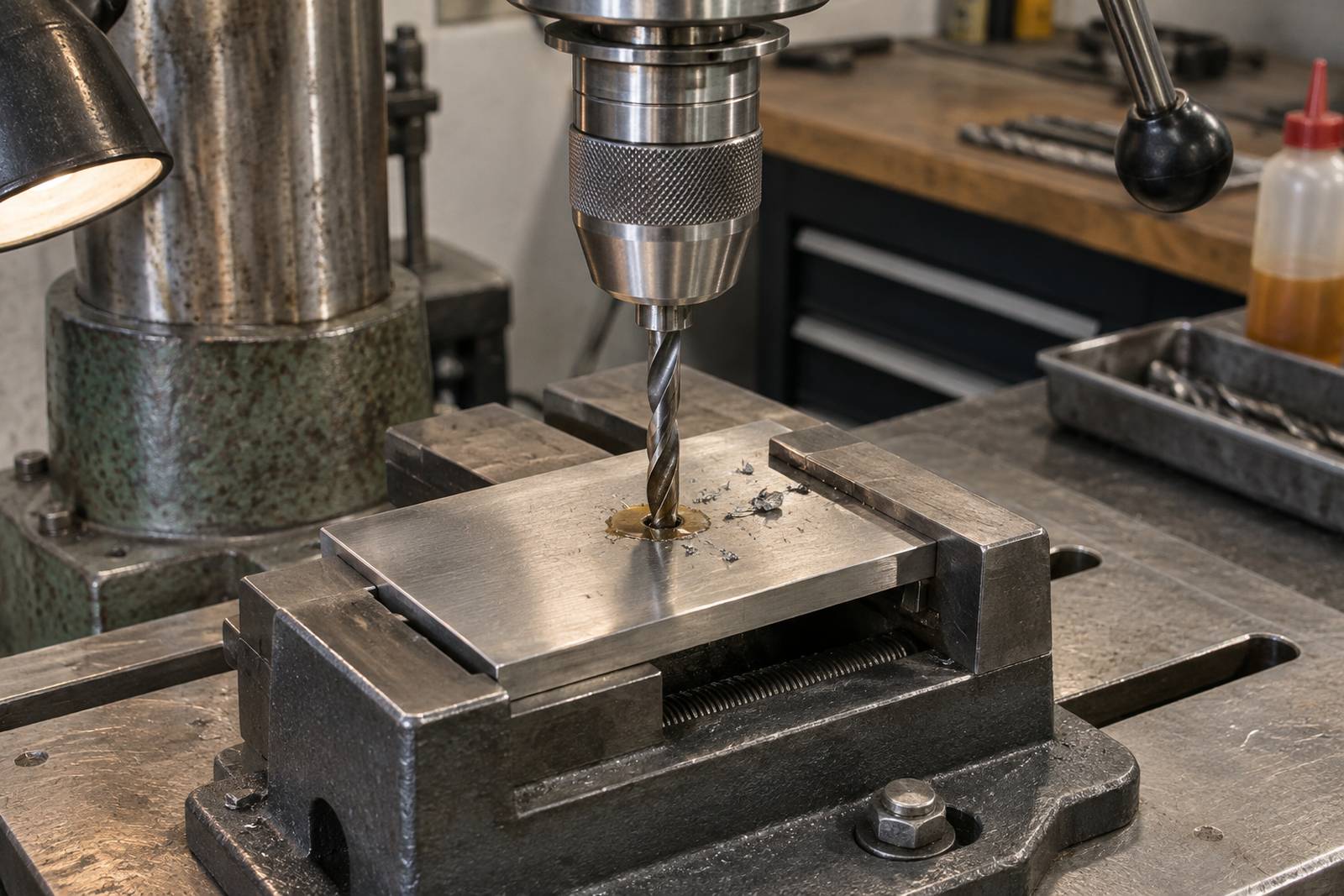
How to drill stainless steel without rubbing the surface
Work hardening changes the cutting problem as you drill. Norseman explains that the chip hardens through deformation. The drill needs to keep cutting beneath that hardening area, rather than repeatedly working the hardened material. A spinning bit that stops advancing is a reason to reassess the cut, not to squeeze the trigger harder.
That does not mean force the feed until something breaks. The work must stay secure, the spindle must run true and the point must be sharp. Norseman's troubleshooting guide lists excessive speed and insufficient feed among causes of poor tool life, but also lists excessive feed as a cause of rough holes and broken bits. Balance matters.
What are the best drill bits for stainless steel?
Choose by the grade and setup, not simply by the word cobalt. Norseman recommends its Magnum Super Premium drills for work-hardening stainless. The manufacturer explains that their thin web allows penetration fast enough to keep cutting beneath the hardening chip. Norseman says Magnum will substantially outperform cobalt drills in that application. This is the manufacturer's guidance, not a BRAIGG comparison test.
M42 cobalt has a different place. Norseman recommends it for hard, tough metals and free-machining stainless, and specifies rigidly held, positive-feed drilling equipment. Its M42 high-speed steel contains 8% cobalt for hot hardness. Check the Norseman 150 M42 cobalt jobber bits or D-29 M42 cobalt set when that guidance matches your material and equipment.
What drill bit for stainless steel suits the job?
For an unidentified offcut, find the grade first if possible. Browse twist drill bits and cobalt drill bits with that information in hand. A gold color alone does not tell you what steel the drill is made from or which materials it is meant to cut.
How to drill through stainless steel: the setup and cut
1. Identify the material and hole
Confirm the stainless grade, required hole diameter and thickness. Check the space behind the hole before drilling. A clearance hole, a tap-drill hole and a finish-size hole are different requirements; use the drawing or service instructions rather than estimating from the bolt.
2. Clamp the work and check the drill
Wear eye protection and clamp the part so it cannot spin. Keep hands, loose clothing and gloves away from rotating tools. Inspect the cutting lips for damage and make sure the bit runs true. Extend only as much of the drill from the chuck as needed, keeping enough flute clearance for the hole depth.
3. Lubricate and choose a starting speed
Apply suitable cutting lubricant to the cutting area, following the product's safety instructions. Use the diameter-based guidance below as a starting point, not a fixed setting for every alloy. Set up access to replenish lubricant without reaching near the rotating bit.
4. Feed steadily and clear chips
Keep the drill aligned and feed so it cuts rather than rubs. Clear packed chips by withdrawing as needed; stop the machine before removing swarf with a suitable tool. Never grab stringy chips by hand. Deep holes need particular attention because chips can clog the flutes and bind the drill.
5. Control breakthrough and inspect
Keep the work clamped as the drill exits. Avoid a sudden plunge or side load at breakthrough. Stop the spindle before checking the hole and remove sharp burrs with the appropriate tool. If the hole is rough or oversized, correct the setup before repeating it on the next part.
How to drill stainless steel at a sensible speed
Norseman's HSS drilling table gives 30 to 50 surface feet per minute for stainless steel, grouped with Monel and high-nickel steel. Its formula is RPM = (3.8197 ÷ drill diameter in inches) × surface feet per minute. The examples below convert that published range; they are rounded starting values, not alloy-specific recommendations.
| Drill diameter | At 30 SFM | At 50 SFM |
|---|---|---|
| 1/8 inch (0.1250) | 917 RPM | 1,528 RPM |
| 1/4 inch (0.2500) | 458 RPM | 764 RPM |
| 3/8 inch (0.3750) | 306 RPM | 509 RPM |
| 1/2 inch (0.5000) | 229 RPM | 382 RPM |
Use the nearest suitable machine setting and adjust for the material, rigidity, depth and drill maker's instructions. Norseman cautions that varying drilling conditions prevent setting rigid feed-and-speed rules. A larger diameter needs fewer revolutions for the same surface speed. Learning how to drill stainless steel means watching the cut after choosing a setting, not trusting the dial alone.
Use cutting lubricant where it reaches the point
Norseman's troubleshooting advice names insufficient or incorrect coolant, and coolant failing to reach the point, as causes of poor tool life. Putting lubricant on the top face is not enough if chips prevent it reaching the cutting area. Withdraw and clear the flutes when necessary rather than continuing with a packed hole.
Norseman Ultra S/P cutting lubricant uses a concentrated, no-run formula that clings to vertical surfaces, according to the manufacturer. It is one option alongside the cutting fluids and lubricants range. Lubricant supports the cut; it cannot correct a dull point or insecure workholding.
How to drill stainless steel when the cut goes wrong
For a rough hole, Norseman lists a dull or incorrectly ground point, excessive feed, and insufficient or incorrect coolant. For an oversized hole, check an off-center point, spindle runout and loose or vibrating work. For broken drills, check packed flutes, insecure clamping and excessive feed as well as drill condition. Fix the cause before fitting another bit.
Do not treat stainless steel and fully hardened steel as interchangeable. Norseman's speed table directs users drilling high-tensile, heat-treated material to consult their material supplier. This guide does not promise that an HSS or cobalt drill will cut every hardened part. If the drill has already stopped cutting, inspect the point and identify the material before trying again.
Frequently asked questions
What are the best drill bits for stainless steel?
The stainless grade and drilling setup decide. Norseman recommends Magnum Super Premium for work-hardening stainless and explains the benefit in terms of its thin web. It recommends M42 cobalt for free-machining stainless and hard, tough metals with rigidly held positive-feed equipment. That is application guidance, not a claim that one drill suits every stainless alloy.
Why does my drill spin without cutting stainless?
Stop and inspect rather than increasing speed. A dull point, unsuitable geometry or insufficient feed can leave the tool rubbing. Norseman lists excessive speed and low feed among causes of poor life. Check the drill condition, lubricant reaching the point and rigidity before resuming; more pressure alone is not a diagnosis.
What speed should I use to drill stainless steel?
Norseman's HSS table gives 30 to 50 surface feet per minute for stainless steel. The matching RPM depends on drill diameter: a larger drill turns more slowly at the same surface speed. Treat those values as starting guidance and adjust for alloy, depth, drill instructions and the rigidity of your equipment.
Do I need cutting lubricant for stainless steel?
Use a suitable cutting lubricant and follow its safety instructions. Norseman's troubleshooting guide identifies incorrect or insufficient coolant, or coolant not reaching the point, as causes of poor tool life. Clear packed chips so lubricant can reach the cutting area. A lubricant cannot make a damaged drill point cut correctly.
Is drilling stainless the same as drilling hardened steel?
No. Stainless describes an alloy family, while heat treatment and hardness create separate drilling requirements. Norseman's table tells users drilling high-tensile heat-treated material to consult the material supplier. Do not assume a cobalt label makes a drill suitable for every hardened part, or keep repeating a cut that has stopped producing chips.