
Slide Hammers
A slide hammer pulls with an outward blow instead of pushing against the housing face. At BRAIGG, the KUKKO selection includes separate sliding weights, internal bearing extractors with built-in hammers, threaded adapters and dedicated puller assemblies. The attachment determines what you can grip; the moving weight alone is not a complete removal tool. Start with the part you need to hold, then check the connection, travel space and impact mass. This guide separates the bearing, dowel pin and threaded-part options so you can choose the right assembly rather than just the heaviest hammer.


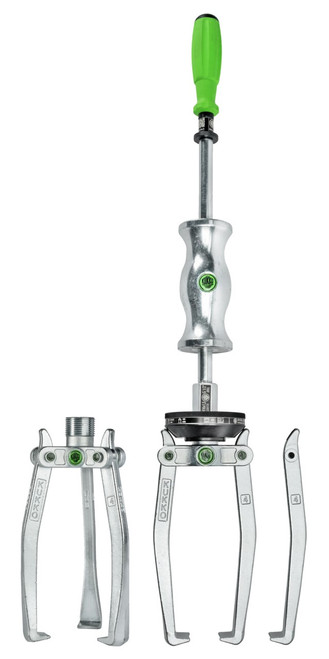

How a slide hammer tool pulls
The weight travels along a shaft and strikes an end stop. That impact passes through the shaft and its attachment to pull the part outward. There is no bridge foot bearing against the housing, which is why KUKKO recommends this method when a support surface is missing or too delicate. You still need access along the pulling axis and a secure attachment to the part.
A hammer cannot solve a poor grip. The surface you can reach determines the attachment: expanding segments engage inside a bearing, while a chuck holds an exposed pin. Bearings seated in pockets belong with pilot bearing and blind hole pullers. If only an outer ring remains, inspect the options under bearing race pullers before choosing the attachment.
Separate weights: KUKKO series 22-0
The 22-0 sliding hammers work with compatible KUKKO series 21 internal extractors. Four listed models provide different combinations of moving mass and travel:
- 22-0-05: 0.5 kg, about 1.1 lb, with a 200 mm stroke, about 7.87 in.
- 22-0-10: 1 kg, about 2.2 lb, with a 250 mm stroke, about 9.84 in.
- 22-0-17: 1.7 kg, about 3.7 lb, also with a 250 mm stroke.
- 22-0-50: 5 kg, about 11 lb, with a 340 mm stroke, about 13.39 in.
Stroke is the weight's travel, not the full length of the assembly. The largest model is 700 mm long, about 27.56 in, before accounting for the attached extractor. Check the working space around the repair. Also check the model's connection and any required adapter rather than assuming every weight screws directly onto every head.
Buying a slide hammer bearing puller
A slide hammer bearing puller combines an internal gripping tool with the moving weight. KUKKO offers integrated series 21-G and 224 extractors for small guide bearings, bearing rings and similar parts. They avoid a separate housing support, but their gripping range and reach still have to match the bearing.
For multiple bearing sizes, the K-26 bearing puller sets include internal extractors and a hammer. Other sets add a counterstay, giving you a supported screw-pull option when the housing provides a suitable reaction face. Before ordering a slide hammer puller set, read the contents carefully to confirm which heads and connecting pieces are included, especially if you plan to use an extractor you already own.
Threaded parts and dowel pins
The KS-22 adapter sets are intended for bushings and threaded components such as dowel pins and keys. KS-22-01 includes metric inserts from M3 through M10 in the listed sizes; KS-22-01-UNC covers listed UNC threads from 1/4-20 through 1/2-13. KS-22-02 supplies another metric selection, including fine-pitch sizes. Verify both diameter and pitch on the part.
An unthreaded pin needs a different hold. The 223-0 dowel pin pullers use a three-jaw chuck rather than a thread screwed into the pin. The 223-1 grips 1 to 8 mm, about 0.04 to 0.31 in. Exposed pin length and access still matter; the chuck must actually reach and hold the pin.
Choose the attachment, then check the load path
A slide hammer kit with adapters is not automatically suited for wheel hub, injector or bearing removal. KUKKO lists dedicated tools for those jobs, each with its own gripping arrangement. Use the correct application-specific assembly and consult the repair instructions for anything retaining the part. The parent pullers and extractors category covers other ways to apply pulling force.
Wear eye protection and use a suitable guard or cover over the work where possible without obstructing weight travel. Keep fingers outside the weight's path. Align the shaft with the extraction direction and stop if an adapter loosens or the attachment slips. Moving mass is not a published pulling-force rating, so do not judge a setup's capacity by weight alone.
Frequently asked questions
What is a slide hammer used for?
It supplies an outward impact through an attachment fixed to the part being removed. KUKKO offers tools for internal bearings, dowel pins and threaded components, along with dedicated assemblies for other applications. The attachment makes the difference: a bare sliding weight cannot grip a bearing, pin or hub by itself.
How do I choose the weight of a slide hammer?
Start with the extractor or attachment approved for the task and check which hammer models and adapters are compatible. Then check stroke and working clearance. KUKKO's listed 22-0 models range from 0.5 to 5 kg, about 1.1 to 11 lb. The heaviest model is not automatically suitable for a small extractor.
Does a slide hammer kit include bearing extractors?
Not necessarily. Some KUKKO sets include internal bearing extractor heads, while KS-22 sets focus on threaded adapters. Read the individual contents and gripping ranges. If you need to remove bearings from blind bores, choose heads that match those bores rather than assuming a threaded-adapter kit will provide an internal grip.
Can I use metric and UNC adapters interchangeably?
No. Match the actual thread diameter, pitch and system. KUKKO offers separate metric and UNC selections in the KS-22 family because a similar-looking diameter does not make the threads compatible. Confirm the thread before assembly, and do not force an adapter that binds instead of threading in correctly.
Why use a slide hammer instead of a counterstay?
KUKKO recommends a sliding hammer where no suitable support face exists or the face is too delicate for a counterstay. A counterstay provides a screw pull where a sound reaction surface is available. Both methods require correct engagement, alignment and compatible connecting hardware; the available access helps determine which setup fits.